
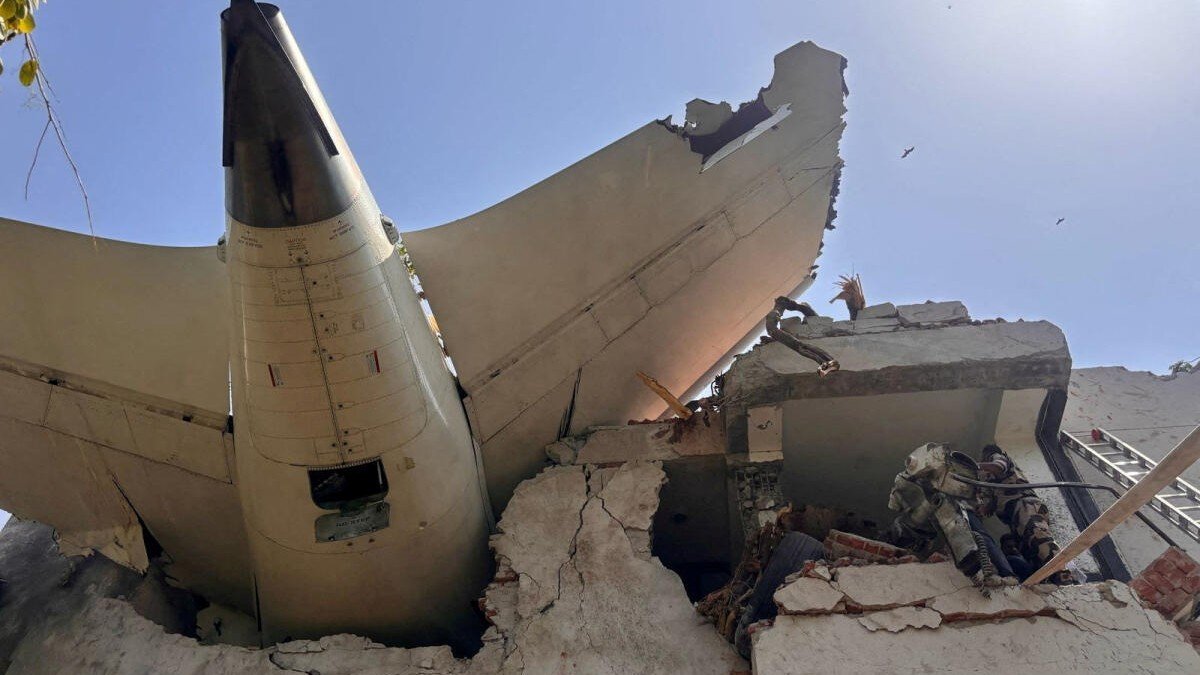

New Delhi | December 7, 2025: The investigation into the tragic crash of an Air India Boeing 787 Dreamliner in Ahmedabad this June has reached a decisive phase. A delegation from India’s Aircraft Accident Investigation Bureau (AAIB) will travel to Washington, D.C. next week to hold a joint technical review with experts from the U.S. National Transportation Safety Board (NTSB), according to a Bloomberg report.
The high-level meeting, to be held at the NTSB headquarters, will bring together representatives from India, U.S. aviation authorities, and aircraft manufacturer Boeing, who will examine all the data collected so far including crucial findings from the Cockpit Voice Recorder (CVR) and Flight Data Recorder (FDR).
AAIB is leading the probe into one of India’s worst aviation disasters in recent years, in which 241 passengers and crew members lost their lives shortly after take-off from Ahmedabad. Investigators are now focused on determining whether the twin-engine failure was the result of a technical malfunction, procedural lapse, or human error.
Tensions Surface Between Investigators, Pilots’ Bodies Express Displeasure
Reports suggest there have been some differences of opinion between Indian and U.S. investigators ahead of the review. Several Indian pilot unions have expressed concern that the probe appears to be leaning toward blaming the cockpit crew without sufficient evidence. They argue that the circumstances were highly complex and that drawing conclusions prematurely would be unfair.
Preliminary findings indicated that fuel control switches in both engines turned off abruptly moments after take-off, causing the aircraft to lose thrust and descend rapidly. Although the switches were reactivated roughly 10 seconds later, the aircraft had already lost too much altitude to recover.
The cockpit voice recorder captured a brief exchange between the young co-pilot, who was flying the aircraft, and the senior captain. In the audio, the co-pilot is heard asking, “Why were the fuel switches turned off?” — to which the captain reportedly denied doing so. This exchange has now become one of the central elements in the ongoing investigation.
AAIB Urges Caution Against Premature Conclusions
AAIB officials have advised the public and media not to speculate until the final report is released.
“All available technical data is being examined thoroughly,” said a senior official. “Assigning blame before the entire picture emerges would be premature.”
The NTSB spokesperson, when contacted by Bloomberg, declined to comment on the details, saying that all queries should be directed to Indian authorities. Similarly, Boeing stated that it is fully cooperating with the AAIB and refrained from issuing any independent statement. India’s Ministry of Civil Aviation has so far not issued an official comment regarding the ongoing review or its findings.
A New Chapter in Global Aviation Cooperation
Aviation safety experts view this joint meeting as an important milestone in India–U.S. collaboration on air safety and technical transparency. Analysts believe the exercise will not only strengthen the scientific basis of the probe but could also help shape future international protocols for handling complex aircraft incidents. This is one of the rare instances where the AAIB and NTSB will engage in such an extensive data-sharing and cross-analysis process, highlighting a growing commitment to cooperative safety investigations.
The probe has also reignited debate over the robustness of India’s aviation safety mechanisms, especially in handling emergencies involving next-generation aircraft like the Dreamliner. Experts caution that despite advances in aircraft automation, human factors and systemic vulnerabilities continue to pose risks that demand constant vigilance.
The Road Ahead
The final report from the AAIB is expected in the coming weeks. Officials say the Washington review is likely to provide crucial clarity on the technical chain of events that led to the crash, offering both closure for the victims’ families and lessons for the aviation industry at large.
For now, the upcoming India–U.S. technical review marks a pivotal moment in the investigation one that underscores not just the search for truth in this tragedy, but also the broader pursuit of global transparency and accountability in aviation safety.
