

Centre for Police Technology Launches a 31-Day Cybersecurity Knowledge Series for Police, LEAs, Corporate Investigators, Digital Forensics, Fraud, Cyber Risk and Security Professionals
Police organisations today depend heavily on digital systems for crime records, investigations, communication, intelligence, digital evidence, emergency response and administration.
Every connected system also creates an opportunity for cyberattack.
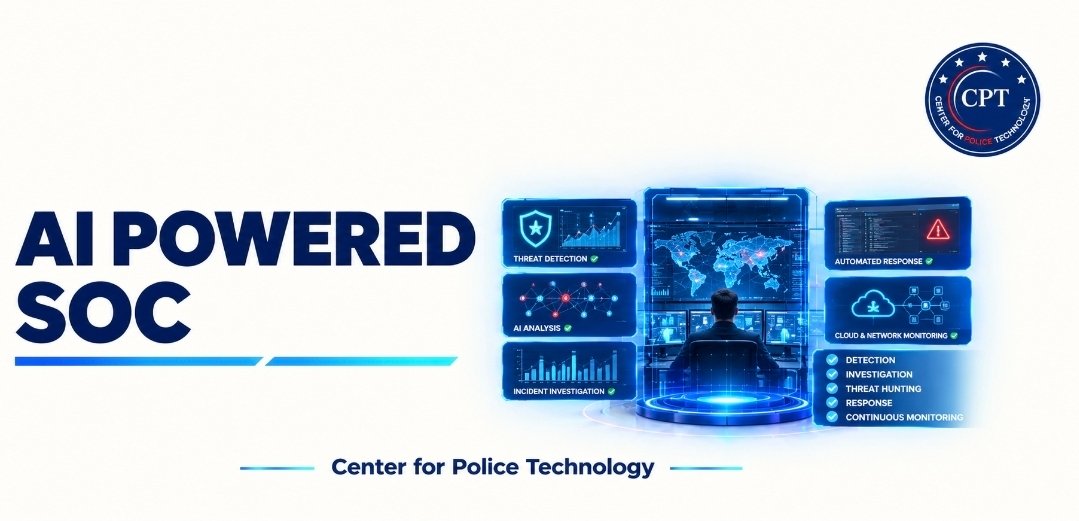
A Security Operations Centre (SOC) continuously monitors an organisation’s digital environment for cyber threats. An AI-powered SOC adds artificial intelligence, machine learning, automation and increasingly AI agents to this process.
Instead of requiring security analysts to manually examine every alert, AI can help identify suspicious behaviour, connect related events, investigate incidents, prioritise threats and recommend or perform approved defensive actions.
For police and law-enforcement agencies, the objective is not simply to automate cybersecurity.
It is:
Detect threats faster while keeping sensitive police systems, investigative information, digital evidence and important security decisions under accountable human control.
What Is an AI-Powered SOC?
A traditional SOC receives security information from computers, servers, networks, firewalls, applications, cloud systems, email platforms and identity systems.
Security analysts examine this information to answer questions such as:
- Has an officer’s account been compromised?
- Is malware spreading through the police network?
- Is someone attempting unauthorised access?
- Is sensitive information being transferred outside the organisation?
An AI-powered SOC performs the same fundamental mission but uses AI to process much larger amounts of security information and assist analysts in determining what requires immediate attention.
The difference can be understood simply:
Traditional SOC: Alert → Analyst Investigation → Decision → Response
AI-Powered SOC: Security Signals → AI Correlation → AI-Assisted Investigation → Human Validation → Approved Response
AI therefore acts as a force multiplier for cyber defenders, rather than automatically replacing the SOC team.
Some platforms primarily provide AI assistance, while newer systems can perform multi-step investigations and certain response actions. These capabilities should not all be described as fully autonomous.
FCRF Launches CP-FRM to Build India’s Next Generation of Fraud Risk Professionals
How Does an AI-Powered SOC Work?
The process begins with security telemetry, meaning information continuously generated by digital systems.
This may include login records, endpoint activity, network traffic, firewall events, email security information, cloud activity, application logs and threat-intelligence feeds.
The first stage is data collection. Security information is brought together from different systems.
The information is then normalised, allowing records generated in different formats to be analysed together.
The next stage is correlation.
Suppose a system records:
Unusual login → Privilege escalation → Suspicious program execution → External connection → Large data transfer
Individually, these events may produce separate alerts.
An AI-supported SOC may recognise that together they represent a possible cyberattack.
Machine learning, behavioural analytics, threat intelligence and security rules then help determine whether the activity is suspicious.
Generative or agentic AI may conduct further investigation.
It could examine:
- Who owns the account?
- Which device was used?
- Has this IP address previously been associated with malicious activity?
- What happened immediately before the suspicious login?
- Did the account access unusual files?
The system can then prioritise the incident for analysts.
Depending on organisational policy, approved automation may perform actions such as isolating a compromised endpoint, blocking a malicious IP address, disabling a session or creating an incident for investigation.
The overall process becomes:
Telemetry → Correlation → Detection → AI Investigation → Risk Assessment → Human Decision or Approved Automation → Response → Audit Trail
What Technologies Power an AI SOC?
An AI-powered SOC is not a single technology.
Several cybersecurity technologies work together.
A Security Information and Event Management system, or SIEM, collects and analyses security events from across an organisation.
Endpoint Detection and Response, or EDR, monitors computers and servers for suspicious behaviour.
Extended Detection and Response, or XDR, connects information from endpoints, identity systems, email, cloud infrastructure and networks.
Security Orchestration, Automation and Response, or SOAR, automates predefined security workflows.
Machine learning helps identify unusual behaviour that fixed security rules may not recognise.
Generative AI can summarise incidents, explain alerts, generate investigation queries, interpret logs and help analysts search large security datasets using ordinary language.
The newest development is agentic AI.
An AI agent can receive an objective, determine what information it needs, use authorised security tools and perform multiple investigative steps.
Several agents could potentially cooperate:
Identity Agent → Endpoint Agent → Network Agent → Threat Intelligence Agent → Investigation Agent
The findings are then presented to an analyst or used within an approved automated workflow.
This movement from an AI assistant towards an AI investigator is one of the most important changes occurring in modern security operations.
Which AI-SOC Platforms Are Important?
Major cybersecurity companies are increasingly adding AI to their security operations platforms.
- Microsoft combines Security Copilot with its Defender ecosystem for security investigation and incident analysis.
- Google Security Operations combines large-scale security analytics with AI-supported investigation.
- CrowdStrike’s Charlotte AI supports AI-assisted and increasingly agentic security operations across areas such as endpoint, identity and cloud security.
- Palo Alto Networks’ Cortex XSIAM combines security data, analytics, automation and threat detection.
- SentinelOne’s Purple AI supports AI-assisted security investigation and emerging autonomous workflows.
- Elastic Security combines SIEM, threat detection, security search and AI-assisted investigation.
- India also has an important indigenous development.
The Centre for Development of Telematics (C-DOT) has developed TRINETRA and the newer TRINETRA-SHAKTI.
C-DOT describes TRINETRA-SHAKTI as an indigenous AI-SOC platform incorporating behavioural analytics, reasoning AI, multi-agent workflows, autonomous investigation and governed response.
An important distinction must nevertheless be maintained:
AI-powered does not automatically mean fully autonomous.
How Can AI-Powered SOCs Support Police?
The most immediate police application is protecting police digital infrastructure itself.
Police systems can contain criminal records, intelligence, investigation files, complainant information, officer details, CCTV material and digital evidence. Compromise of these systems can affect investigations and operational security. An AI-powered SOC could continuously monitor for compromised credentials, malware, unauthorised access, suspicious administrator activity, ransomware and attempted data theft.
It can also support cybercrime investigations. SOC information may reveal malicious IP addresses, domains, file hashes, compromised accounts, malware activity, command-and-control connections and attack timelines. For digital forensics, SOC records may help reconstruct what happened before, during and after an intrusion.
However:
SOC analysis should support forensic investigation, not automatically replace it.
Can AI-SOC Information Become Evidence?
Potentially, yes.
But an AI conclusion is not automatically proof.
Suppose an AI system reports:
“This officer’s account was probably compromised.”
The investigator should ask:
“What evidence supports that conclusion?”
The answer might involve authentication logs, endpoint records, network traffic, timestamps, malware artefacts and security alerts.
The evidentiary process should therefore follow:
Collection → Preservation → Authentication → Analysis → Chain of Custody → Reporting → Court Presentation
India’s Bharatiya Sakshya Adhiniyam, 2023 recognises electronic and digital records and establishes requirements relevant to electronic evidence.
The Bharatiya Nagarik Suraksha Sanhita, 2023 also contains investigation-related provisions concerning electronic devices and custody.
Where an AI system contributes to an investigation, relevant records may need to preserve the original logs, timestamps, investigation queries, system or tool version, actions performed and analyst review.
The principle is simple:
Preserve the evidence behind the AI conclusion, not merely the conclusion itself.
Can Criminals Attack an AI-Powered SOC?
Yes.
AI strengthens cybersecurity, but it also creates new attack surfaces. Threat actors may attempt to manipulate telemetry, evade behavioural detection, compromise privileged integrations, exploit excessive AI permissions or interfere with data used by AI systems.
AI agents create a particularly important risk. An agent capable of isolating computers, disabling accounts or modifying security controls possesses real operational authority.
If manipulated or compromised, it could potentially cause disruption itself.
Therefore:
The more authority an AI agent receives, the stronger its security and oversight must become.
What Are the Major Challenges?
- AI systems can produce false positives, incorrectly identifying legitimate behaviour as malicious.
- They can also produce false negatives, allowing genuine attacks to go undetected.
- Generative AI introduces another problem: hallucination. A system may generate an incorrect explanation that appears convincing.
- This creates the danger of automation bias, where an analyst trusts a conclusion simply because AI produced it.
- Explainability is therefore important. Investigators should be able to understand what information contributed to significant security decisions.
- Privacy is another major concern because SOCs can process large amounts of personal, sensitive and operational information.
- Police organisations must also consider cybersecurity of the AI itself, vendor dependency, data location, interoperability, staff skills and accountability for automated decisions.
What Is the India Perspective?
Several Indian legal and regulatory frameworks may become relevant depending on the deployment.
- The Digital Personal Data Protection Act, 2023 establishes India’s statutory framework concerning digital personal data.
- The Bharatiya Sakshya Adhiniyam, 2023 becomes particularly important when SOC records contribute to electronic evidence.
- The Bharatiya Nagarik Suraksha Sanhita, 2023 is relevant to criminal investigation procedures involving electronic devices and evidence.
- The Information Technology Act, 2000 and applicable cybersecurity rules and directions may also apply depending on the circumstances.
- CERT-In has also encouraged stronger AI-supported cybersecurity capabilities, including continuous monitoring, telemetry correlation, alert prioritisation and agentic SOC approaches.
The applicable law must always be determined according to the actual system and purpose.
Are Indian Police Already Using Advanced SOC Technology?
Yes, there are documented Indian examples.
Kerala Police inaugurated an advanced Cybersecurity Operations Centre in March 2025 using C-DOT’s TRINETRA technology.
The system was established to protect police digital infrastructure and support continuous monitoring of areas including endpoints, network traffic and user behaviour. This is an important example because it demonstrates that advanced SOC technology in Indian policing is not merely theoretical.
In 2026, Delhi Police and C-DOT also announced technology deployments involving TRINETRA ESOC. The system is intended to monitor endpoints, identify vulnerabilities and detect anomalies affecting internal and internet-facing Delhi Police infrastructure.
India’s broader cybercrime ecosystem, including the Indian Cyber Crime Coordination Centre, also provides national capabilities for cybercrime coordination, threat analytics, reporting and forensic support.
However, these capabilities should not automatically be described as complete AI-powered SOC deployments unless verified evidence supports that description.
Operational technology, pilot deployments and future capabilities must always be clearly distinguished.
What Can Indian Police Adopt?
Immediate: 0–1 Year
Police organisations can centralise security logs, improve asset visibility, introduce AI-assisted alert triage, integrate trusted threat intelligence and use natural-language investigation tools.
These capabilities can improve existing SOC operations without giving AI extensive autonomous authority.
Medium Term: 1–3 Years
Police agencies could develop cross-domain XDR, behavioural identity monitoring, AI-assisted threat hunting, automated evidence-preservation workflows and governed incident response.
Long Term: 3–5+ Years
More advanced capabilities may include multi-agent cyber investigations, autonomous threat hunting, automated attack-path reconstruction and cross-jurisdiction threat correlation.
These applications require stronger governance and technological maturity.
How Should Police Implement an AI-Powered SOC?
Police organisations should not begin by purchasing AI.
They should begin by identifying a specific problem.
For example:
“Too many cybersecurity alerts are going uninvestigated.”
The organisation should then assess whether reliable security data is available.
A limited proof of concept can follow.
Before deployment, police leadership should determine exactly what the AI is authorised to do.
A useful authority model is:
Observe → Recommend → Investigate → Execute
Each stage gives the AI greater operational power.
Legal, privacy and security reviews should take place before high-impact automation is enabled.
Officers and analysts should then be trained, the technology piloted in a controlled environment and its performance measured.
Implementation should therefore follow:
Problem Identification → Data Assessment → Proof of Concept → Legal Review → Pilot → Training → Evaluation → Deployment → Continuous Audit
What Skills Will Police Officers Need?
Police cyber personnel will not necessarily need to become AI engineers.
They will need AI literacy.
Officers should understand networks, endpoints, identity systems, cloud infrastructure and security logs.
They should understand what machine learning, generative AI and AI agents can and cannot reliably do.
Cyber investigators will increasingly need threat-hunting, natural-language querying, digital evidence handling and AI-output verification skills.
Supervisors will also need to understand automation governance.
The role of the SOC analyst may increasingly move from:
“Review every alert manually.”
towards:
“Supervise, verify and direct machine-assisted investigations.”
What Could the AI-Powered SOC Look Like by 2030?
Security operations are moving from isolated alerts towards connected investigations.
They are also moving from simple AI assistants towards specialised AI agents capable of performing multiple investigative tasks.
By 2030, AI agents may be capable of conducting substantial portions of a cyber intrusion investigation.
The unresolved question is how much authority those systems should receive.
For police organisations, two questions must therefore always be asked together:
“What can the AI do?”
and:
“What should the AI be authorised to do?”
Police Officer’s Quick Reference
5 Things Every Police Officer Should Know
- AI-powered SOCs combine security monitoring, analytics, automation and AI.
- AI can accelerate investigations, but it can still make mistakes.
- AI agents can perform multi-step cybersecurity tasks.
- AI conclusions should be checked against underlying evidence.
- Human accountability remains essential.
5 Major Opportunities
Faster threat detection, continuous monitoring, reduced alert overload, quicker investigations and stronger correlation across security systems.
5 Major Risks
False conclusions, automation bias, compromised AI agents, privacy risks and excessive autonomous authority.
5 Actions Police Leadership Should Consider
Improve asset visibility, centralise security telemetry, introduce AI first in lower-risk tasks, establish human approval boundaries and require auditable evidence for important AI conclusions.
From AI-Powered SOC to Accountable Cyber Defence
AI-powered security operations can help police organisations detect attacks earlier, investigate incidents faster and protect increasingly complex digital infrastructure.
But faster automation also creates greater responsibility.
AI should assist investigators without weakening forensic standards, accountability or human oversight.
The central principle is:
AI should make the SOC faster, not make accountability weaker.
Use AI to investigate at machine speed. Preserve evidence at forensic standards. Keep consequential decisions under accountable human control.
Day 5 — AI Powered SOC
31 Days | 31 Key Topics | October 2026
A Cybersecurity Awareness Month Knowledge Initiative
Created by Centre for Police Technology (CPT)
Follow Centre for Police Technology (CPT) for the complete 31-Day Cybersecurity Knowledge Series.
Follow for daily updates on cybercrime, corporate fraud, DFIR, hacking, investigations, and digital forensics
