

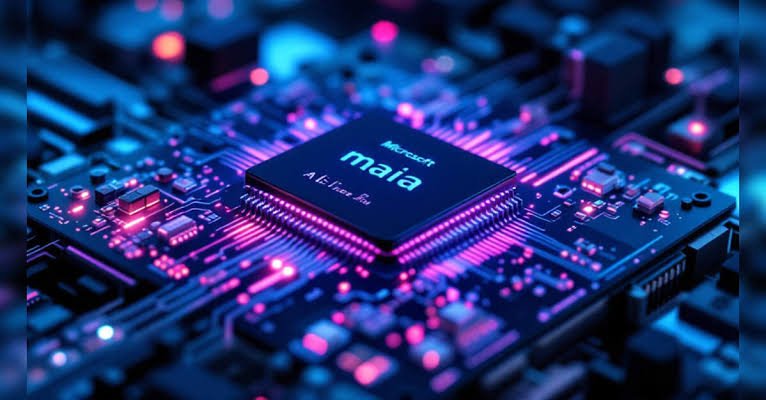

Microsoft is preparing one of its biggest moves yet to reduce the cost of running artificial intelligence, with plans to deploy potentially more than one million of its own Maia AI chips starting in 2027.
The company says its third-generation Maia 300 accelerator will become a major part of the infrastructure behind Microsoft’s AI products and services. The strategy could reduce its dependence on expensive third-party processors from companies such as Nvidia while giving Microsoft tighter control over power use and operating costs.
FCRF Launches CP-FRM to Build India’s Next Generation of Fraud Risk Professionals
Microsoft Wants Maia at Massive Scale
Microsoft said it intends to expand the Maia platform into “multi-gigawatt deployments” beginning in 2027.
The company has not committed to a precise chip count, but Reuters reported that deployments could eventually exceed one million Maia 300 processors. These chips would support Microsoft’s internal AI services and workloads running through its Azure cloud platform.
Its previous-generation Maia 200 is already being used for Microsoft Copilot and to run models developed by Microsoft and OpenAI.
Microsoft has also said GitHub Copilot and Microsoft Foundry workloads are expected to move onto Maia infrastructure.
Why Microsoft Is Building Its Own AI Chips
The economics of AI are increasingly becoming a hardware problem.
Every time a user asks an AI system to generate text, analyse documents, write code or perform a complex task, powerful processors inside data centres perform the calculations needed to produce the answer.
At Microsoft’s scale, even small improvements in the cost of processing each AI request can translate into substantial savings.
Building its own processors gives Microsoft another option alongside Nvidia and AMD hardware. It also allows the company to design chips, servers and software together instead of adapting its services entirely around processors designed by outside suppliers.
Microsoft has previously said Maia 200 delivers more than 30% better tokens-per-dollar compared with the latest silicon in parts of its existing infrastructure.
Maia 300 Targets Power and Cost Efficiency
The Maia 300 has been designed specifically for AI inference.
Inference is the stage after an AI model has already been trained, when the model actually responds to users. A chatbot generating an answer, an AI coding assistant suggesting software or an agent performing a business task are all examples of inference.
Microsoft says the new system can deliver roughly 40% more useful AI computing per megawatt than leading GPU-based systems currently in use.
That matters because electricity has become one of the biggest constraints on AI data-centre expansion.
The Maia 300 will be deployed in racks containing 96 accelerators. Microsoft says each rack will operate within a 167-kilowatt power envelope while providing enough memory and bandwidth to handle increasingly complex AI workloads.
Smaller Chip Components Used to Improve Efficiency
Instead of manufacturing the entire Maia 300 as one giant piece of silicon, Microsoft is using a chiplet design.
The main computing components are manufactured using an advanced 2-nanometre-class process, while some functions related to memory and input-output operations use less expensive manufacturing technologies.
This allows Microsoft to reserve the most advanced manufacturing process for the parts of the processor that benefit from it most.
The company says the architecture improves performance, scalability and cost efficiency while allowing the chips to process larger AI contexts and more complicated multi-step tasks.
Nvidia Still Remains Central to Microsoft’s AI Infrastructure
Microsoft’s move does not mean it is abandoning Nvidia.
The company continues to deploy Nvidia and AMD hardware alongside its own processors and has said it plans to use upcoming Nvidia Vera Rubin and AMD Helios systems in its data centres.
But the scale planned for Maia changes the balance.
Nvidia has benefited enormously from the AI boom because its GPUs became the preferred hardware for training and running advanced AI models. Microsoft, Google, Amazon and other major cloud companies have consequently spent heavily on Nvidia systems.
Developing competitive in-house chips gives these companies more bargaining power and reduces their exposure to a single supplier.
For Microsoft, which expects enormous infrastructure spending as AI demand expands, reducing the cost of individual AI requests could have a major effect on long-term profitability.
AI Infrastructure Spending Continues to Surge
Microsoft’s chip push comes as technology companies commit unprecedented amounts of money to AI data centres.
Reuters reported that Microsoft expects capital expenditure to exceed $175 billion this year as it expands computing capacity for AI.
The company has said it added another gigawatt of data-centre capacity during its latest reported quarter and remains on track to roughly double its total capacity within two years.
That expansion makes efficiency increasingly important.
If Microsoft can perform more AI calculations using the same amount of electricity and infrastructure, it can serve more users without increasing costs at the same rate.
What This Means for You
Microsoft designing its own chips may appear to be an internal infrastructure decision, but it could eventually affect the cost and availability of everyday AI services.
Cheaper inference could allow services such as Copilot, GitHub Copilot and enterprise AI agents to handle more complex tasks without requiring the same increase in computing costs.
It also signals a wider shift in the AI industry. The biggest cloud companies are no longer relying entirely on Nvidia and other chipmakers for the hardware powering their services.
Instead, they are increasingly designing their own processors so that the AI model, software, networking and hardware can be optimised together.
The result could be stronger competition in AI hardware, lower operating costs for cloud companies and greater pressure on Nvidia’s dominance of the market.
Follow for daily updates on cybercrime, corporate fraud, DFIR, hacking, investigations, and digital forensics
