

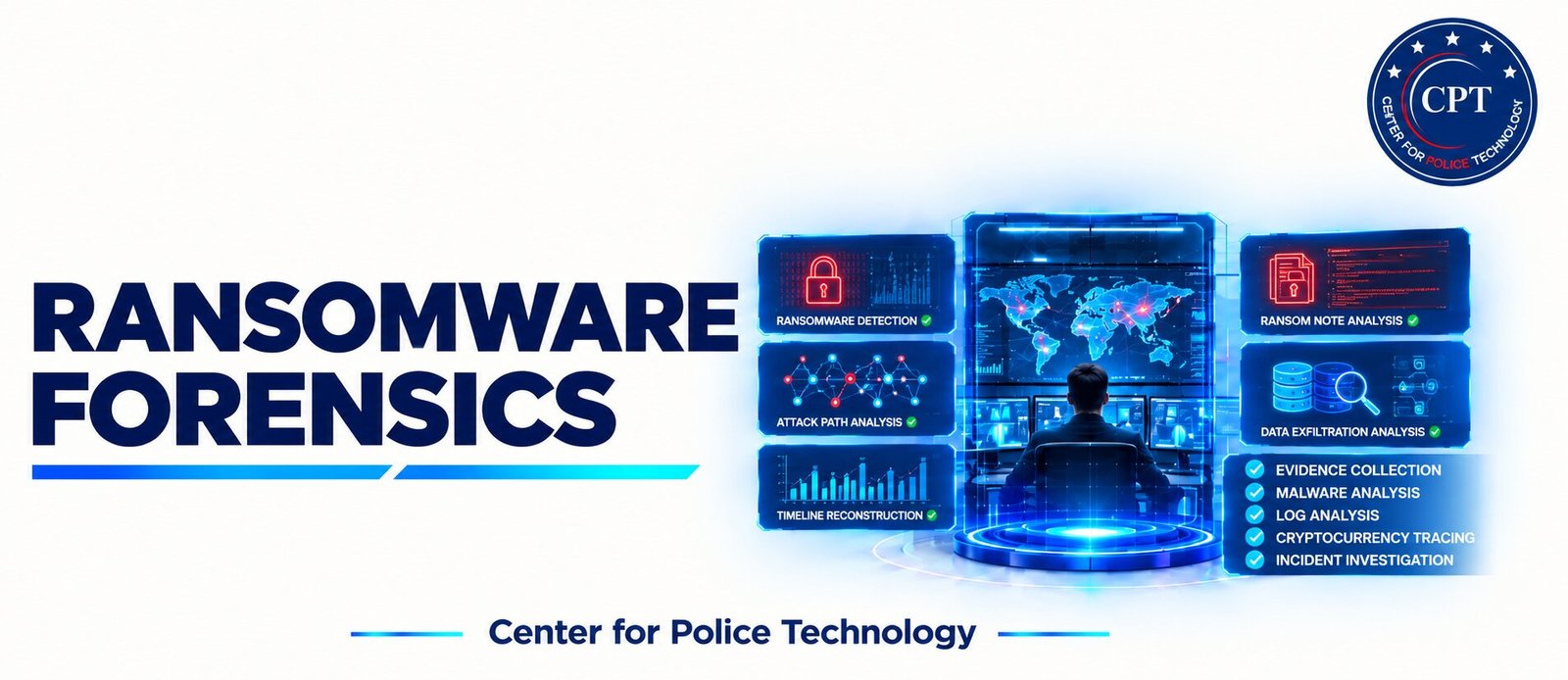
Centre for Police Technology Launches a 31-Day Cybersecurity Knowledge Series for Police, LEAs, Corporate Investigators, Digital Forensics, Fraud, Cyber Risk and Security Professionals
A ransomware attack may appear simple from the outside: files become inaccessible, a ransom note appears and criminals demand payment.
For investigators, the reality is far more complex.
Modern ransomware incidents can involve stolen credentials, privilege escalation, movement across networks, data theft, destruction of backups, encryption, extortion and cryptocurrency payments. Europol continues to describe ransomware as a major cybercrime threat, with ransomware-as-a-service helping criminal groups expand their operations.
This makes ransomware forensics essential.
Ransomware forensics is the systematic examination of computers, networks, logs, malware, accounts and other digital evidence to determine how attackers entered, what they did, what they stole or encrypted, which systems were affected and what evidence can identify the criminal operation.
For police and cybercrime investigators, the objective is not simply:
“Find the ransomware file.”
It is:
“Reconstruct the entire attack while preserving evidence that can support investigation and prosecution.”
What Is Ransomware Forensics?
Ransomware forensics is a specialised area of digital forensics and incident investigation focused on ransomware attacks.
An investigator may need to answer several questions:
- How did the attacker enter the network?
- Which account was compromised?
- How long was the attacker inside?
- Did the attacker steal information before encryption?
- Which malware was deployed?
- What systems communicated with the attacker?
- Was cryptocurrency demanded or transferred?
- Can this attack be connected with other cases?
These questions cannot normally be answered from the ransom note alone.
Investigators must reconstruct activity across computers, identity systems, network devices, security platforms, cloud environments and other digital sources.
The forensic investigation therefore moves backwards from the visible impact to the original compromise.
How Does a Ransomware Attack Usually Develop?
Ransomware is often the final stage of a longer intrusion. Attackers may initially obtain access through phishing, stolen credentials, exposed remote services, compromised third parties or exploitation of vulnerabilities. Once inside, they may attempt to obtain higher privileges. They can then explore the environment, identify important servers, steal credentials and move between systems.
Modern ransomware groups may also steal sensitive information before encryption.
This creates additional pressure on victims because criminals can threaten to publish stolen information even if backups allow the organisation to restore encrypted files.
The attack may therefore follow a sequence such as:
Initial Access → Credential Theft → Privilege Escalation → Network Discovery → Lateral Movement → Data Exfiltration → Backup Disruption → Ransomware Deployment → Encryption → Extortion
Forensic investigators attempt to reconstruct this sequence.
What Happens First During a Ransomware Investigation?
The first priority is to prevent further damage while preserving as much evidence as possible. Affected systems should be identified and appropriately isolated from the network.
CERT-In’s ransomware guidance recommends identifying affected systems or subnets and isolating them, including at the network level where necessary. International ransomware-response guidance similarly recommends determining which systems were affected and isolating them quickly. For cloud systems, point-in-time snapshots may help preserve material for later forensic examination.
However, investigators must understand an important forensic problem. Simply switching off an infected computer can destroy volatile evidence held in memory. This may include running processes, active network connections, encryption keys and other temporary information.
International guidance therefore notes that powering down a device may result in the loss of ransomware artefacts stored in volatile memory and should be considered carefully when network isolation is possible.
The correct response depends on operational circumstances.
Contain the attack, but do not destroy valuable evidence unnecessarily.
What Evidence Should Investigators Look For?
Ransomware investigations can involve evidence from many locations.
Endpoint Evidence
Affected computers and servers may contain ransomware executables, scripts, scheduled tasks, malicious services, persistence mechanisms, temporary files and traces of attacker activity.
Memory Evidence
RAM may contain active processes, network connections, malware code, credentials and sometimes cryptographic material.
Because memory is volatile, it requires careful handling.
Log Evidence
Logs can become some of the most important evidence in the investigation.
Investigators may examine:
- Authentication logs
- Windows event logs
- Firewall logs
- VPN logs
- Endpoint security logs
- Email logs
- Cloud audit logs
- DNS records
- Proxy logs
- Application logs
Together, these can help establish a timeline.
Network Evidence
Network records may reveal connections to attacker-controlled infrastructure, command-and-control servers or systems used for data exfiltration.
Ransomware Artefacts
Important artefacts may include ransom notes, encrypted files, malware samples, scripts and configuration information.
Cryptocurrency Evidence
If criminals provide a cryptocurrency address, investigators may preserve the wallet address, ransom demand and associated communications for further financial investigation.
Why Is the Timeline So Important?
A ransomware investigation is fundamentally a reconstruction exercise. Investigators need to establish what happened and in what order.
Suppose encryption began at 2:15 am. The forensic investigation should not begin only at 2:15 am. Investigators may need to look days or weeks earlier.
Perhaps an administrator account logged in from an unusual location several days before the encryption. Perhaps a remote-access tool was installed later. Perhaps large volumes of data were transferred shortly before ransomware deployment.
When these events are placed together, the attack becomes clearer.
A simplified timeline could look like:
Compromised Account → Remote Login → Privilege Escalation → Security Tools Disabled → Network Discovery → Data Transfer → Ransomware Deployment → File Encryption
The timeline helps investigators distinguish the initial compromise from the final ransomware event.
What Role Does Malware Analysis Play?
The ransomware executable itself can provide valuable information.
Investigators may examine the file without running it through static analysis.
They may also execute it inside a properly isolated environment through dynamic analysis.
The objective is to understand how the ransomware operates.
Questions may include:
- Which files does it target?
- How does it encrypt them?
- Does it attempt to stop security software?
- Does it delete backups or shadow copies?
- Does it communicate with external infrastructure?
- Does it contain identifiers linked to a known ransomware family?
Malware analysis may also reveal indicators that investigators can search for across other systems.
However, identifying a ransomware family does not automatically identify the individual offender.
Malware attribution and criminal attribution are not the same thing.
Can Ransomware Forensics Connect Different Cases?
Potentially, yes.
Investigators can compare technical and financial indicators across incidents.
These may include file hashes, domains, IP addresses, ransom-note language, malware configuration, infrastructure, cryptocurrency addresses and attacker communication methods.
Similarities may reveal investigative links. International investigations demonstrate why this matters.
Operation Cronos, targeting LockBit, involved law-enforcement authorities from multiple countries. Authorities took control of infrastructure supporting the ransomware operation, and Europol provided analytical, cryptocurrency-tracing and forensic support.
More recently, Europol announced in October 2026 that an international operation targeting KillSec involved the seizure of its leak site and the securing of at least 110 terabytes of data. Authorities linked the group to around 1,000 suspected attacks worldwide.
Ransomware investigations therefore increasingly require cooperation across organisations and jurisdictions.
What Role Does Cryptocurrency Forensics Play?
Many ransomware groups demand payment through cryptocurrency. The blockchain can therefore become another source of investigative information.
Investigators may examine wallet addresses, transactions, movement of funds and connections with exchanges or laundering services. Cryptocurrency does not automatically make offenders invisible.
In June 2026, Europol announced an operation against the service known as AudiA6, suspected of laundering more than €336 million between 2022 and 2025. Europol said its analysis connected the service with more than 15 international cybercrime investigations, including activity involving ransomware groups. The ransomware investigation may therefore extend beyond malware and computers into financial investigation.
A ransom payment can itself create an investigative trail.
Should a Victim Pay the Ransom?
From a forensic perspective, investigators should carefully preserve ransom demands, communications, wallet addresses and any payment-related records. But payment does not guarantee recovery.
International ransomware guidance states that paying a ransom does not ensure that data will be decrypted, that systems will no longer be compromised or that stolen information will not be leaked. Law-enforcement and cybersecurity authorities generally discourage ransom payments.
The investigative focus should instead include containment, evidence preservation, recovery, attribution and disruption of the criminal infrastructure.
Can Encrypted Files Be Recovered?
Sometimes.
The ability to decrypt files depends on the ransomware family, its implementation, available keys and whether researchers or law-enforcement agencies have developed a working decryptor.
The No More Ransom initiative was created by Europol’s European Cybercrime Centre, the Dutch police and industry partners to help ransomware victims recover encrypted information without paying criminals. Following the international disruption of LockBit, technical expertise from law enforcement contributed to decryption tools being made available to victims.
Investigators should therefore identify the ransomware family before assuming that encrypted data cannot be recovered.
How Should Digital Evidence Be Preserved?
Evidence preservation begins from the moment investigators respond.
Where appropriate, forensic personnel should document the state of affected systems, preserve relevant logs, acquire forensic images, collect volatile data and calculate cryptographic hashes. The objective is to demonstrate that evidence has not been improperly altered.
A ransomware forensic workflow can be understood as:
Identify → Isolate → Preserve → Acquire → Hash → Analyse → Correlate → Document → Report
Chain of custody is particularly important. Investigators should record who collected evidence, when it was collected, where it came from, how it was acquired, how it was stored and who subsequently accessed it.
CERT-In’s 2026 cyber-forensics training specifically includes system and network artefacts, incident investigation, chain of custody and evidence handling.
What Is the India Legal Perspective?
Ransomware evidence is usually electronic evidence.
The Bharatiya Sakshya Adhiniyam, 2023 therefore becomes important when digital records are produced in legal proceedings.
Section 63 establishes conditions concerning admissibility of electronic records and provides for a certificate accompanying electronic records in specified circumstances.
Investigators must therefore think beyond finding technical indicators.
They must preserve evidence in a manner capable of supporting authentication and legal scrutiny.
The Bharatiya Nagarik Suraksha Sanhita, 2023, the Information Technology Act, 2000 and other applicable legal provisions may also become relevant depending on the offence, investigation and evidence involved.
CERT-In continues to emphasise preservation of logs and forensic evidence when suspicious cyber activity is detected.
The core forensic principle remains:
A technically correct finding becomes much more valuable when its evidentiary integrity can also be demonstrated.
How Can Ransomware Forensics Support Police?
For police cybercrime units, ransomware forensics can help answer four major questions.
What Happened?
Technical evidence can reconstruct the intrusion and encryption process.
Who May Be Responsible?
Infrastructure, malware, accounts, communications and financial evidence may create investigative leads.
What Was Affected?
Forensics can help identify compromised systems, accounts and potentially stolen information.
Can the Case Be Connected?
Indicators may link the incident to other victims, infrastructure or criminal operations.
This transforms ransomware response from simple system recovery into criminal investigation.
What Mistakes Should First Responders Avoid?
- The first major mistake is immediately formatting or rebuilding compromised computers before evidence has been preserved.
- The second is deleting malware after antivirus software detects it without retaining an appropriate sample or relevant records.
- The third is assuming encryption marks the beginning of the incident.
Attackers may have been present much earlier.
Another mistake is failing to preserve logs before retention periods expire or systems overwrite them.
Investigators should also avoid conducting uncontrolled experiments on original evidence.
Recovery and investigation are related, but they are not identical processes.
A system can be restored while valuable investigative evidence is accidentally destroyed.
What Can Indian Police Build Now?
At the immediate level, cybercrime units can develop standard ransomware first-response procedures covering isolation, evidence preservation, log collection, forensic imaging and incident timelines. Investigators should also be trained to recognise the difference between malware evidence, network evidence, identity evidence and financial evidence.
At the next stage, state cybercrime units and forensic laboratories can strengthen integration between endpoint forensics, malware analysis, network forensics and cryptocurrency tracing. Threat indicators from investigated cases can also be systematically preserved and correlated with future incidents.
Over time, more automation and AI-assisted forensic analysis may help investigators examine large ransomware cases faster.
But automation should support forensic judgement rather than replace it.
What Skills Will Investigators Need?
Ransomware investigations require a combination of technical and investigative skills.
Personnel should understand operating-system artefacts, network logs, identity systems, malware behaviour, cloud environments and digital evidence preservation. Specialist teams may require memory forensics, reverse engineering, network forensics and cryptocurrency tracing capabilities.
Investigators must also understand documentation and chain of custody. The future ransomware investigator therefore needs to think beyond the encrypted computer.
The real crime scene may extend across:
Endpoint → Network → Cloud → Identity → Malware → Cryptocurrency → Criminal Infrastructure
What Could Ransomware Forensics Look Like by 2030?
Ransomware forensics is likely to become increasingly automated.
Future investigation platforms may automatically correlate endpoint artefacts, identity events, network activity, cloud logs, malware intelligence and cryptocurrency indicators. AI systems may help reconstruct attack timelines and identify connections between incidents. But increased automation will make verification even more important.
An AI-generated attack timeline may be useful. A court, investigator or forensic examiner must still be able to understand the evidence behind it.
The fundamental question will remain:
“Can we prove how the attack happened?”
Police Officer’s Quick Reference
5 Things Every Police Officer Should Know
- Ransomware encryption may be only the final stage of a much longer intrusion.
- Isolate affected systems without unnecessarily destroying volatile evidence.
- Preserve logs, malware, ransom notes and relevant system artefacts.
- Investigate possible data theft as well as encryption.
- Maintain chain of custody for all digital evidence.
5 Major Evidence Sources
Endpoint artefacts, memory, network and security logs, malware samples and cryptocurrency records.
5 Major Investigative Questions
How did the attacker enter? How did they move through the network? What was stolen? What was encrypted? What evidence could connect the attack to the offenders?
5 Actions Police Leadership Should Consider
Develop ransomware forensic playbooks, train first responders, strengthen forensic laboratories, integrate cryptocurrency investigation and establish procedures for rapid evidence preservation.
From Encrypted Files to a Reconstructed Crime Scene
Ransomware forensics is not simply the examination of encrypted computers. It is the reconstruction of a digital crime scene. The ransom note may be the most visible evidence, but the real investigation lies in the traces left before it appeared.
Those traces can reveal the initial compromise, attacker movement, stolen information, malicious infrastructure and financial trail.
For investigators, the central principle is:
Do not investigate only the encryption. Investigate the intrusion that made the encryption possible.
Contain the attack. Preserve the evidence. Reconstruct the timeline. Follow the digital and financial trail.
Day 7 — AI Malware Analysis
31 Days | 31 Key Topics | October 2026
A Cybersecurity Awareness Month Knowledge Initiative
Created by Centre for Police Technology (CPT)
Follow Centre for Police Technology (CPT) for the complete 31-Day Cybersecurity Knowledge Series.
Follow for daily updates on cybercrime, corporate fraud, DFIR, hacking, investigations, and digital forensics
