

Centre for Police Technology Launches a 31-Day Cybersecurity Knowledge Series for Police, LEAs, Corporate Investigators, Digital Forensics, Fraud, Cyber Risk and Security Professionals
October 4, 2026: Artificial intelligence can now generate highly realistic images, videos, voices and even complete virtual identities.
What once looked obviously fake can now appear convincing enough to deceive employees, investigators, customers and the public.
This creates a growing digital forensics challenge:
Deepfake forensics — the process of detecting, analysing and investigating AI-generated or manipulated digital content.
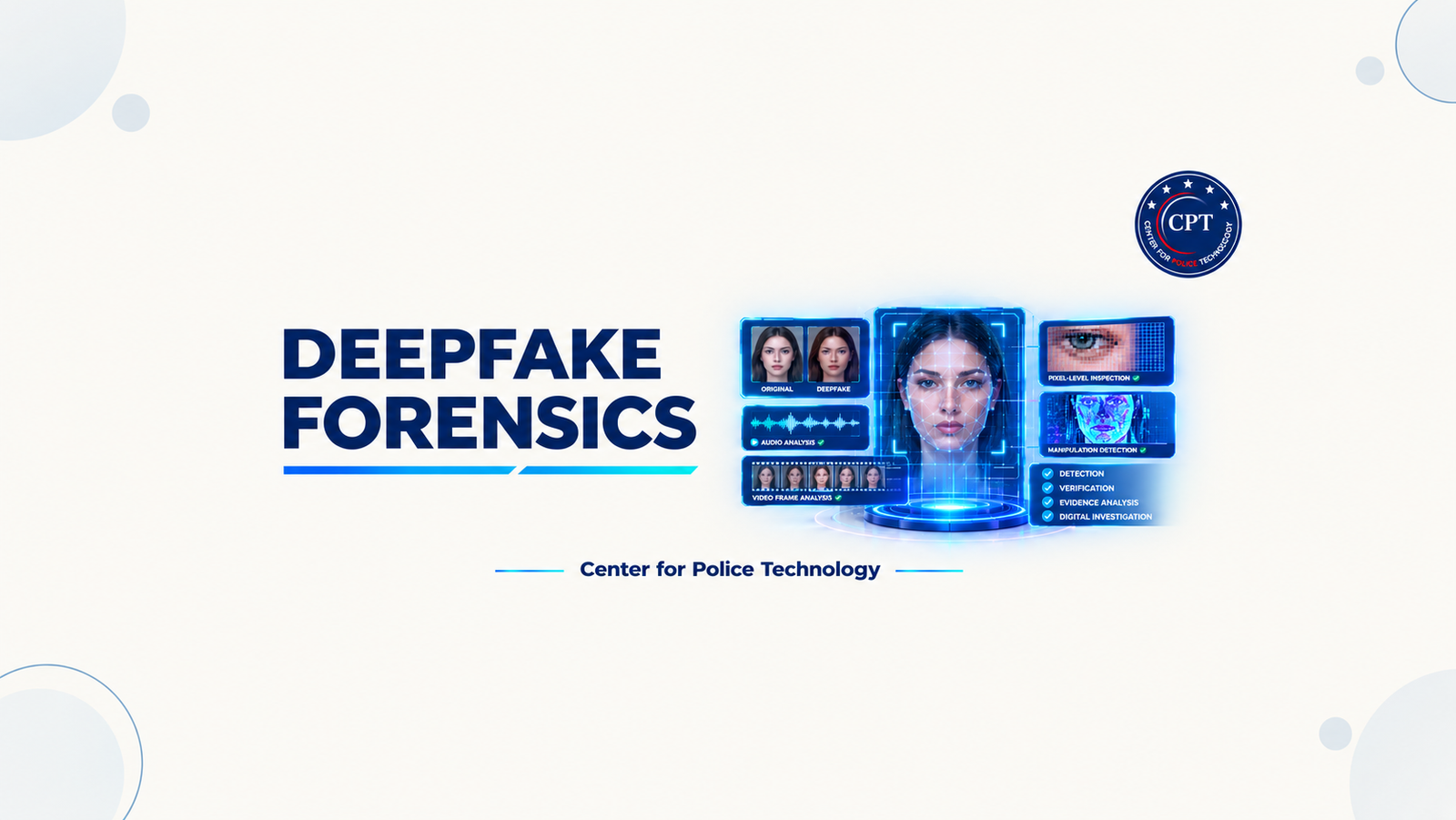
Following Day 1’s focus on Agentic AI Security, Day 2’s focus on AI Threat Detection and Day 3’s focus on Adversarial AI, Day 4 of the Centre for Police Technology (CPT) 31-Day Cybersecurity Knowledge Series examines how deepfakes are created, how investigators can detect them and why proving digital authenticity is becoming increasingly important.
What Is a Deepfake?
A deepfake is synthetic or manipulated digital content created using artificial intelligence.
The technology can alter or generate:
- Faces: Replacing one person’s face with another.
- Voices: Cloning a person’s voice from audio samples.
- Videos: Making a person appear to say or do something they never did.
- Images: Generating realistic photographs of people, places or events that never existed.
- Lip movements: Synchronising a person’s mouth with artificially generated speech.
- Digital identities: Combining synthetic faces, voices and personal information to create convincing identities.
Deepfakes can be used for entertainment and legitimate creative applications, but they can also support fraud, impersonation, misinformation, extortion and social engineering.
The forensic challenge is therefore not simply:
“Does this look fake?”
It is:
“Can we establish whether this digital evidence is authentic, manipulated or synthetically generated?”
How Are Deepfakes Created?
Modern deepfakes can be produced using several AI techniques.
Generative models can learn patterns from existing photographs, videos or audio and then create new synthetic content.
Common techniques include:
- Face swapping: Replacing a person’s face in an existing video.
- Face reenactment: Manipulating facial expressions or movements.
- Voice cloning: Generating speech that resembles a real person’s voice.
- Lip-sync generation: Matching artificial speech with realistic mouth movements.
- Synthetic image generation: Creating entirely artificial photographs.
- Audio manipulation: Altering or generating speech while preserving characteristics of the target voice.
The quality of these techniques continues to improve, making traditional visual inspection increasingly unreliable.
Why Are Deepfakes Difficult to Detect?
Early deepfakes often contained obvious visual errors.
Investigators could sometimes identify:
- Unnatural blinking.
- Distorted facial features.
- Poor lip synchronisation.
- Strange lighting.
- Inconsistent shadows.
- Blurred edges around the face.
Modern generative systems can eliminate many of these obvious indicators.
A deepfake may therefore look completely convincing when viewed casually.
This is why modern deepfake forensics increasingly combines AI detection with traditional digital forensic analysis.
What Is Deepfake Forensics?
Deepfake forensics involves examining digital media to determine whether it has been manipulated, generated or altered.
Investigators may examine several layers of evidence.
1. Visual Analysis
Investigators can look for inconsistencies in facial movements, lighting, reflections, shadows, skin texture and object boundaries.
2. Audio Analysis
Voice characteristics, background noise, compression patterns, speech timing and unnatural acoustic features can provide clues.
3. Metadata Analysis
Metadata may reveal information about when and how a file was created, modified or processed.
However, metadata should not automatically be treated as proof because it can be removed or altered.
4. Compression Analysis
Repeated editing, transcoding and compression can leave traces within an image, video or audio file.
5. Frame-Level Examination
Investigators can examine individual video frames to identify inconsistencies that may not be visible when watching the complete video.
6. Source and Provenance Analysis
Investigators should determine where the file originated, who first shared it and whether an original version exists.
The source history can sometimes be more valuable than simply analysing the final copy.
FCRF Launches CP-FRM to Build India’s Next Generation of Fraud Risk Professionals
Can AI Detect AI-Generated Content?
Yes — AI-based detection tools can assist investigators.
Deepfake detection systems can analyse:
- Facial movements.
- Image artefacts.
- Audio characteristics.
- Pixel-level inconsistencies.
- Frequency patterns.
- Biological signals.
- Compression characteristics.
- Synthetic generation patterns.
However, no detector should automatically be treated as a perfect truth machine.
Generative AI changes rapidly, while detection systems must continuously adapt.
A detector may also produce:
False positives: Authentic content incorrectly identified as synthetic.
False negatives: Deepfakes incorrectly classified as authentic.
For this reason:
Detection should support forensic investigation — not replace it.
How Can Police and LEAs Investigate Deepfakes?
Deepfake-related investigations can involve fraud, impersonation, cybercrime, misinformation, extortion, identity theft and threats.
Investigators should begin by preserving the original evidence.
Important steps include:
- Obtain the highest-quality original file available.
- Preserve the original media without unnecessary re-encoding.
- Record the source and acquisition method.
- Preserve metadata where available.
- Calculate and document cryptographic hashes.
- Examine frames and audio independently.
- Compare the suspected content with known authentic material.
- Analyse the distribution and sharing history.
- Use multiple forensic techniques rather than relying on one detector.
- Document every forensic step.
The investigation should establish not only whether content appears manipulated, but how that conclusion was reached.
Why Chain of Custody Matters
Deepfake investigations can become particularly difficult when digital evidence has been downloaded, forwarded, compressed or edited multiple times.
Every transformation can potentially change the evidence.
A proper chain of custody helps investigators establish:
Who obtained the evidence → When it was obtained → How it was preserved → What analysis was performed → What changed, if anything
This becomes critical when manipulated media is presented in criminal investigations or legal proceedings.
Deepfakes and Financial Fraud
Deepfakes are increasingly relevant to fraud because criminals can combine synthetic media with social engineering.
For example, an attacker could potentially use:
- A cloned executive voice.
- A fabricated video call.
- A synthetic identity.
- A fake photograph.
- AI-generated documents.
The objective may be to convince an employee that a fraudulent instruction is coming from a trusted person.
This creates a new form of authentication problem:
Seeing and hearing someone is no longer necessarily proof that the person is actually present.
Organisations therefore need stronger verification mechanisms for high-value transactions and sensitive requests.
Deepfakes in Cybercrime Investigations
Investigators may encounter synthetic media in several forms.
A criminal may create a fake video to impersonate a victim, use a cloned voice during a fraud attempt or manipulate evidence to mislead an investigation.
Deepfakes may also be used to create fake social-media accounts or support synthetic identities.
Investigators should therefore consider:
Is the person real?
Is the account authentic?
Is the media original?
Has the content been altered?
Who created or distributed it?
These questions can become as important as the content itself.
Emerging Technologies Fighting Deepfakes
Technology companies, researchers and cybersecurity organisations are developing multiple approaches to identify synthetic media and establish content provenance.
Content Credentials and Provenance
Cryptographically signed provenance systems can help record information about where digital content originated and how it was modified.
AI-Based Deepfake Detection
Machine-learning models can analyse images, video and audio for patterns associated with synthetic generation or manipulation.
Watermarking
Some generative AI systems are exploring machine-readable signals or watermarks that can help identify AI-generated content.
Media Authentication
Digital signatures, secure capture systems and tamper-evident workflows can help establish whether media has been modified after creation.
The broader direction is moving from:
“Detect the fake”
towards:
“Prove where the content came from and whether it changed.”
How Can Organisations Defend Against Deepfake Fraud?
Organisations should not rely on visual or voice recognition alone for high-risk decisions.
Important safeguards include:
- Establishing verification procedures for financial requests.
- Using independent communication channels for sensitive instructions.
- Requiring multiple approvals for high-value transactions.
- Training employees to recognise synthetic media and social engineering.
- Preserving original communications and files.
- Using trusted identity and authentication mechanisms.
- Monitoring unusual executive or employee impersonation attempts.
- Testing incident-response procedures involving deepfake attacks.
A simple principle can help:
Never authenticate a high-risk request using the same communication channel that delivered the request.
How Can Individuals Stay Safer?
Individuals should be cautious when receiving unexpected videos, voice messages or urgent requests involving money or sensitive information.
If someone appears to call asking for an emergency transfer:
Stop → Verify → Confirm
Contact the person through a known phone number or another trusted channel.
Users should also avoid assuming that a video or voice recording is authentic simply because it looks or sounds convincing.
The Future of Digital Evidence
Deepfakes are changing the meaning of digital authenticity.
For years, investigators could often treat photographs, recordings and videos as relatively direct representations of real-world events.
That assumption is becoming weaker.
As generative AI improves, the question surrounding digital evidence will increasingly become:
“Can we prove that this content is authentic?”
This means future investigations will require a combination of:
Digital Forensics + AI Detection + Provenance + Metadata + Human Verification
No single technology will solve the problem.
From Deepfake Detection to Digital Trust
Deepfake forensics is ultimately about more than identifying fake videos.
It is about protecting trust in digital evidence.
For police and LEAs, this means strengthening forensic capabilities.
For organisations, it means building stronger verification and fraud controls.
For investigators, it means preserving evidence and documenting analytical methods.
For individuals, it means understanding that realistic audio and video are no longer automatically proof of authenticity.
The central principle is simple:
In an AI-generated world, authenticity must be verified — not assumed.
Day 4 — Deepfake Forensics
31 Days | 31 Key Topics | October 2026
A Cybersecurity Awareness Month Knowledge Initiative
Created by Centre for Police Technology (CPT)
Follow Centre for Police Technology (CPT) for the complete 31-Day Cybersecurity Knowledge Series.
Follow for daily updates on cybercrime, corporate fraud, DFIR, hacking, investigations, and digital forensics
