

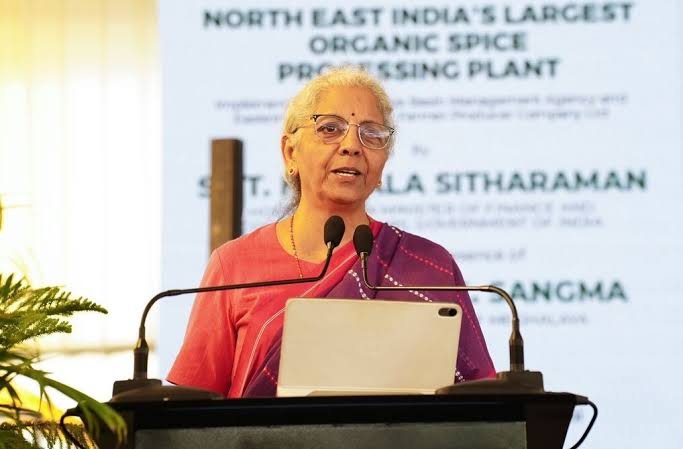

Union Finance Minister Nirmala Sitharaman has defended the government’s decision to introduce a Merchant Discount Rate on certain high-value UPI transactions, saying the move was taken professionally by the payments ecosystem and was not influenced by any external pressure.
The clarification comes amid political criticism over the new 0.4% MDR applicable to specified person-to-merchant UPI transactions above ₹2,000. Sitharaman rejected allegations that the decision was taken because of pressure from outside the country or from private interests.
The government has also reiterated that ordinary UPI users will not be charged for making payments.
Proposal for Conducting Cyber Crisis Drill, Tabletop Exercise (TTEx) & CCMP Readiness Exercise
0.4% MDR applies only to specified merchant transactions
The new framework took effect after the government announced changes on September 15.
Person-to-person UPI transfers will continue to remain free irrespective of the amount. Merchant payments up to ₹2,000 will also remain free, along with transactions covered by the zero-MDR framework for small merchants.
The government estimates that around 96% of person-to-merchant UPI transactions will remain unaffected.
The 0.4% MDR applies only to specified higher-value merchant transactions above ₹2,000.
MDR is not a tax collected by the government.
It is a fee distributed among participants in the payments ecosystem, including banks and payment application providers, to help cover the cost of processing and expanding digital payments infrastructure.
Consumers will not pay MDR directly
Sitharaman stressed that the new charge is not intended to be passed on to consumers.
She said the fee is borne within the merchant and payments ecosystem rather than being imposed directly on people using UPI.
That distinction is important because the public debate has often described the measure simply as a “UPI charge”.
For an individual transferring money to another person, there is no MDR.
For a customer paying an eligible merchant, the government’s position is that the merchant-side charge should not be added separately to the consumer’s bill.
Government says decision was taken by payment ecosystem
The latest controversy centres less on the rate itself and more on how the decision was made.
Sitharaman said allegations that the 0.4% MDR was imposed due to external pressure were “absolutely baseless”.
She said the decision was taken professionally after considering the sustainability of the UPI ecosystem.
The government has argued that UPI has grown into one of the world’s largest real-time payments systems and requires continuing investment in servers, cybersecurity, fraud controls, banks and payment infrastructure.
Until now, the government had relied heavily on subsidies to support zero-MDR UPI merchant transactions.
The revised framework shifts part of that cost towards selected higher-value merchant payments while keeping most transactions free.
Why MDR has become a policy issue
UPI has expanded rapidly because users and merchants have largely been able to transact without direct fees.
That helped accelerate adoption among small shops, restaurants, service providers and individual users.
But banks and payment companies still incur costs each time a transaction is processed.
The government had already signalled in August that any future MDR would apply only to a limited category of merchant transactions and would not affect person-to-person transfers or ordinary consumers.
At that stage, the Finance Ministry said the eventual rate would be decided through the UPI and Services Steering Committee headed by NPCI after the necessary legal changes.
The September framework has now fixed the rate at 0.4% for specified merchant transactions above ₹2,000.
Small merchants remain largely protected
The policy has been designed to shield small merchants from the new charge.
Payments up to ₹2,000 remain free, and existing zero-MDR protections continue for eligible small merchants.
The Economic Times separately reported that 5% of collections generated through the new MDR framework are expected to be directed towards expanding digital payment infrastructure for smaller merchants.
That reflects the government’s attempt to balance two objectives.
It wants the UPI ecosystem to become financially more sustainable without discouraging small merchants or consumers from using digital payments.
Opposition questions policy, government rejects criticism
The MDR decision has also become politically contested.
Opposition parties have criticised the government over the new framework, while Sitharaman has accused critics of spreading misinformation about whether users themselves will have to pay.
The government’s current position is that the charge applies within the payments ecosystem and should not result in a direct fee on consumers.
There is still a practical question over whether some merchants may try to indirectly recover the cost through pricing or other charges.
The Finance Ministry has said it is engaging with banks and merchant bodies to ensure the MDR is not passed on to users.
What this means for you: Person-to-person UPI transfers remain free, and most merchant payments will also remain unaffected. The 0.4% MDR applies only to specified higher-value merchant transactions, and the government says it should not be charged separately to consumers.
Follow for daily updates on cybercrime, corporate fraud, DFIR, hacking, investigations, and digital forensics
