

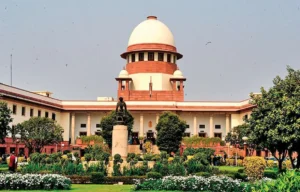
The Supreme Court has refused bail to a man accused in a cybercrime case after taking note of three identical criminal antecedents against him, with Justice J.B. Pardiwala observing that “cyber crime is like an addiction” as it involves “easy money”.
The court directed that the ongoing trial be conducted expeditiously and completed within six months. Only one witness had been examined since the previous year.
Why Did the Supreme Court Refuse Bail?
A bench of Justice J.B. Pardiwala and Justice K. Vinod Chandran was hearing a Special Leave Application challenging an order of the Jharkhand High Court that had rejected the accused’s bail plea.
The State told the Supreme Court that three identical criminal antecedents were registered against the petitioner. Taking note of this, Justice Pardiwala orally remarked, “cyber crime is like an addiction, as it is all easy money.”
The Supreme Court ultimately declined to grant bail.
Proposal for Conducting Cyber Crisis Drill, Tabletop Exercise (TTEx) & CCMP Readiness Exercise
What Cybercrime Case Is the Accused Facing?
The petitioner is an accused in a cybercrime case pending before the Additional Sessions Judge-II-cum Cyber Crime Special Court at Deoghar.
He was booked under Sections 111(2), 111(3), 111(4), 319(2), 318(4), 338, 336(3), 340(2) and 61(2) of the Bharatiya Nyaya Sanhita, 2023, along with Sections 66B, 66C and 84C of the Information Technology Act, 2000.
The petitioner and a co-accused were apprehended with SIM cards and mobile phones.
What Was Allegedly Found on the Phones?
While rejecting the petitioner’s bail plea, the Jharkhand High Court recorded that the seized phones contained material impersonating Flipkart Customer Care, Amazon Customer Care, Airtel Payment Bank, PhonePe Customer Care and the PM Kisan Yojna.
The material allegedly indicated that the petitioner was involved in cybercrime.
The High Court dismissed his bail application but expected the trial to be concluded within six months from its order dated July 10, 2026.
What Did the Accused Argue Before the Court?
The petitioner told the Supreme Court that he had been in custody for the last one year and that his co-accused had already been granted bail by the High Court after remaining in custody for one year.
He also submitted that he was 26 years old, had a child to care for and had no other source of income.
His counsel further pointed out that only one witness had been examined during the past year.
Why Did Criminal Antecedents Matter?
The State countered the bail plea by informing the court that the petitioner had three identical criminal antecedents.
After the court referred to three antecedents, the petitioner’s counsel said he was aware of only one such case. The court recorded that the counsel would provide instructions on whether his client had only one antecedent and not three.
The existence of the three identical antecedents was among the factors considered by the Supreme Court while declining bail.
What Did the Court Say About the Trial?
The Supreme Court noted that the trial was already in progress and that one witness had been examined.
It said it could have considered the bail plea but for the fact that the petitioner had three identical antecedents. Instead, the court directed that the trial proceed expeditiously and be completed within six months.
The case is Pintu Kumar Das v State of Jharkhand.
The420 Takeaway: “Repeat Cybercrime Allegations Can Weigh Heavily in Bail Proceedings”
The order highlights how criminal antecedents can become significant when courts consider bail in cybercrime cases. While the petitioner relied on his period in custody and the slow progress of the trial, the Supreme Court focused on the three identical antecedents and chose to direct a faster trial rather than grant bail.
About the author — Ayesha Aayat writes on cybercrime, digital safety, and emerging online threats. Her work focuses on public awareness, legal clarity, and technology-driven risks.
Follow for daily updates on cybercrime, corporate fraud, DFIR, hacking, investigations, and digital forensics
