

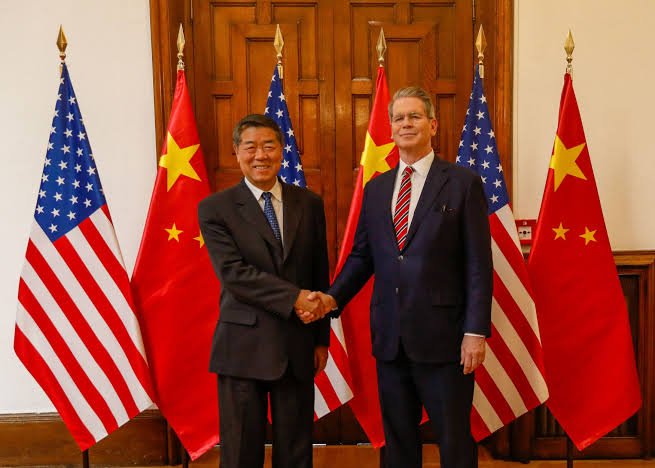

The United States and China have opened a new round of high-level economic talks focused on artificial intelligence, tariffs and critical minerals, days before Presidents Donald Trump and Xi Jinping are due to meet in Washington.
US Treasury Secretary Scott Bessent and Chinese Vice Premier He Lifeng began discussions in New York on September 20. US Trade Representative Jamieson Greer is also participating in the negotiations.
The talks are intended to prepare possible agreements before the Trump-Xi summit scheduled for September 24. No final deal had been announced when the discussions began.
Proposal for Conducting Cyber Crisis Drill, Tabletop Exercise (TTEx) & CCMP Readiness Exercise
AI moves into the centre of US-China negotiations
Artificial intelligence has become a significant part of the economic and security relationship between Washington and Beijing.
The United States and China are the two biggest competitors in advanced AI, making questions around powerful models, chips and security increasingly difficult to separate from trade policy.
Reuters reported that negotiators are examining possible safeguards around AI technology, including concerns surrounding powerful open-weight models.
Open-weight models are AI systems where important technical parameters are made available for others to download, modify or run independently.
Supporters argue that this can accelerate innovation. Governments and security experts, however, have raised concerns that highly capable models could also be adapted for cyberattacks, military purposes or other harmful uses.
The wider Trump-Xi discussions are expected to include questions around autonomous AI systems and possible mechanisms to reduce the risk of accidental escalation.
Rare-earth supplies remain a major pressure point
Critical minerals are another central issue.
The US has repeatedly pressed Beijing to maintain exports of rare earths and related materials required for advanced manufacturing, electronics, defence systems and clean-energy technologies.
China holds an unusually strong position in several parts of the rare-earth supply chain, particularly processing.
That creates strategic concerns for Washington because restrictions or delays can affect manufacturers that depend on specialised magnets and other mineral-based components.
The September 20 talks are expected to examine whether China can provide greater certainty around those supplies.
In return, Beijing has pushed Washington to ease some technology-related restrictions, particularly those affecting advanced computing and semiconductor access.
Tariff truce could be extended beyond November
Trade remains the broadest part of the negotiations.
The current US-China tariff truce is due to expire in November, and both governments are discussing ways to prevent another escalation.
Possible areas under discussion include lower tariffs on some non-strategic goods and increased Chinese purchases of American agricultural products.
Reuters also reported that aircraft purchases involving Boeing could form part of a broader package.
For the US, agricultural sales are politically and economically important because China has historically been a major buyer of products such as soybeans.
For China, lower tariffs could reduce pressure on exporters already facing weak domestic demand and growing international scrutiny over industrial overcapacity.
Another proposal under discussion is a possible new “Board of Trade” that could create a more permanent structure for handling commercial disputes between the two countries.
Why these talks matter beyond Washington and Beijing
The outcome will have consequences far beyond the two countries.
AI chips, rare-earth minerals, batteries, electronics and industrial equipment move through global supply chains that depend heavily on both American technology and Chinese manufacturing.
Restrictions imposed by either side can therefore raise costs for companies in Europe, India and other major markets.
The discussions also come as Chinese technology companies make rapid gains in areas such as memory chips, AI models, batteries and electric vehicles. On September 20, Chinese chipmaker CXMT said its latest memory-chip manufacturing platform had entered mass production, another indication of Beijing’s drive to reduce dependence on foreign semiconductor technology.
At the same time, Washington continues to restrict access to some advanced chips over national-security concerns.
The September negotiations are therefore about more than simply tariffs. They sit at the intersection of trade, artificial intelligence, technology security and control over strategic resources.
Much will now depend on whether Bessent and He can narrow the disagreements enough to produce concrete arrangements before Trump and Xi meet.
For now, the talks remain negotiations rather than agreements. Details on AI safeguards, mineral supplies and tariff concessions may change significantly before the leaders’ summit.
What this means for you: US-China agreements on AI chips, tariffs or rare-earth supplies can affect global electronics, cloud infrastructure, electric vehicles and manufacturing costs. Businesses should watch the September 24 Trump-Xi summit for actual policy changes rather than treating current negotiating proposals as settled deals.
Follow for daily updates on cybercrime, corporate fraud, DFIR, hacking, investigations, and digital forensics
