

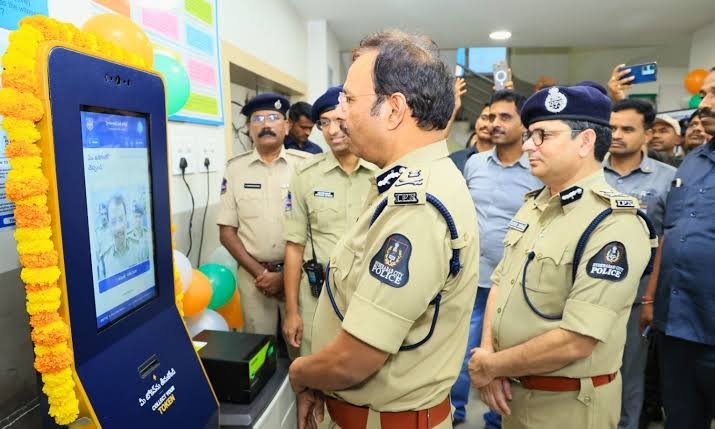

Hyderabad Police has launched an artificial intelligence-powered kiosk that can record complaints in nine languages, issue instant acknowledgements and digitally track what action police take on each grievance.
The system, called SETU, has been introduced as a pilot project at Mehdipatnam Police Station. Police Commissioner V C Sajjanar said it is intended to make the first interaction with a police station easier and reduce delays at the reception counter.
If the pilot succeeds, Hyderabad Police plans to expand the service to other police stations across the commissionerate in phases.
Proposal for Conducting Cyber Crisis Drill, Tabletop Exercise (TTEx) & CCMP Readiness Exercise
Complaint can begin before speaking to an officer
A person approaching the police station can use SETU to explain a grievance in a language they are comfortable with.
The AI system digitally records the statement and creates an acknowledgement immediately. It also tells the complainant what the next step is likely to be.
Police say the kiosk supports complaints in nine languages.
If the information indicates that an FIR needs to be registered, the matter can proceed through the normal legal process. The kiosk itself does not replace the police officer responsible for deciding and processing the case.
Each application also receives a digital tracking mechanism.
Senior officers can monitor what happened after the grievance was submitted, what action has been taken and whether the matter remains pending. Police say that this could improve accountability while also reducing time spent manually recording basic complaints.
What the AI is actually doing
The system should not be understood as an AI police officer deciding whether someone has committed a crime.
Its main role is closer to that of a digital receptionist and transcription assistant.
A complainant speaks or submits information. The software helps convert that information into a digital record, handles language differences and places it into a workflow that officers can then examine.
This distinction matters because legal decisions such as whether an FIR should be registered, what offences may apply and how an investigation proceeds remain police functions.
SETU therefore appears aimed mainly at removing administrative friction rather than automating criminal investigation.
That could be particularly useful in a city where residents may speak Telugu, Hindi, Urdu or several other Indian languages and may struggle to formally describe an incident at a police station.
Hyderabad Police already testing AI in complaint handling
SETU is not Hyderabad Police’s first attempt to bring AI into citizen-facing policing.
In January, the force launched C-Mitra, an AI-supported virtual helpdesk for cybercrime victims. Within its first 10 days, the programme had helped facilitate more than 100 FIRs while contacting around 1,000 victims.
C-Mitra uses AI to help prepare complaint drafts after victims report cybercrime through the 1930 helpline or National Cyber Crime Reporting Portal. The completed complaint can then be processed without the victim initially having to visit a police station.
In May, Hyderabad Police also launched AI-CopWriter, an application designed to record, transcribe and translate complaints in 10 Indian languages in real time.
The new kiosk takes that idea directly to the police-station reception.
Hyderabad Police has also deployed AI elsewhere, including its SOCEYE system for monitoring harmful online content and analysing social-media activity.
Digital tracking could be SETU’s biggest test
The most significant feature may ultimately be the ability to track what happens after a complaint is submitted.
Citizens often face uncertainty over whether a written grievance has been formally recorded, transferred or acted upon.
SETU creates a digital acknowledgement at the beginning of the process and allows senior officers to review progress until the issue is resolved.
That could create a clearer audit trail.
But the pilot will also have to answer practical questions around transcription accuracy, personal-data protection and how errors in AI-generated records are corrected before they become part of a police workflow.
The wider police system is already becoming increasingly digital. The Union Home Ministry said in March that all 17,798 police stations in India were using the Crime and Criminal Tracking Network and Systems, or CCTNS, for processes including FIRs and chargesheets.
SETU represents a different step: using AI at the point where an ordinary citizen first approaches the police.
Its success will therefore depend less on how impressive the technology appears and more on whether complaints are accurately recorded, promptly acted upon and easier for citizens to follow.
What this means for you: If SETU reaches your police station, it could make filing and tracking a grievance easier, especially where language is a barrier. Always review the recorded details carefully and ensure you receive the digital acknowledgement before leaving.
Follow for daily updates on cybercrime, corporate fraud, DFIR, hacking, investigations, and digital forensics
