
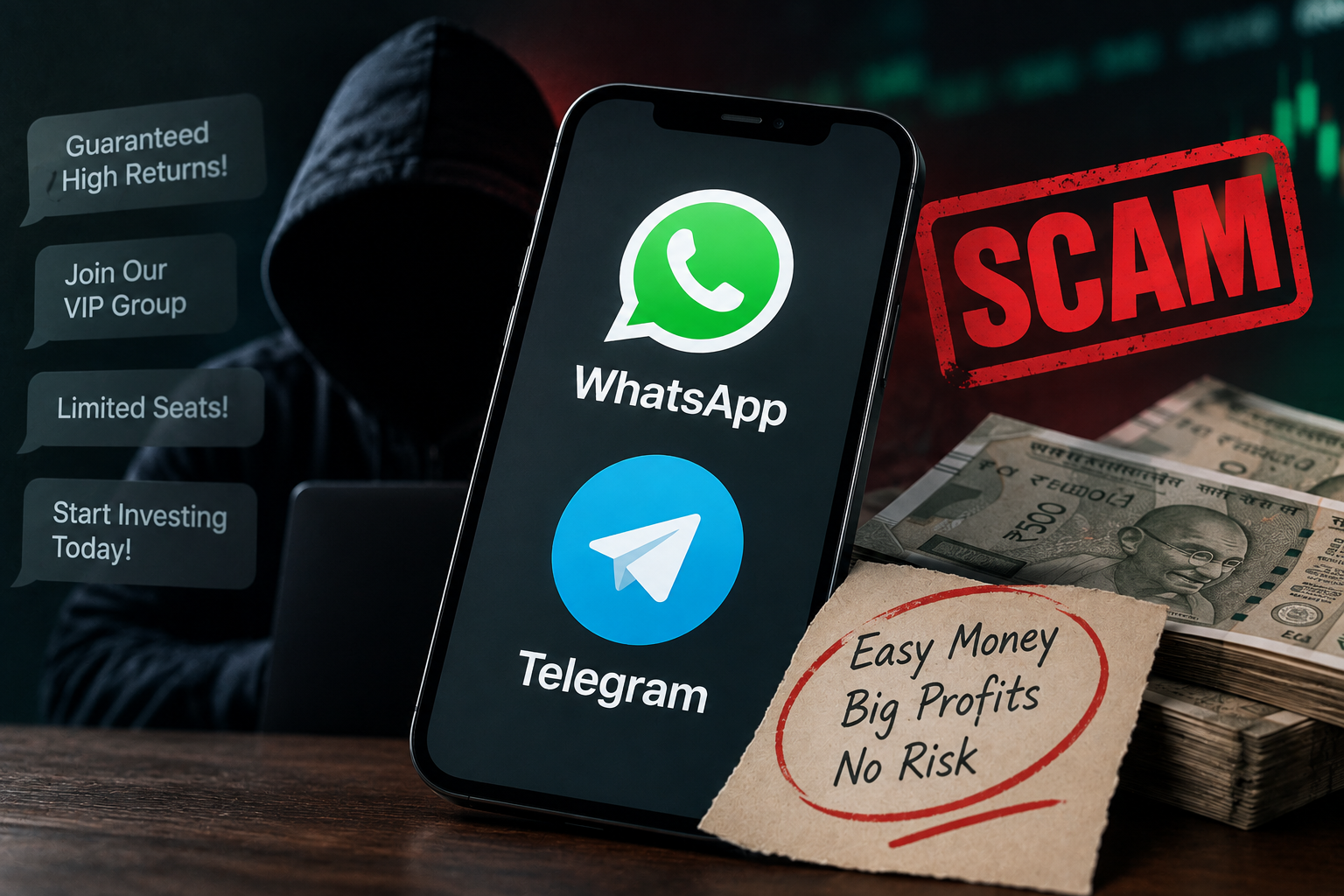

A stranger adds you to a WhatsApp group called “VIP Stock Club”.
The administrator claims to be a market expert. Other members post screenshots showing huge profits. A “professor”, “assistant” or “relationship manager” offers access to block trades, IPO allocations or institutional investments unavailable to ordinary investors.
Then comes the link to a trading app.
Your first few trades appear profitable. The balance on the screen keeps rising. You are encouraged to invest more.
But when you try to withdraw, the money suddenly becomes inaccessible.
This is one of the most common patterns behind WhatsApp and Telegram investment scams in India.
SEBI has warned that fraudsters use social-media groups, fake experts, fabricated trading apps and unrealistic return promises to build trust before pushing victims into larger transfers.
The scam often looks professional enough to fool even experienced investors.
These are the 10 red flags that should make you stop before transferring money.
1. You were added to the group without asking
An unknown WhatsApp or Telegram group itself should be treated with caution.
Fraudsters often add hundreds of people to investment groups where administrators claim to provide exclusive stock recommendations, IPO access or institutional trading opportunities.
Some participants may appear to be ordinary investors.
They post screenshots of profits, praise the “mentor” and claim that they have already withdrawn large amounts.
Those profiles may be part of the scam.
SEBI warns investors to be sceptical of unsolicited investment advice received through social media and messaging platforms.
A genuine investment adviser does not become trustworthy simply because dozens of group members appear to support them.
2. Someone promises guaranteed or unusually high returns
No one can guarantee stock-market profits.
Markets move up and down.
SEBI specifically identifies assured or unusually high returns as one of the clearest warning signs of investment fraud.
Scammers may use phrases such as “100% guaranteed return”, “risk-free profit”, “daily 5% income” or “double your money”.
Sometimes they use more sophisticated language.
They may claim that their institution has access to block trades, upper-circuit stocks, pre-IPO shares or confidential market information.
The wording changes.
The basic promise does not.
If the return sounds almost certain, the risk is probably being hidden from you.
3. The ‘expert’ cannot be independently verified with SEBI
Many investment scams involve people pretending to be portfolio managers, brokers, research analysts or investment advisers.
A polished WhatsApp profile is not proof of registration.
Neither is a certificate sent as a PDF.
SEBI advises investors to deal only with regulated or registered intermediaries and to independently check their status through official SEBI and exchange records.
Do not verify the person using a link they themselves send.
Search independently.
Fraudsters frequently impersonate genuine registered entities by copying their logos, employee names, registration numbers and websites.
A real company name attached to a fake WhatsApp account is still a scam.
4. You are told to download a trading app from a private link
This is one of the strongest red flags.
SEBI’s fake-trading-app advisory specifically warns against apps downloaded through links or APK files shared on social media or messaging platforms.
The app may look extremely convincing.
It may show live-looking charts, portfolio values, transaction histories and customer-support options.
But the numbers on the screen may be entirely controlled by the fraudsters.
No real trade needs to take place.
The app only needs to convince you that the money you transferred has become a larger amount.
SEBI recommends verifying trading platforms through recognised exchanges or the authorised mobile-trading-app information available through its investor portal.
5. Your ‘profits’ rise almost every day
Fake profits are one of the most effective psychological tools in an investment scam.
You transfer ₹50,000.
The app shows ₹65,000.
A week later it may display ₹90,000.
Nothing necessarily happened in the market.
The fraudster simply changed the number visible on your screen.
SEBI describes fabricated profits as a standard stage of fake trading app scams because apparent success encourages victims to invest more.
Some groups also allow a small initial withdrawal.
That can make the scheme appear genuine.
A victim who successfully withdraws ₹2,000 or ₹5,000 may feel much safer transferring ₹5 lakh later.
The small payment can simply be the cost of building trust.
6. The group pressures you to invest quickly
Scammers do not want you to stop and investigate.
They may tell you that an IPO allocation closes in 20 minutes.
A “special block trade” is available only today.
Only five VIP seats remain.
Or the stock is about to hit the upper circuit.
SEBI warns that legitimate investment professionals should not pressure investors into immediate decisions and identifies aggressive urgency as a common scam indicator.
Pressure also exploits fear of missing out.
If everyone else in the group appears to be making money, hesitation begins to feel like a financial mistake.
That is exactly the emotion the group is designed to create.
7. You are asked to transfer money to unrelated bank accounts
This is another major warning sign.
A fake investment platform may ask you to send money to the account of a private company, small business or individual who appears completely unrelated to the broker whose name is being used.
Sometimes each payment goes to a different account.
SEBI specifically warns investors against payments to third-party accounts and notes that legitimate trading platforms do not operate this way.
The receiving accounts may be mule accounts.
Their purpose is to create distance between the victim and the people controlling the scam.
Once money enters the first account, it may be transferred through several others, withdrawn in cash or converted into another form.
That is why recovery becomes difficult very quickly.
8. Withdrawal suddenly requires tax, margin or a new fee
This is often the point where the fraud becomes obvious.
The app may show ₹25 lakh in profit.
But the withdrawal button does not work.
Customer support then says you must first pay capital-gains tax.
Another victim may be told to deposit margin money.
Others are asked for currency-conversion charges, account-unfreezing fees, verification deposits or commissions.
SEBI says blocked withdrawals followed by demands for additional fees are a standard part of fake trading app scams.
The important point is that the displayed profit is usually not real.
Paying another ₹2 lakh will not unlock ₹20 lakh.
It simply creates another loss.
9. The group claims access to secret, VIP or insider opportunities
Fraudsters often sell exclusivity.
You may be invited into a “VIP institutional account”, “upper-circuit strategy”, “premium IPO group” or “private placement desk”.
Some pretend that ordinary investors have been selected for a special trading programme.
Others claim their professor or fund manager receives institutional allocations unavailable to the public.
SEBI has separately warned about so-called stock-market gurus who sell exclusive groups, paid courses and insider-style tips while making misleading claims about guaranteed profits.
Secret access is not proof of expertise.
It is often the sales pitch.
Any supposed insider information should create more suspicion, not less.
10. Deepfake celebrities or famous investors appear to endorse the platform
Investment scams increasingly borrow trust from people victims already recognise.
A social-media video may appear to show a famous industrialist, investor, television anchor or senior official discussing an investment opportunity.
The voice sounds real.
The face moves naturally.
But the video may have been manipulated using AI.
SEBI’s investor-awareness material now specifically warns about deepfake investment videos and misleading digital content.
Never invest because a celebrity appears in an advertisement.
Verify the platform independently.
If a famous person really launched an investment service, there should be reliable information outside the advertisement itself.
How the WhatsApp investment scam usually works
The entire operation is designed as a sequence.
First comes the social-media hook.
Then trust.
Then the fake platform.
Then fake profits.
Then larger deposits.
Finally, withdrawal is blocked and further money is demanded.
SEBI describes almost exactly this progression in its fake trading app warning.
The scam works because every stage makes the next stage feel more reasonable.
A person who would never transfer ₹20 lakh to a stranger on day one may eventually do so after weeks of apparent profits, group testimonials and small successful withdrawals.
WhatsApp groups can manufacture social proof
One reason these scams are so convincing is that the victim rarely feels alone.
The group may contain dozens or hundreds of apparent investors.
One person says they made ₹4 lakh.
Another posts a withdrawal screenshot.
Someone thanks the professor for helping them buy a new car.
This creates social proof — the feeling that an opportunity must be genuine because everyone else appears satisfied.
But the victim does not know who those accounts belong to.
The same criminal team can operate multiple profiles.
Profit screenshots can be fabricated.
Testimonials can be scripted.
SEBI’s material on social-media fraud specifically identifies fake testimonials and fake success stories as tools used to build credibility.
Telegram does not make an investment opportunity more legitimate
Telegram is popular with trading communities because it allows large groups and channels.
That also makes it useful to fraudsters.
Scammers may move victims from WhatsApp to Telegram after initial contact.
One platform is used to recruit.
Another hosts the investment group.
A third fake app displays the supposed portfolio.
The use of several platforms can make the operation seem sophisticated.
It does not make it regulated.
The same verification rules apply regardless of whether the recommendation arrives through WhatsApp, Telegram, Instagram, YouTube or another social network.
A real stock can still be used in a scam
Not every WhatsApp investment fraud uses a completely fake asset.
Some groups promote genuine listed shares.
That can lead to pump-and-dump manipulation.
Fraudsters accumulate shares in a thinly traded company, promote it aggressively through WhatsApp or Telegram and persuade followers to buy.
As demand pushes the price higher, the promoters sell their holdings.
Late investors are left with losses when the price collapses.
SEBI specifically warns that WhatsApp and Telegram stock-tip groups can be used in this type of scheme.
So checking whether the stock itself exists is not enough.
You must also question why an unknown group is aggressively telling hundreds of people to buy it.
How to verify a trading app before investing
Do not start with Google results or the link sent by the adviser.
Start with the regulator.
Check whether the broker or intermediary is recognised or registered.
Then verify the trading application through official exchange or SEBI resources.
SEBI advises investors to use its registered mobile trading app information and recognised intermediary databases rather than trusting screenshots or certificates circulated by the promoter.
Compare the official website domain, customer-care number and app publisher with what you received on WhatsApp.
Even one mismatch should stop the payment.
What if you have already transferred money?
Stop sending more.
Do not pay any additional tax, margin, verification fee or withdrawal charge.
Take screenshots of the WhatsApp or Telegram group, administrator profiles, phone numbers, app, website, beneficiary accounts and payment receipts.
Preserve the chats rather than deleting them.
Then call the national cybercrime helpline 1930 immediately and report the fraud through the National Cyber Crime Reporting Portal.
SEBI’s scam advisories also direct suspected cyber-fraud victims towards the cybercrime authorities and 1930.
Speed matters because money can move through several mule accounts very quickly.
Reporting early may give banks and investigators a chance to freeze funds that have not yet moved further.
The 10-second test before you invest
Before transferring money from a WhatsApp or Telegram recommendation, ask yourself three questions.
Did the offer come to me unsolicited?
Am I being promised an unusually easy or guaranteed profit?
Am I being asked to send money somewhere other than a verified brokerage account?
If even one answer is yes, stop and independently verify everything before proceeding.
Investment opportunities survive verification.
Scams depend on preventing it.
Follow for daily updates on cybercrime, corporate fraud, DFIR, hacking, investigations, and digital forensics
