
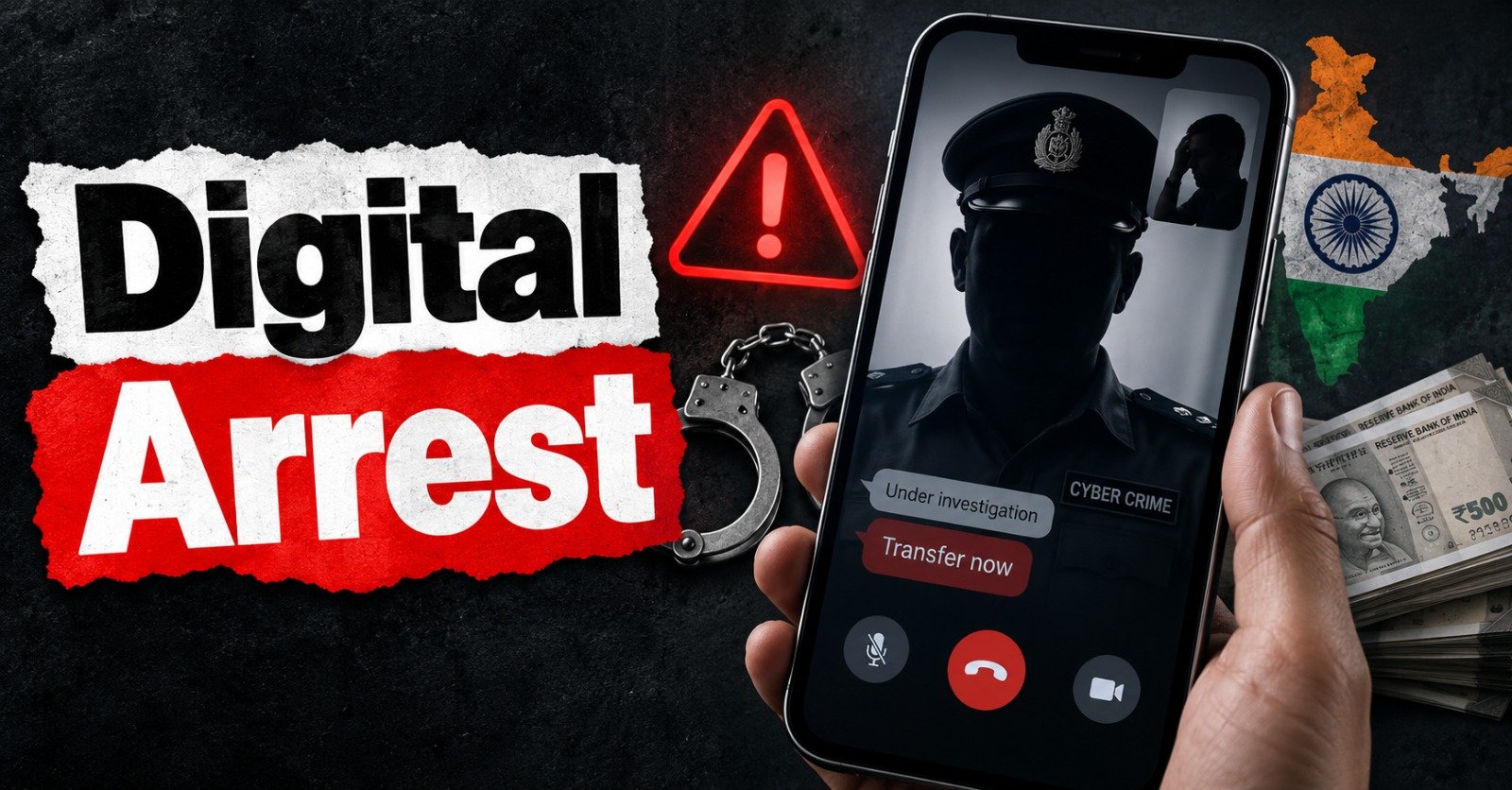

A police officer appears on a video call. He says your Aadhaar number has been linked to drugs, money laundering or terrorism. A forged arrest warrant arrives on WhatsApp. You are told not to disconnect, not to speak to your family and not to leave the room.
Then comes the demand: transfer your savings to a “safe account” so investigators can verify the money.
This is a digital arrest scam.
There is no legal procedure called “digital arrest” in India. The Indian Cyber Crime Coordination Centre has explicitly warned that genuine law-enforcement agencies do not arrest people through video calls or demand money to settle an investigation.
Yet the scam continues to cost victims crores because it combines impersonation, forged documents, psychological isolation and rapid movement of money through mule accounts.
What is a digital arrest scam?
A digital arrest scam is a form of cyber-enabled impersonation fraud in which criminals pretend to be police officers, CBI officials, Enforcement Directorate officers, narcotics investigators, telecom officials or other government authorities.
The victim is falsely told that their mobile number, Aadhaar details, bank account or a parcel sent in their name has been connected with a serious crime.
I4C says common allegations include drugs or fake passports found in courier parcels, illegal SIM cards, Aadhaar misuse, money laundering, terrorist activity and suspicious money deposited into a victim’s account.
The allegation is deliberately serious.
A fake traffic fine may be questioned. A claim that the CBI has found your bank account in a money-laundering case creates much more fear.
Once that fear is established, the fraudster begins controlling the victim’s behaviour.
How does a digital arrest scam usually begin?
The first caller often does not claim to be a police officer.
They may say they are calling from a telecom company, TRAI, a courier service, a bank or another institution.
The victim may be told that a mobile number registered in their name is being disconnected because it was used for fraud.
In another variation, the caller says a FedEx or DHL parcel linked to the victim contains drugs, passports, SIM cards or other illegal material.
The call is then “transferred” to a supposed police station or investigating agency.
This staged handover makes the conversation feel like a genuine escalation from one government or corporate department to another.
The second caller is often more aggressive.
They may appear in uniform on video, show an official-looking office background and display forged FIRs, arrest warrants or notices carrying the logos of agencies such as the CBI, ED, RBI or Supreme Court.
Why do victims stay on the video call?
Isolation is one of the most important parts of the scam.
I4C describes cases in which victims are forced to remain continuously available on WhatsApp, Skype or other video platforms while fraudsters monitor them. Fake police-station settings and uniforms are used to reinforce the illusion.
The victim may be told that the investigation is confidential and that speaking to a spouse, child, lawyer or bank employee would amount to interfering with the investigation.
Some are warned that their family members will also be arrested if they disclose the case.
This serves a very practical purpose.
A frightened victim who is kept continuously occupied has less opportunity to call genuine police, search online, contact their bank or ask a family member whether the story makes sense.
In several cases covered by The420.in, victims were kept under this pressure for hours, days or even weeks before money was transferred.
What is the biggest warning sign?
The demand for money.
Fraudsters may call it a verification transfer, security deposit, investigation account, safe account, RBI account or temporary government account.
The terminology changes, but the objective does not.
The victim is instructed to move money into an account supplied by the caller.
Sometimes they are told to break fixed deposits, sell investments or transfer funds in several instalments.
There is no legitimate investigative process under which police, CBI, ED, RBI or a court asks someone to transfer personal savings to prove that the money is clean.
I4C specifically warns that criminals use digital-arrest threats to extort money in exchange for supposedly clearing or settling fabricated legal cases.
There is no ‘digital arrest’ under Indian law
This is the single most important fact to remember.
I4C’s official advisory says there is no concept of digital arrest under Indian law.
Police cannot lawfully arrest a person simply by ordering them to remain in front of a camera.
A genuine investigation may involve a formal notice, summons, questioning or arrest under applicable legal procedure.
None of those procedures involves transferring money to a private bank account over WhatsApp.
A genuine officer will also not require a suspect to remain on a video call while their savings are supposedly being “verified”.
Why do the fake documents look so convincing?
Digital-arrest gangs increasingly operate like organised businesses.
They use stolen government logos, copied court formats, forged signatures and publicly available information about real police officers.
Some attackers use photographs or video of senior officers to strengthen the impersonation.
Others build fake police-station backgrounds or use multiple callers, each playing a different role.
One person may pose as a telecom official.
Another acts as the investigating officer.
A third pretends to be a senior CBI or police officer.
A fourth may appear as a prosecutor or judge.
The more people involved, the more the victim feels that they have entered a real criminal-justice process.
Artificial intelligence and deepfake technology can make that deception even harder to detect. The CBI acknowledged this risk when it launched ABHAY in May 2026, an AI-powered system designed to help citizens verify whether a purported CBI notice is genuine.
How can you verify a supposed CBI notice?
Do not use the phone number, QR code or web link printed on the notice sent by the caller.
That information may itself be fake.
The CBI launched its ABHAY verification system in May 2026 specifically because forged CBI notices are increasingly used in digital-arrest scams. The tool allows citizens to authenticate notices rather than trusting what appears on a WhatsApp message or PDF.
The same principle applies when someone claims to represent any agency.
End the call and independently obtain the organisation’s official contact details.
Do not allow the caller to “transfer” you to the supposed police station.
What if the caller knows your Aadhaar number or bank details?
That does not prove the caller is genuine.
Cybercriminals may already possess personal information obtained from data breaches, leaked databases, compromised documents, phishing attacks or other criminal sources.
Knowing your name, address, Aadhaar details, bank name or family information can make the call extremely convincing.
But real data can be inserted into a completely fabricated story.
The correct question is not, “How did they know my details?”
It is, “Is the procedure they are asking me to follow something a genuine authority would ever do?”
If the answer involves secret video detention or transferring money, it is a scam.
Where does the money go after a victim transfers it?
Usually not directly to the person making the call.
Large digital-arrest networks often rely on mule bank accounts.
These may belong to individuals, small businesses, shell companies or people who handed over their banking credentials in return for commission.
Funds can move through several accounts within minutes or hours before being withdrawn, converted or transferred onward.
The420.in has reported cases in which investigations uncovered hundreds of mule accounts, shell firms and cryptocurrency transfers behind what initially appeared to be a single fake police call.
This is why early reporting matters so much.
Once the money moves through several layers, recovery becomes increasingly difficult.
What should you do if you receive a digital arrest call?
The safest response is to disconnect.
Do not debate the caller or try to prove your innocence.
Do not share Aadhaar images, bank details, OTPs, passwords, PINs or information about fixed deposits and investments.
Do not install screen-sharing or remote-access applications.
Do not move to another app simply because the caller says the “investigation” must continue on WhatsApp, Skype or Telegram.
Most importantly, do not transfer money.
After disconnecting, contact the concerned agency independently if you still believe there may be a genuine legal issue.
If money has already been transferred, call 1930 immediately and file a complaint through the National Cyber Crime Reporting Portal.
The CBI also advises victims of digital-arrest and other impersonation frauds to report suspicious activity through 1930, cybercrime.gov.in or the nearest law-enforcement agency.
Why is calling 1930 quickly so important?
Cyber-fraud money moves fast.
The Citizen Financial Cyber Fraud Reporting and Management System was created to connect complaints with banks and financial institutions so suspicious funds can potentially be stopped before they disappear further into the network.
By June 30, 2026, the system had helped save more than ₹11,158 crore across over 32.80 lakh complaints, according to the Ministry of Home Affairs.
That does not mean every victim will recover their money.
But reporting immediately gives banks and police a better opportunity to place a lien or freeze funds that are still sitting in the recipient account.
Waiting several days can drastically reduce that opportunity.
What evidence should victims preserve?
Do not delete the conversation out of embarrassment or fear.
Keep screenshots of WhatsApp chats, phone numbers, profile photographs and video-call records.
Preserve fake FIRs, warrants, RBI letters, court documents and any PDFs or images the fraudsters sent.
Keep bank transaction receipts, beneficiary account numbers, UPI IDs and payment references.
If you were instructed to install an app, note its name and preserve the device rather than immediately resetting it.
This information can help investigators link one victim’s case to accounts, numbers and devices appearing in other complaints.
Are senior citizens specifically targeted?
Senior citizens frequently appear in reported digital-arrest cases, but anyone can be targeted.
Older victims may have larger retirement savings and fixed deposits, and some may be less familiar with the way genuine agencies communicate digitally.
Fraudsters exploit both factors.
But professionals, business owners, engineers, bank employees and younger victims have also been cheated.
The scam succeeds because it attacks fear of law enforcement rather than a lack of intelligence.
In July 2026, the CBI announced an arrest in a case where a senior citizen was allegedly coerced into transferring ₹25.65 lakh after being falsely accused of terrorism-linked transactions. Investigators later helped facilitate refund of ₹2.65 lakh.
The case illustrates both the scale of the psychological manipulation and the importance of quickly tracing the receiving accounts.
How big is the wider cyber-fraud problem?
Digital arrest is one part of a much larger financial-cybercrime problem.
The Ministry of Home Affairs said more than 53.87 lakh cyber-fraud complaints were reported through NCRP between the financial years 2023-24 and 2025-26, involving reported amounts exceeding ₹56,087 crore.
At an NHRC discussion in June 2026, officials cited I4C-linked data indicating that Indians had lost roughly ₹52,976 crore to cyber-enabled fraud over six years, with around 8% of those losses attributed to digital-arrest scams.
Those figures cover reported complaints and should not be confused with convictions or final judicially established losses.
But they show why digital-arrest fraud has become a national enforcement priority.
What is the government doing against these networks?
The response increasingly focuses on the infrastructure behind the scam rather than only the callers.
I4C works with banks, telecom companies and law-enforcement agencies to identify mule accounts, fraudulent SIM cards and devices used in cybercrime.
By June 30, 2026, the government said more than 15.75 lakh SIM cards and 5.77 lakh IMEIs reported by police had been blocked. I4C had also shared more than 32.08 lakh Layer-1 mule accounts with participating institutions through its Suspect Registry, helping decline transactions worth ₹25,698 crore.
The CBI is also investigating major digital-arrest networks, including cases transferred following Supreme Court proceedings.
The challenge is that the visible caller may be only one person in an international chain involving recruiters, SIM suppliers, mule-account handlers, cash collectors and overseas operators.
The five signs that should end the call immediately
Treat the call as fraudulent if someone claiming to be an authority says you are under “digital arrest”; demands secrecy from family or lawyers; keeps you under continuous video surveillance; tells you to transfer money to a safe, verification or government account; or threatens immediate arrest unless you follow financial instructions.
Any one of these is enough reason to disconnect and independently verify the claim.
You do not need to wait for all five.
Follow for daily updates on cybercrime, corporate fraud, DFIR, hacking, investigations, and digital forensics
