
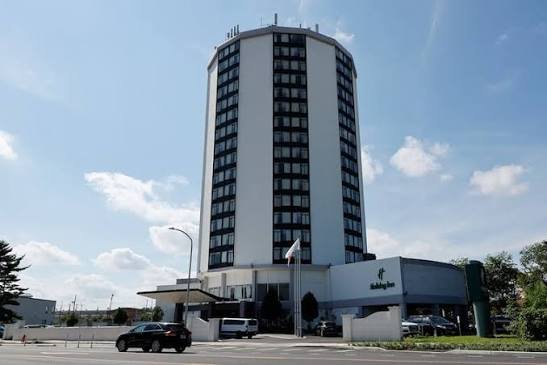

An Indian-origin father and son who built a hotel business in the United States are facing a sprawling federal civil lawsuit accusing them and their associates of obtaining more than $100 million in government-backed financing through allegedly false ownership structures, concealed financial problems and repeated refinancing.
The US government filed the 332-page complaint against Pankaj Sheth, Rajan Sheth, five other family members, 21 business entities and eight associates in the US District Court for the Eastern District of Pennsylvania on August 14. It contains 133 counts and invokes the federal False Claims Act, among other legal provisions.
The allegations stretch across nearly three decades.
Federal lawyers claim the family repeatedly moved financially distressed hotels between companies and so-called “straw owners”, allowing new borrowers to seek government-backed loans without fully disclosing links to earlier defaults, bankruptcies and judgments.
Algoritha Security Launches ‘Make in India’ Cyber Lab for Educational Institutions
New Loans Allegedly Kept Older Debts Alive
The Justice Department describes the alleged arrangement as cyclical.
According to the complaint, companies would obtain fresh financing and then use part of that money to deal with older debts, including loans nearing foreclosure. When another property ran into trouble, a new entity or purported owner could allegedly enter the picture and seek more financing.
The Philadelphia Inquirer reported that the complaint characterises the operation as a “multi-decade Ponzi scheme” in which the United States was effectively an unwitting source of financing.
That description needs context.
A traditional Ponzi scheme usually involves paying earlier investors with money collected from newer investors.
Here, prosecutors are alleging a comparable cycle involving new government-backed loans being used to sustain older obligations. It is therefore more accurate to describe it as Ponzi-like, unless a court ultimately accepts the government’s characterisation.
Rajan Sheth has denied wrongdoing, saying the family buys distressed properties and turns them around. He has maintained that there was no fraudulent scheme.
What Is a ‘Straw Owner’?
A straw owner is someone who appears on paper to own an asset or company while another person allegedly exercises the real control.
The arrangement is not automatically illegal.
But it can become fraudulent if the named owner is used to hide the real borrower, conceal financial history or obtain financing that would otherwise be unavailable.
The government alleges that hotel properties were transferred to such purported owners so lenders would not see the full relationship between new loan applicants and businesses connected with previous defaults.
Loan applications allegedly overstated management experience, included misleading personal financial information and, in some instances, contained forged signatures.
Government Says One Hotel Was Effectively Sold Back to Family
The complaint also points to a New Jersey hotel transaction that prosecutors say illustrates the alleged structure.
US authorities previously prosecuted a fraud involving the Arlington Suites property, where Pankaj Sheth owned a hotel financed partly through a Small Business Administration loan.
Trial evidence in that earlier criminal case showed that the hotel was purportedly sold to a company in another person’s name while Sheth remained the true owner. The SBA ultimately wrote off nearly $1 million of the existing loan balance.
That earlier case resulted in convictions of three other defendants involved in related loan fraud. The current civil complaint is broader and names the Sheth family and associated businesses directly.
The government also alleges that some hotels were chronically understaffed and underfunded, with properties facing building-code violations, liens and public nuisance or accessibility complaints.
What the False Claims Act Means
The False Claims Act, or FCA, is one of the US government’s main tools for recovering taxpayer money allegedly obtained through fraud.
It applies when a person knowingly submits a false claim for government money or uses false records that materially influence such a claim.
The financial consequences can be severe.
A defendant found liable can potentially be ordered to pay three times the government’s actual loss, known as treble damages, plus a civil penalty for each violation.
For 2026, the inflation-adjusted FCA penalty remains approximately $14,308 to $28,619 per violation. The older statutory figure of up to $11,000 is no longer the operative penalty level.
With 133 counts in the complaint, the potential exposure could therefore extend far beyond repayment of the underlying loans if the government proves its case.
Civil Case Does Not Mean Criminal Conviction
The current lawsuit is civil, not a criminal indictment.
That means the defendants are not facing imprisonment merely because of these allegations.
The government is seeking financial recovery, including money it says was improperly obtained, damages and statutory penalties.
The Sheths and other defendants will have the opportunity to challenge the allegations, evidence and government’s calculation of losses in court.
The filing itself is not proof of liability.
But the scale of the complaint — more than $100 million in alleged financing, dozens of defendants and 133 counts — makes it an unusually extensive examination of how government-backed lending can allegedly be manipulated through ownership structures that exist differently on paper and in practice.
What this means for you: In any loan or investment transaction, the person shown as the legal owner is not always the person exercising real control. Banks, investors and business partners should verify beneficial ownership, past defaults and related companies rather than relying only on documents presented by the borrower.
https://www.linkedin.com/company/policetechnology/
