
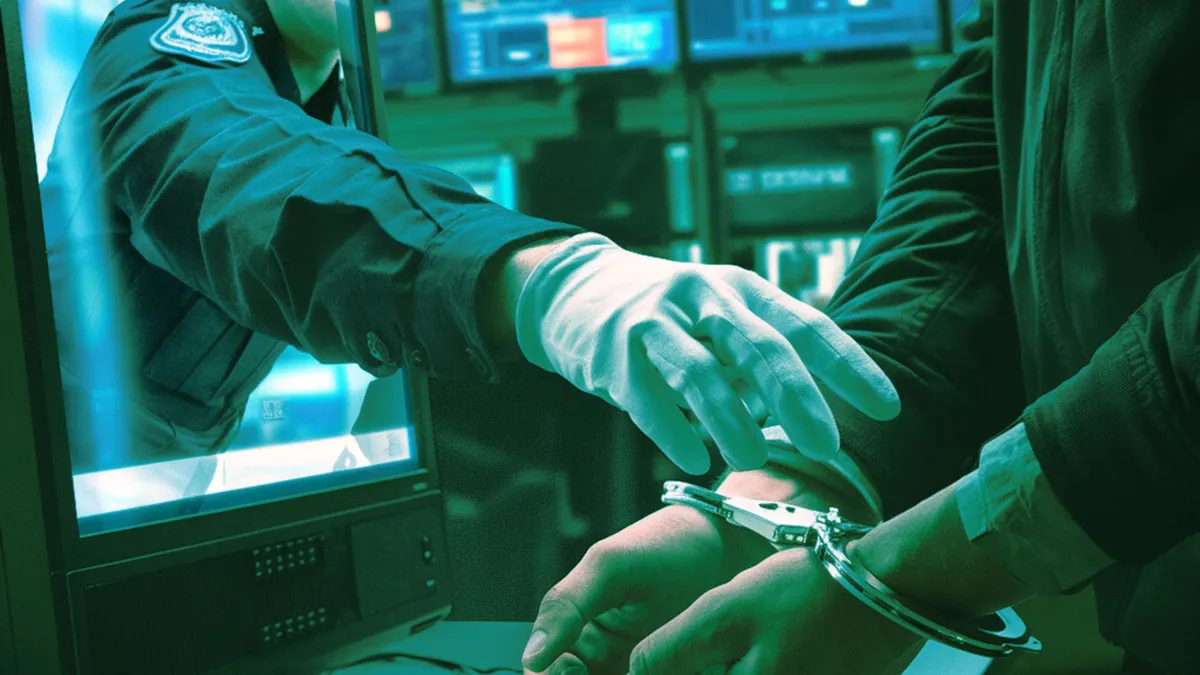

A 73-year-old retired LIC manager and his wife were allegedly kept under “digital arrest” for four days by cyber fraudsters posing as Mumbai Crime Branch officers, who claimed that his Aadhaar had been used for a ₹2 crore transaction linked to Pakistan.
The victim, a resident of Ramganga Vihar in Moradabad’s Civil Lines area, eventually broke a fixed deposit and transferred ₹27 lakh through RTGS to an account specified by the fraudsters.
According to the complaint, the scam began on August 28 when the retired officer received a call from a man claiming to be an ACP with the Mumbai Crime Branch. The caller alleged that a bank account had been opened in Mumbai using the victim’s Aadhaar number and that the account had handled ₹2 crore linked to Pakistan.
Police have registered an FIR against unidentified accused and begun tracing the bank accounts, phone numbers and digital communication used in the fraud.
Algoritha Security Launches ‘Make in India’ Cyber Lab for Educational Institutions
Fake Police Office Made the Threat Look Real
The fraudsters allegedly shifted quickly from a voice call to video.
When the victim’s phone could not connect properly, they obtained his wife’s number and continued the conversation through her device.
The couple allegedly saw men in police uniforms, files placed on desks and a background designed to resemble a Crime Branch office. The setup helped convince them that they were speaking to genuine law enforcement officers.
The Ministry of Home Affairs has warned that this is a recognised tactic.
Its advisory on digital-arrest scams says fraudsters have used studios designed to resemble police stations and government offices, along with uniforms, to make video calls appear genuine. Victims are then threatened with criminal proceedings and kept visually connected until money is transferred.
In the Moradabad case, the fraudsters allegedly demanded ₹50 lakh to settle the supposed case.
When the victim suggested asking his daughters or sons-in-law for financial help, he was reportedly told not to discuss the investigation with anyone.
That instruction was central to the deception.
What Is a ‘Digital Arrest’?
There is no lawful procedure in India called a digital arrest.
Police, CBI, RBI or other government agencies do not place a person under arrest through WhatsApp, Skype or another video-calling platform and then demand money to avoid prosecution.
The term describes a fraud technique where criminals convince a victim that they are under official surveillance or investigation and must remain connected to a video call.
The victim is isolated from family, friends and genuine police while being threatened with arrest, freezing of accounts or prosecution for crimes such as money laundering, drug trafficking or terrorism.
I4C has specifically warned that fraudsters commonly impersonate police, CBI, RBI and narcotics officials and use intimidation and blackmail to extract money.
The objective is psychological control.
Once a victim believes that disconnecting the call itself could be treated as disobedience, the fraudster no longer needs any real legal authority.
₹27 Lakh FD Broken and Sent Through RTGS
The victim allegedly told the callers that he had money in a fixed deposit.
The fraudsters then instructed him to visit the bank while keeping his phone switched on and concealed in his pocket so that they could continue monitoring him.
He reportedly went to a Bank of Maharashtra branch in Ramganga Vihar and broke a fixed deposit worth ₹27 lakh. The amount was then sent by RTGS to the account provided by the accused. The district administration lists a Bank of Maharashtra branch in Ram Ganga Vihar.
RTGS, or Real Time Gross Settlement, is a banking system used for high-value transfers.
Unlike a wallet payment, the money moves directly through the banking system from one account to another. That makes the recipient bank account an important part of the police trail.
Investigators can seek transaction records, account-opening documents and downstream transfers to determine where the ₹27 lakh moved after reaching the first account.
Phone Failure Finally Broke the Fraudsters’ Control
The deception continued even after the payment.
According to the complaint, the couple remained convinced that they were under official monitoring and could face arrest if they ignored instructions.
The situation changed when the victim’s phone stopped functioning.
He then contacted his daughter and son-in-law, who lived nearby. Genuine police personnel subsequently reached the house.
The fraudsters reportedly called again while police were present and continued behaving as though they were legitimate officers before eventually disconnecting.
The confrontation highlights how strongly such scams depend on keeping victims isolated.
The moment an outside person independently checks the claim, the entire story often collapses.
Another Moradabad Victim Lost ₹14.41 Lakh Days Earlier
The case follows another major digital-arrest fraud reported in Moradabad only days earlier.
The widow of a retired deputy superintendent of police was allegedly kept under pressure for three days after fraudsters claimed her account had been used for money laundering.
She transferred ₹5 lakh and later broke a fixed deposit worth ₹9.41 lakh, taking her total alleged loss to ₹14.41 lakh. Reports said the money was routed through 11 bank accounts across Delhi, West Bengal and Rajasthan.
That repetition matters.
Both cases involved elderly victims, police impersonation, video calls, money-laundering allegations and pressure to break fixed deposits.
The Union Government has been trying to disrupt these networks on a larger scale. By March 2025, I4C had blocked more than 3,962 Skype IDs and 83,668 WhatsApp accounts associated with digital-arrest scams, according to information provided to Parliament.
The National Human Rights Commission also held a dedicated discussion on digital-arrest frauds in June 2026, noting that cybercriminals increasingly exploit leaked personal information to make threats more convincing.
For Moradabad Police, the immediate task is now to follow the ₹27 lakh.
The recipient account, subsequent transfers, KYC documents, mobile numbers and video-call infrastructure could reveal whether the accused are part of a wider interstate or cross-border network.
What this means for you: No police officer, CBI official or court will demand money through a video call to cancel an arrest. Disconnect immediately, contact family, and report the number to 1930 or the National Cyber Crime Reporting Portal before transferring any money.
https://www.linkedin.com/company/policetechnology/
