

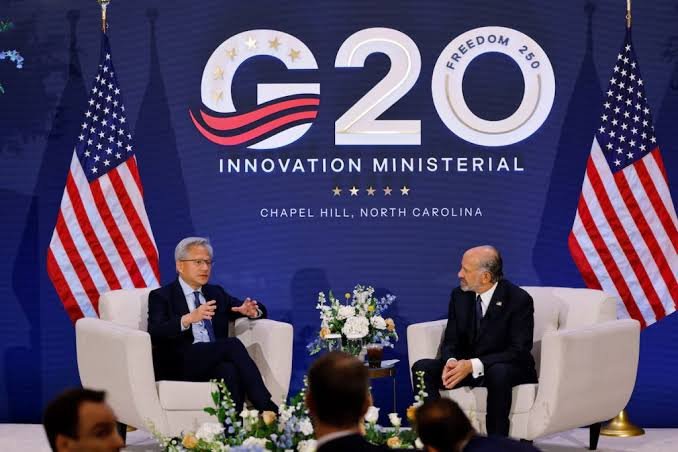

India has joined a new G20 consensus that calls for governments to encourage artificial intelligence and emerging technologies through flexible regulation, stronger research investment, skilled workforces and more resilient technology supply chains.
The agreement was reached at the G20 Innovation Ministerial in Chapel Hill, North Carolina, on September 2. The United States, which holds the G20 presidency in 2026, hosted the meeting through its Department of Commerce and White House Office of Science and Technology Policy.
At the centre of the agreement are the Carolina Principles for Emerging Technologies, a policy framework backed by G20 ministers.
The principles argue that emerging technologies can increase productivity, create jobs and improve living standards, but governments should avoid regulatory approaches that unnecessarily slow their development or deployment.
Union Minister Jitin Prasada represented India at the ministerial and presented the country’s approach towards pro-innovation policy and technology-led inclusive growth.
Algoritha Security Launches ‘Make in India’ Cyber Lab for Educational Institutions
What the G20 Has Actually Agreed To
The consensus rests on six broad areas.
These include pro-innovation regulation, using technology to expand economic opportunity, developing skilled technical workers, creating intellectual-property rules suited to AI, using AI in standards-setting and strengthening industrial innovation and critical technology supply chains.
The final ministerial statement says governments should consider sector-specific and risk-based regulation where appropriate.
In simple terms, that means governments should not necessarily regulate every AI system in exactly the same way.
An AI tool recommending songs, for example, may not need the same level of scrutiny as one deciding whether a person receives medical treatment or access to financial services.
The framework also places considerable emphasis on private investment and commercialisation.
G20 governments said they want research discoveries to move more quickly from laboratories into businesses and real-world products. The statement also calls for policies that provide greater regulatory certainty to companies developing new technologies.
US Commerce Secretary Howard Lutnick described the agreement as a way of giving entrepreneurs confidence to invest while supporting domestic manufacturing and protecting intellectual property.
What Are the Carolina Principles, AI Standards and Interoperability?
The Carolina Principles are not a new international law.
They are a set of common policy principles that G20 members have agreed should guide how governments support and govern emerging technologies.
Individual countries remain free to create their own laws and regulations.
Another important phrase in the agreement is AI standards.
Standards are common technical rules that help different technologies work safely and consistently. A simple example is USB: devices made by different companies can connect because they follow common specifications.
For AI, standards can cover areas such as testing, reliability, safety, cybersecurity and how systems exchange information.
Interoperability means different systems can communicate and work together rather than remaining locked inside isolated platforms.
The ministerial also discussed using AI itself to help create and improve technical standards, while simultaneously establishing standards governing AI. South Korea’s industry ministry confirmed that these were among the principal areas debated by participating countries.
India’s Position Fits Its Wider AI Strategy
India joining the consensus is significant because New Delhi has repeatedly argued for an approach that encourages AI development while addressing identifiable risks.
India’s current policy direction has focused on building domestic computing infrastructure, supporting local AI models, developing skills and expanding affordable access to artificial intelligence.
At the India AI Impact Summit earlier this year, Electronics and IT Minister Ashwini Vaishnaw said India was working across the entire AI technology stack while also seeking collective solutions to risks involving safety and human dignity.
Prime Minister Narendra Modi made a similar argument at the G20 Summit in November 2025, calling for AI development that was human-centric, widely accessible and responsibly deployed.
The Carolina framework is therefore broadly compatible with India’s position: encourage innovation first, but apply stronger safeguards where risks justify them.
That approach differs from systems built primarily around broad upfront restrictions.
The G20 statement specifically encourages governments to remove unnecessary regulatory barriers, including overly burdensome permitting requirements and certain data-localisation mandates, while still respecting privacy and existing laws.
For India, that language could become important as policymakers continue debating rules around AI, cross-border data, cloud infrastructure and domestic technology companies.
AI Skills and Supply Chains Become Global Priorities
The meeting also produced the AI Prosperity Objectives and an AI Prosperity Compact.
According to the ministerial announcement, these initiatives are intended to expand technical workforce development and strengthen cooperation with private industry.
That reflects a growing concern among governments: access to AI is no longer determined only by software.
Countries increasingly need advanced chips, data centres, reliable energy supplies, trained engineers and secure supply chains.
The consensus statement therefore calls for stronger and more diverse manufacturing capacity in strategically important sectors. It also identifies secure digital infrastructure as a core element of industrial resilience.
This matters particularly for India, which is simultaneously trying to expand semiconductor manufacturing, AI computing capacity and domestic technology development.
India has also been pushing internationally for greater participation by developing countries in emerging technology governance.
During its 2023 G20 presidency, New Delhi secured consensus around Digital Public Infrastructure and promoted mechanisms to help developing economies build digital systems at scale.
The 2026 agreement shifts the conversation further towards AI, intellectual property and industrial competitiveness.
It also shows how rapidly artificial intelligence has moved from being mainly a technology-sector issue to becoming a major subject of economic diplomacy.
G20 countries are now debating not only how AI should be made safer, but who will build it, who owns the underlying intellectual property, where the chips come from and whether national regulations will allow companies to deploy it quickly.
For India, joining the Carolina Principles puts it inside that emerging global rule-making process.
The challenge will be ensuring that a push for faster innovation does not weaken safeguards involving privacy, cybersecurity, consumer protection or accountability when AI systems cause harm.
What this means for you: The G20 agreement will not immediately change how you use AI, but it could influence future Indian rules on AI products, data, jobs and digital services. The larger direction is clear: governments want faster AI adoption, but the debate over where stronger safeguards are needed is far from settled.
https://www.linkedin.com/company/policetechnology/
