

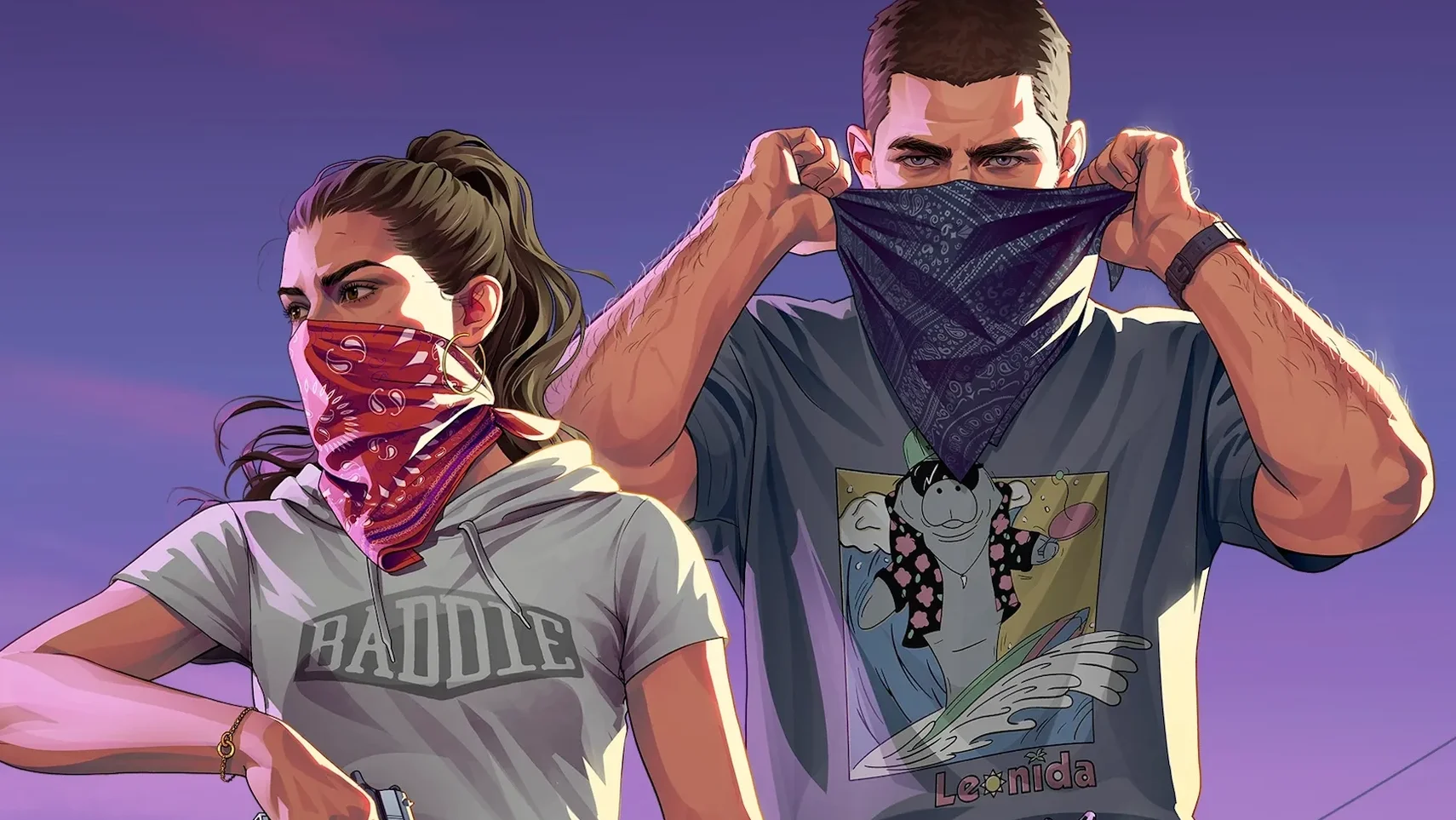
When fragments of Grand Theft Auto VI began spilling onto the internet this week — gameplay clips, glimpses of the sprawling Leonida map and footage suggesting that someone may have access to a playable development build — Rockstar Games responded in the way large entertainment companies increasingly do when their most valuable secrets escape: with silence in public and copyright notices behind the scenes.
The leaks began circulating on August 18 under the watermark CyberLeek, an anonymous individual or group that has since portrayed the breach as a protest against what it calls anti-consumer practices in the gaming industry. Rockstar and its parent, Take-Two Interactive, have not publicly authenticated the material or explained how it was obtained, but repeated copyright takedowns have added weight to assessments that at least some of the footage is genuine.
Then the financial markets reacted. Take-Two shares, which traded around $248 on August 18, fell sharply over the following two days. One calculation based on the company’s share price put the resulting reduction in market capitalisation at approximately $2.83 billion at one point during the sell-off. That does not mean Take-Two literally lost $2.83 billion in cash, nor can the entire share-price movement be conclusively attributed to the leak. But the timing illustrated something investors already understand: GTA 6 is not simply another game in Take-Two’s catalogue. It is one of the most commercially consequential entertainment launches in the world.
And amid the speculation over where such closely guarded material could have come from, India has unexpectedly entered the story. Not because investigators have established that CyberLeek is Indian — they have not. Nor has Rockstar said that its Bengaluru operation was breached. The India connection is more fundamental: Rockstar India has become an important part of the company’s global production machine, underscoring how the security of a blockbuster like GTA 6 is now inseparable from a vast international development network.
Bengaluru Is No Longer a Peripheral Outpost in Rockstar’s World
Rockstar Games established Rockstar India in Bengaluru in 2016, and its Indian presence expanded considerably in 2019 when Take-Two acquired Dhruva Interactive, one of India’s oldest game-development studios, and folded its roughly 300 employees into Rockstar’s Bengaluru operation.
The studio has since worked across game development, art, animation, quality assurance and online services. Rockstar India employees appeared extensively in the credits for Red Dead Redemption 2, one of the company’s most technically ambitious releases.
Industry reporting has suggested that the Indian operation has grown considerably for GTA 6. One recent account, citing information discussed by gaming-industry interviewer Reece Reilly, estimated that around 1,600 people in India may be contributing to the game. Rockstar has not publicly confirmed that figure, so it should be treated as an industry estimate rather than an official headcount. That scale helps explain why India surfaced so quickly in online discussions surrounding the leak.
Modern AAA games are not developed by a few dozen people working in one secure building. They are enormous distributed software projects involving programmers, environment artists, animators, testers, producers, online-services teams and external partners operating across multiple countries. That production model makes games possible at a scale unimaginable two decades ago. It also creates an immense cybersecurity problem.
Every developer account, testing machine, build server, contractor credential and remotely accessible system becomes part of the security perimeter. The problem resembles the one confronting multinational banks or technology companies: the organisation is only as secure as the sprawling network through which sensitive information must legitimately travel every day. That does not mean Rockstar India caused the latest breach. No credible public evidence currently establishes that.
But social-media speculation has included unverified claims that a development build may have passed through an India-linked employee or testing environment. Those claims have not been substantiated by Rockstar, Take-Two or law enforcement and remain rumours. The documented India connection is Rockstar’s increasingly significant Bengaluru development operation — not a proven Indian source for CyberLeek’s material. That distinction matters, particularly when an anonymous leak produces an information vacuum that internet communities quickly fill with theories.
CyberLeek Appears to Have More Than a Few Stolen Videos
What makes the latest incident particularly uncomfortable for Rockstar is the nature of the footage.
Initial clips showed GTA 6 protagonist Jason Duval performing relatively ordinary actions: playing basketball near a coastal home, driving through the game world and becoming involved in street violence. The images appeared to expose elements of the user interface and gameplay systems that Rockstar had not yet formally demonstrated.
More footage followed. One video reportedly showed the character firing bullets into a wall to spell out “LEEK” — an apparent attempt by the leaker to prove that the material was not simply a collection of prerecorded clips obtained months ago.
The episode immediately fuelled speculation that CyberLeek might possess direct access to a playable development build. That has not been independently confirmed, and the age of the material remains uncertain. Some observers believe the footage comes from an older build rather than the version currently approaching release.
CyberLeek has meanwhile wrapped the leaks in an unusual mixture of digital-rights activism and cryptocurrency promotion. Its manifesto attacks digital pre-orders, downloadable-content practices and the disappearance of permanent offline access to games. The group has threatened further action unless companies alter those practices and issue apologies.
But CyberLeek has also promoted a Solana-based token connected to its campaign, raising obvious questions about whether the ideological language is being used to drive attention toward a speculative cryptocurrency. That combination has attracted criticism even from organisations broadly sympathetic to game-preservation campaigns.
The Stop Killing Games movement publicly distanced itself from CyberLeek, arguing that illegal methods undermine legitimate campaigns for consumer and preservation rights. Rockstar has so far avoided a prolonged public confrontation with the leaker. Its strategy has instead appeared focused on removing leaked footage wherever possible.
That is particularly important because the leak arrived only days before Rockstar’s scheduled August 27 extended presentation of GTA 6, a carefully planned marketing moment that was supposed to offer players a controlled look at the game before its November 19 launch. For a company as secretive about unfinished work as Rockstar, losing control of that reveal carries a value that is difficult to measure purely in dollars.
The Real Damage Goes Beyond a $2.8 Billion Market-Cap Swing
Take-Two’s share-price decline generated the most dramatic number attached to the episode. According to market data cited by gaming publications, Take-Two traded around $248.13 on August 18 before falling to roughly $232.84 during subsequent trading. On that basis, one estimate placed the reduction in the company’s market capitalisation at about $2.83 billion.
Another analysis, using a narrower trading window, calculated a roughly $980 million reduction in market value. The difference demonstrates why claims that the hacker “cost Take-Two $2.5 billion” should be treated carefully: market capitalisation changes continuously, and share prices move for many reasons.
Take-Two had already experienced volatility before the leaks. Earlier in August, investors were reacting to its earnings outlook and bookings forecasts, even as exceptionally strong GTA 6 pre-orders supported longer-term optimism around the company. It is therefore impossible to say that every dollar erased from Take-Two’s market capitalisation was caused by CyberLeek.
What can be said is that the decline occurred almost immediately after the leak began dominating gaming news, and that the company controlling the world’s most anticipated video game suddenly found itself confronting a fresh cybersecurity problem months before launch. The more lasting costs may be less visible.
Rockstar must determine where the footage originated. Security teams may need to audit credentials, development machines, testing infrastructure and external access. Employees may need to change workflows. Legal teams must pursue copies distributed across platforms. Marketing teams must decide whether leaked information changes the timing or content of official announcements.
And developers must watch unfinished work — sometimes created years earlier and never intended for public scrutiny — become a global product review before they have finished the product.
Rockstar has been here before. In 2022, a member of the Lapsus$ hacking group penetrated Rockstar’s systems and released approximately 90 videos from an early GTA 6 development build. During subsequent proceedings, Rockstar said the breach had cost it approximately $5 million in recovery expenses and thousands of hours of staff time.
The new episode is different in both timing and apparent motivation. GTA 6 is now much closer to release, consumer expectations are extraordinary and Take-Two’s financial outlook is unusually intertwined with the game’s success.
That is also why the India connection deserves attention without being exaggerated. Bengaluru’s role in Rockstar’s development network is evidence of how far India’s game-development industry has moved into the global mainstream. An Indian studio is no longer merely providing peripheral outsourcing for a Western blockbuster; it is reportedly embedded deeply in the production ecosystem of one of the biggest entertainment properties ever created.
That is a significant technology story. It is also a cybersecurity story.
When a product is built by a global workforce, protecting it becomes a global responsibility. Sensitive builds may have to move among studios. Employees need legitimate access. Testing environments have to operate before launch. Vendors and developers need to collaborate without exposing valuable intellectual property.
GTA 6 may ultimately demonstrate both sides of that globalisation: the extraordinary creative capacity made possible by distributed development — and the extraordinary difficulty of keeping the world’s most anticipated game secret until the company itself decides to show it.
For now, CyberLeek’s identity and the precise path through which the material escaped remain unknown.
The Bengaluru connection is real. A Bengaluru breach, at least on the evidence currently available, is not.
