

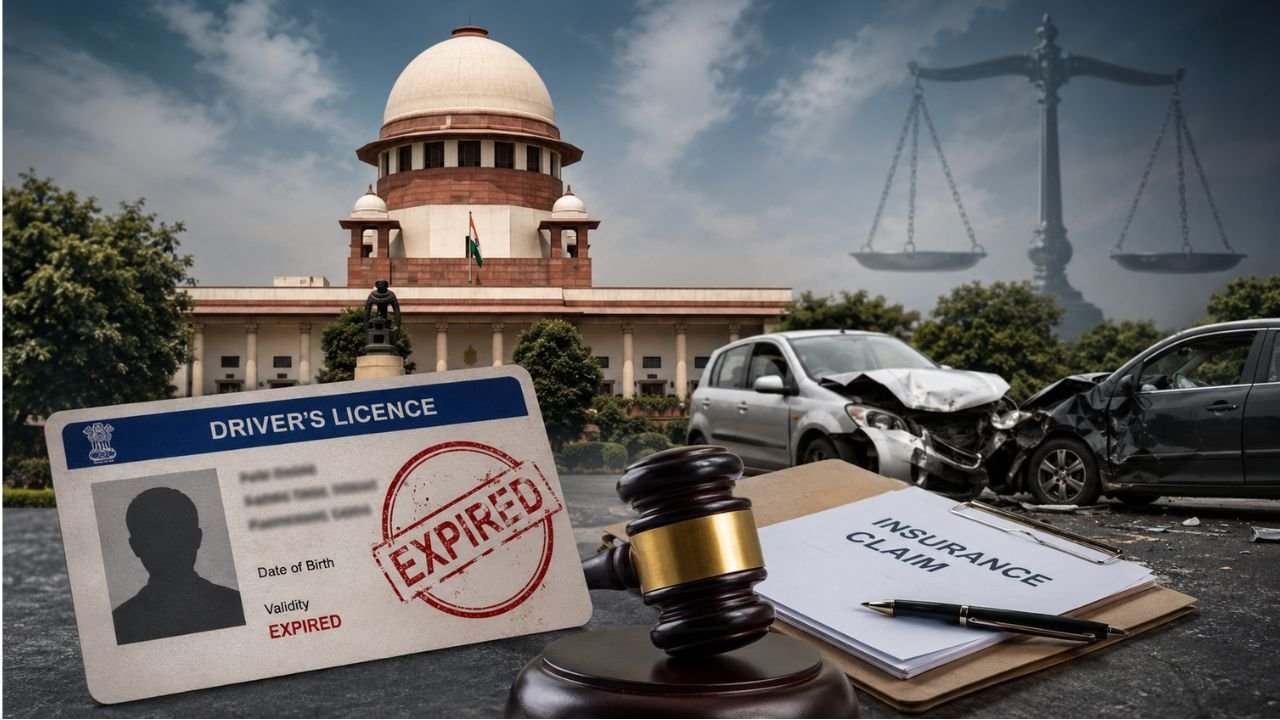

New Delhi: The Supreme Court has delivered a significant ruling on the liability of insurance companies in road accident compensation cases. The court clarified that if a vehicle driver did not possess a valid driving license at the time of an accident or failed to renew the license on time, the insurance company cannot be held ultimately responsible for paying the compensation. The Supreme Court observed that driving without a valid license is a violation of the Motor Vehicles law, and in such cases, the responsibility lies with the vehicle owner and driver.
A bench comprising Justice Sanjay Karol and Justice N. Kotiswar Singh, while delivering the judgment, said that it is the primary responsibility of a vehicle operator to ensure possession of a valid driving license. The court stated that a driving license is not merely a document but an important legal requirement linked to the driver’s eligibility and road safety.
The case was related to a road accident that took place in 2009. In the accident, a vehicle driven by a person named Om Prakash collided with a two-wheeler. Following the accident, the affected party filed a compensation claim before the Motor Accident Claims Tribunal (MACT).
During the proceedings, it was found that the driver’s license was not valid at the time of the accident. The license had expired and was renewed after a considerable delay. Based on this fact, the Motor Accident Claims Tribunal had relieved the insurance company of the final liability for compensation.
The matter later reached the Punjab and Haryana High Court. The High Court had directed the insurance company to pay compensation of around ₹1.08 crore based on a letter from an official regarding missing license records. The insurance company challenged the High Court’s order before the Supreme Court.
The Supreme Court overturned the High Court’s decision and observed that an insurance company cannot be held responsible merely because license records were unavailable or documents were missing. The bench said that determining whether the driver possessed a valid license at the time of the accident is crucial, as it directly affects the terms of the insurance contract and legal liability.
However, keeping the interests of accident victims in mind, the Supreme Court applied the ‘Pay and Recover’ principle. The court directed that the insurance company would first pay the compensation amount to the victims, but it would have the right to recover the amount later from the vehicle owner and the driver.
The court said that the purpose of this arrangement is to ensure immediate relief to accident victims so that they do not remain trapped in prolonged legal proceedings for receiving compensation. At the same time, the judgment sends a clear message that vehicle owners and drivers cannot escape responsibility for violating legal requirements.
The Supreme Court also expressed concern over road safety and suggested that the Ministry of Road Transport and Highways and transport departments of all states should conduct awareness campaigns regarding valid driving licenses, traffic rules, and safe driving practices. The court emphasized that public awareness is essential to reduce road accidents.
The bench observed that merely framing rules is not enough to control road accidents; strict compliance is equally important. Driving without a valid license not only puts the driver at risk but also endangers the lives of other road users.
The Supreme Court’s decision is considered significant for pending motor accident compensation cases across the country. The ruling makes it clear that while deciding insurance liability in accident cases, factors such as the validity of the driver’s license, negligence of the vehicle owner, and insurance policy conditions must be carefully examined.
The judgment provides relief to insurance companies by limiting their final liability in cases involving invalid licenses while also ensuring that accident victims continue to receive compensation through the ‘Pay and Recover’ mechanism.
About the author — Suvedita Nath is a science student with a growing interest in cybercrime and digital safety. She writes on online activity, cyber threats, and technology-driven risks. Her work focuses on clarity, accuracy, and public awareness.
