
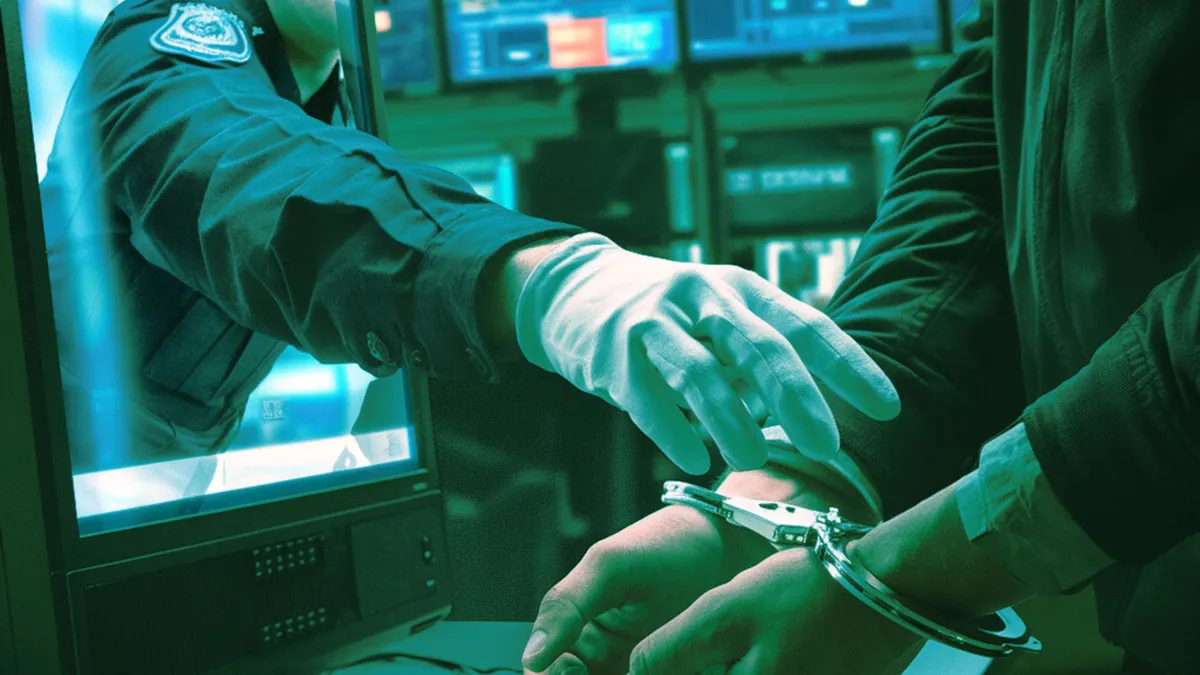

Police in Etah district have arrested two alleged mule account holders in connection with a ₹8 lakh digital arrest scam targeting a Hyderabad resident. Investigators say cyber fraudsters impersonated CBI officers, placed the victim under a fake digital arrest, and coerced him into transferring ₹8 lakh to multiple bank accounts under the pretext of an official investigation, while the two arrested accused allegedly withdrew and routed the fraud proceeds through mule accounts. The mastermind behind the racket remains absconding.
How the Arrests Were Made
The arrested accused have been identified as Nitesh Babu and Shobhit Chauhan, both produced before a court and remanded to judicial custody. Police recovered ₹40,000 in cash, a mobile phone, a bank Insta Kit and an ATM card from their possession, with preliminary investigation finding the pair had acted as mule account operators facilitating withdrawal and movement of the fraud proceeds.
The arrests came under Operation CY Vajra, Uttar Pradesh Police’s statewide anti-cybercrime campaign. Acting on a District Intelligence Pack from Cyber Headquarters, investigators analysed suspicious mule accounts and complaints registered on the National Cyber Crime Reporting Portal, eventually surfacing a complaint from a Hyderabad resident who alleged fraudsters posing as CBI officials had placed him under a fake digital arrest through video call and intimidated him into transferring ₹8 lakh. Police examined bank transaction records, KYC documents and branch details while tracking the money trail, using CCTV footage and electronic surveillance to identify the suspects before arresting both near the Government College at Tarigaon in Etah district.
A Scam Format Now Familiar Across India
The Etah case fits a template that has become depressingly consistent nationwide. In one Delhi case, a retired government officer was kept under so-called virtual custody for three days after fraudsters posing as TRAI, then CBI, then Mumbai Police and even a Supreme Court judge convinced him his Aadhaar was linked to a money laundering case, ultimately extracting ₹48.5 lakh through simulated court proceedings conducted entirely over WhatsApp video. In another, Delhi Police arrested four people after a Mayur Vihar resident was coerced into transferring ₹44.50 lakh, with the money trail leading investigators from a Jaipur bank account through a chain of associates to an alleged mastermind.
The CBI has treated digital arrest as enough of a systemic threat to launch dedicated national operations against it, including Operation Chakra-V, under which the agency searched 42 locations across eight states and arrested five people connected to SIM card fraud feeding digital arrest networks, and a more recent coordinated search spanning 16 states specifically targeting shell companies and mule accounts used to launder digital arrest proceeds. That national scale mirrors what Etah investigators are now finding locally: mule accounts opened by ordinary local residents, often for a small fee, becoming the critical link connecting a fraud victim in one state to a fraud network potentially spread across many others.
What Happens Next
During interrogation, investigators obtained several leads regarding the wider network, and are now examining whether the two accused’s bank accounts were used in other cybercrime cases reported elsewhere in the country. Cybersecurity experts note that digital arrest scams typically involve fraudsters impersonating officials from the CBI, police, Enforcement Directorate, Income Tax Department or other agencies, threatening victims with allegations of money laundering, suspicious parcels or narcotics offences while keeping them on prolonged video calls until they transfer money.
According to the Future Crime Research Foundation, digital arrest is entirely a fabricated cyber fraud tactic; no government agency conducts investigations by placing individuals under digital arrest through video calls or directs citizens to transfer money for verification purposes. Anyone receiving such calls should immediately report the incident to the National Cyber Crime Helpline at 1930 or file a complaint through the National Cyber Crime Reporting Portal. Police said the investigation continues, with efforts underway to trace the mastermind and other members of the racket while authorities examine the complete mule account network to uncover the full extent of the operation.
Follow for daily updates on cybercrime, corporate fraud, DFIR, hacking, investigations, and digital forensics
