
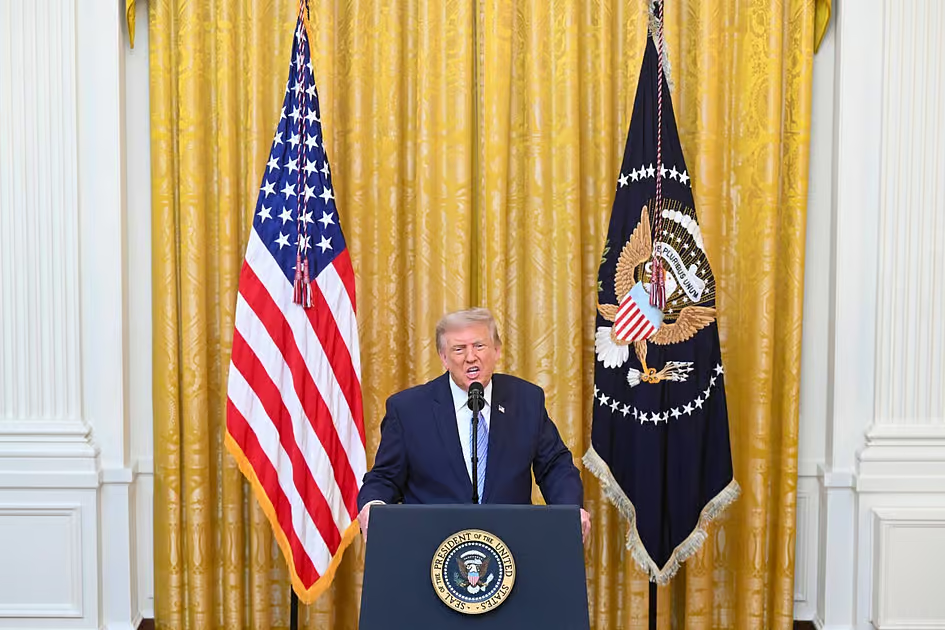

U.S. President Donald Trump has revived his long-running attacks on the security of the 2020 presidential election, using a 25-minute primetime address from the White House to allege that China illicitly obtained voter data belonging to roughly 220 million Americans. He announced the immediate declassification of intelligence documents he said would prove the claim, calling it “the largest compromise of election data in history.”
What Trump Alleged
Trump said the operation began during the 2020 election cycle and involved voter registration files from 18 states, encompassing names, addresses, phone numbers, political party affiliations, voting history and, according to some reports, military status. He said Beijing had assigned a dedicated “data exploitation unit” to analyse the material, calling the breach “an unprecedented election security nightmare.”
He went further, alleging that U.S. intelligence officials had known about the activity for years but had “actively suppressed and downplayed” it, keeping the information from him as president, from Congress, and from the public. He said he had directed the Office of the Director of National Intelligence, the Department of Justice, the FBI and the CIA to investigate why the information was withheld, and warned that officials found responsible could face administrative or criminal consequences.
What the Documents Actually Show
Independent review of the released files by several U.S. news organisations found the picture more complicated than Trump’s framing suggested. One CIA document cited by the White House concerned alleged election manipulation in Venezuela rather than the United States. Another document, addressing the security of American vote-counting systems, concluded the opposite of what Trump claimed, stating that vote tabulation systems would be difficult to manipulate on a wide enough scale to alter results.
Analysts also noted that voter registration data of the kind described is routinely available commercially, and several states, including North Carolina, publish portions of it online; obtaining such records is not by itself evidence of vote manipulation or interference with an election outcome. The documents reportedly provide more granular detail about Chinese data-collection activity than was previously public, and reveal internal disagreement within the intelligence community over how to characterise Beijing’s conduct, but they do not appear to overturn the community’s earlier, bipartisan conclusion that no foreign adversary altered the outcome of the 2020 election.
A Familiar Dispute, Freshly Fuelled
Trump lost the 2020 election to Joe Biden, and has disputed its legitimacy ever since despite more than 60 post-election lawsuits, multiple recounts, and independent audits finding no evidence of fraud capable of changing the result. Democratic lawmakers dismissed Thursday’s claims in similar terms. Senator Mark Warner, the top Democrat on the Senate Intelligence Committee, said it was “laughable” to equate access to voter files with election interference, and noted Trump’s address made no mention of Russia, which U.S. intelligence agencies have identified as the more active foreign influence actor. The Chinese Embassy in Washington denied any involvement in efforts to interfere in American elections.
The timing is notable: the address comes months ahead of the November midterms, in which Trump’s Republican Party will be defending its congressional majorities. Trump has been pressing fellow Republicans to pass legislation imposing new voter identification and citizenship requirements, despite longstanding findings that voter fraud in U.S. elections is rare, and has made such legislation a top priority.
Why This Matters Beyond Washington
For India, the episode is a reminder of how election-security narratives, even contested ones, can shape domestic political debate well before hard evidence is examined. Political analysts say the credibility of Trump’s specific claims will ultimately hinge on independent scrutiny of the declassified files themselves, several of which have already drawn scrutiny for containing material unrelated to the claim they were meant to support. Until such review is complete, the allegations remain, as several experts have stressed, unverified assertions rather than established fact.
Follow for daily updates on cybercrime, corporate fraud, DFIR, hacking, investigations, and digital forensics
