

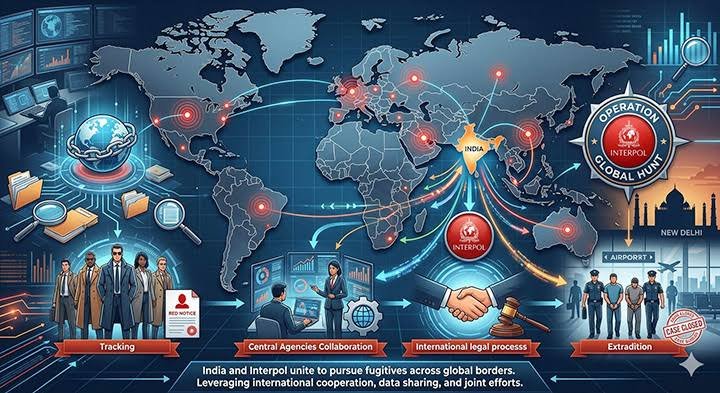
In the largest coordinated multi-agency sweep targeting external threats, Indian federal enforcement commands have scaled up a high-intensity transnational containment matrix labeled ‘Operation Global Hunt.’ Working through unified intelligence channels, the Delhi Police Special Cell, the National Investigation Agency (NIA), and the Central Bureau of Investigation (CBI) have integrated domestic databases with international policing networks. The massive strategic offensive aims to completely neutralize the operational infrastructure of sovereign-threat networks, organized extortion rings, and terror cartels running cross-border crime matrices against the Indian state from safe havens overseas.
Registration Begins for FutureCrime Summit 2026, India’s Largest Cybercrime Conference
The Transnational Command Nodes and the Global Extortion Play
The baseline investigation highlights a highly resilient operational pattern where primary cartel leaders exploit geographical distances to manage local street syndicates. Operating from logistics nodes scattered across Canada, the United States, the United Arab Emirates, Malaysia, and Pakistan, these high-profile fugitives deploy digital proxies to run local operations.
The underlying terror-crime network manages its hostile campaigns through three continuous operational loops:
The operators initiate the exploit by using encrypted voice-over-IP software and dark web message boards to pass down target dossiers to localized shooters, executing high-profile political assassinations and merchant contract killings.
The secondary positioning loop launches as the overseas handlers leverage their local violent reputation to run parallel extortion networks, forcing tier-1 builders, tech entrepreneurs, and wealthy doctors to clear massive protection payoffs.
The final extraction loop concludes as the ring systematically channels the extorted capital into international narcotics smuggling routes and shadow money laundering pipelines, converting the cash into untraceable assets before it can be flagged by automated central bank systems.
Multi-Agency Interpol Coordination and Biometric Border Controls
The sudden acceleration of the global fugitive dragnet follows the massive integration of domestic criminal files into Interpol’s real-time international tracking registry. To block the suspects’ ability to navigate international borders under fake identities, federal investigators have secured the activation of nearly 180 Red Corner Notices (RCNs) against top-tier terror and gang masterminds. Furthermore, over 110 Blue Corner Notices have been circulated to global airport immigration centers, establishing an early-warning filter to trap proxy passports and synthetic travel credentials used by the fugitives.
The global security net proved highly effective as international customs desks began cross-referencing biometric logs against the newly updated Indian watchlists. The RCN framework functions as a universal detention request, instructing member countries to immediately seize and isolate target individuals pending formal diplomatic extradition trials. State anti-terror commands are working closely with consular attachés to expedite the legal processing timelines, ensuring captured fugitives are rapidly repatriated to face absolute structural prosecution inside high-security domestic courts.
Systematic Asset Seizures and Financial Infrastructure Chokepoints
A key strategic objective of Operation Global Hunt is the complete destruction of the financial scaffolding that enables transnational crime networks to function. Realizing that field syndicates quickly break down when their cash flows dry up, forensic financial tracking squads have executed sweeping account freezes, completely locking down more than 2,500 suspicious bank nodes across multiple states.
Simultaneously, enforcement directorates have enforced strict asset attachment mandates against valuable real estate holdings tied to prominent crime figures. Heavy property seizures have targeted luxury residences and commercial plots linked to key operational commanders of the Lawrence Bishnoi gang, alongside extensive historical real estate holdings tied to the Dawood Ibrahim and Iqbal Mirchi networks. In parallel anti-terror operations, enforcement teams have locked down prime land parcels and infrastructure assets associated with Gurpatwant Singh Pannun, Arsh Dalla, and active Hizbul Mujahideen networks, permanently stripping the cartels of the economic foundations used to fund local subversion.
Zero-Trust Border Security and Public Registry Overhauls
The massive scale of this global counter-terror dragnet has pushed international security panels and threat researchers at the Future Crime Research Foundation (FCRF) to demand an immediate structural upgrade to passport issuance and financial tracking systems. Security experts emphasize that allowing unverified freelance visa brokers and shadow identity networks to operate enables cross-border syndicates to routinely move cash and personnel without triggering automated security flags.
To permanently insulate national transportation hubs and financial sectors from transnational syndicates, apex security councils are advising a total transition to zero-trust border control architectures. Future security frameworks will mandate the absolute integration of end-to-end cryptographic passport tracking linked directly to international biometric registries, ensuring no travel documents or high-value international bank transfers can clear validation gates unless the origin signature undergoes continuous digital verification. Indian federal authorities maintain that the multi-agency dragnet under Operation Global Hunt will remain fully active until the logistical and financial networks of every listed fugitive are completely dismantled.
