
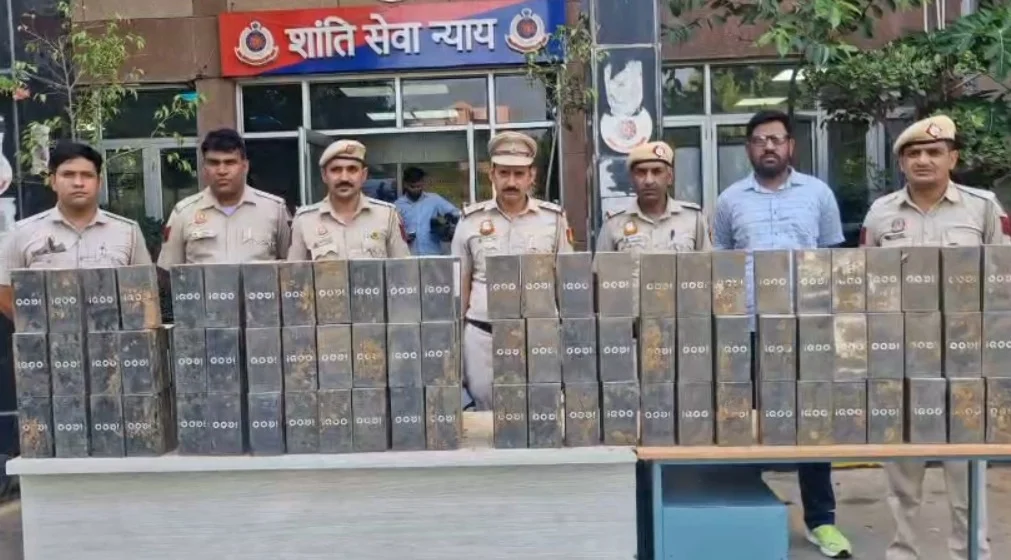

Delhi Police have uncovered an alleged theft of a large consignment of mobile phones being transported for Amazon deliveries, arresting three accused in connection with the case. According to investigators, the accused, in alleged collusion with the truck driver, diverted nearly 1,500 mobile phones while the shipment was in transit, with police recovering 604 of the devices, valued at approximately ₹1.5 crore. Efforts are continuing to trace the truck driver and other suspects allegedly involved in the conspiracy.
The case originated on June 20, when a warehouse manager lodged a complaint at Dwarka Sector-23 Police Station stating that approximately 4,500 mobile phones had been loaded onto a truck at an Amazon warehouse in Gurugram for delivery. Investigators allege the truck driver conspired with associates to divert around 1,500 of those phones during transit, before abandoning the remaining shipment and fleeing the scene, a pattern consistent with an insider using legitimate access to enable the theft rather than an external hijacking.
Two Hundred Cameras and a Trail That Led Across State Lines
What makes this case notable is the scale of the forensic effort behind the arrests. Investigators analysed footage from more than 200 CCTV cameras installed along the suspected transportation route, using technical analysis to identify a pickup vehicle allegedly used to move the stolen phones onward from the original truck. That trail led to an unexpected discovery: police in Uttar Pradesh’s Knowledge Park area had already intercepted the same pickup vehicle independently, arresting three suspects and recovering some of the stolen phones before Dwarka Police had even connected the dots to their own case.
Following this development, Dwarka Police obtained production warrants from the court and took custody of the three accused, identified as Pankaj and Anand, both residents of Etah district in Uttar Pradesh, and Mohit, a resident of Hathras district, for further interrogation. Based on information allegedly provided during questioning, police conducted a search operation at an orchard in Bhighepur village, Bulandshahr district, recovering 604 mobile phones allegedly concealed at the location. Police are now working to verify that the recovered devices were indeed part of the stolen consignment, while investigators separately examine whether the three arrested individuals were involved in similar past offences involving stolen mobile phone consignments in other states.
An Insider Problem That Extends Well Beyond This One Case
The mechanics alleged in this case, a driver working in coordination with an external network to divert cargo mid-transit, reflect a pattern that has become a defining feature of cargo theft both in India and globally. According to the 2025 Global Cargo Theft Report from TT Club and BSI Consulting, insider involvement contributed to 22 per cent of cargo theft cases worldwide, with notable concentrations specifically in India, China, Brazil, the US and Indonesia, and incremental pilferage often enabled by corrupt employees combined with weak inventory controls. The same report found India accounted for 11 per cent of global cargo theft incidents in 2025, trailing only Brazil, Mexico and the United States, with trucks accounting for around 70 per cent of all thefts globally.
Electronics consignments specifically have become an increasingly attractive target for organised theft networks worldwide, driven by high resale value and relative ease of anonymised disposal. A more recent 2026 analysis found electronics made up 22 per cent of cargo theft losses by value, with high-value, easily resold technology becoming an increasingly attractive target as demand for such devices grows across secondary markets. The Amazon consignment theft in Gurugram fits squarely within this global pattern: a driver with legitimate access to a high-value shipment, working alongside an external distribution network capable of quickly moving stolen goods away from the point of theft before detection.
What the Investigation Still Needs to Resolve
With roughly 900 phones from the original 1,500 still unaccounted for, investigators face a race against time to trace where the remaining devices were distributed or sold before they disappear permanently into resale networks. Police said the recovered mobile phones, electronic records, transport documents, CCTV footage and other digital evidence are being examined in detail, alongside efforts to establish the criminal records, bank accounts, call records and digital footprint of all individuals allegedly involved.
Separate teams have been constituted specifically to apprehend the absconding truck driver, whose alleged insider role makes him the most critical remaining link in establishing how the theft was planned and executed, with raids being conducted at multiple locations across state lines. For Amazon and similar large-scale logistics operators, cases like this one underscore a persistent structural vulnerability: no amount of warehouse-level security fully closes the gap once a consignment is handed to a driver whose cooperation cannot be independently verified in real time during transit, a gap that continues to make insider collusion the most difficult category of logistics theft to prevent through physical security measures alone.
Follow for daily updates on cybercrime, corporate fraud, DFIR, hacking, investigations, and digital forensics
