

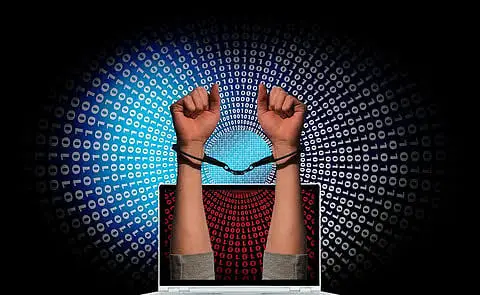
A major breakthrough has emerged in the high-profile “digital arrest” cyber fraud case in Bengaluru, where investigators have now found that the accused in the ₹24 crore scam are also linked to another ₹15 crore cyber fraud case registered in Belagavi, indicating a wider inter-state criminal network.
Inter-State Network Interception and Body Warrants
The case involves a 74-year-old retired teacher who was allegedly trapped by fraudsters posing as officials from the CBI and the Enforcement Directorate. The victim was reportedly placed under what the accused described as “digital surveillance” and coerced into transferring large sums of money under constant psychological pressure.
According to officials, six inter-state cyber fraud suspects have been arrested in connection with the case. Among them, two accused — Palak Bhai Patel and Amit Narendra Patel, both from Ahmedabad, Gujarat — are also named in the Belagavi cyber crime case files. Authorities have obtained body warrants against both individuals, and they are currently in the custody of Bengaluru cyber crime police for further interrogation.
Investigators believe this connection suggests the existence of a coordinated cyber fraud network operating across multiple states, using shared infrastructure and financial channels to execute large-scale scams.
Registration Begins for FutureCrime Summit 2026, India’s Largest Cybercrime Conference
Coercive Impersonation and Multi-Account Routing
In the Bengaluru case, the victim was allegedly threatened over phone calls by individuals impersonating senior officials of central investigative agencies. The fraudsters reportedly accused her of being involved in a money laundering investigation and pressured her into complying with their instructions to avoid arrest.
Under sustained coercion, the victim was made to transfer approximately ₹24 crore over a period of nearly two months. The money was routed through 26 transactions into 23 mule bank accounts spread across 10 different banks in India. These accounts were allegedly used to conceal the origin and destination of the funds.
Officials further revealed that several members of the arrested group are already linked to other cyber crime cases registered in different states. The investigation has so far led to the recovery of around ₹1.46 crore, while efforts are ongoing to trace and recover an additional ₹1.40 crore.
Social Engineering Dynamics and Layering Tactics
Cyber security expert and former IPS officer Professor Triveni Singh said that cases like “digital arrest” scams rely heavily on psychological manipulation. He noted that fraudsters impersonate law enforcement officials, create a sense of urgency and fear, and maintain continuous video call surveillance to isolate victims and control their actions.
He further explained that such inter-state cyber networks typically operate through layered mule accounts, making it difficult for investigators to trace the money trail quickly. Coordinated action across multiple jurisdictions is often required to dismantle these networks.
Investigators also highlighted that the accused systematically used bank accounts across different states to fragment and launder funds. Victims are often kept under constant video surveillance, told they are under investigation, and instructed not to contact family or outside authorities.
Fraudulent Asset Freezing and Institutional Defense
In this case, the victim was psychologically pressured into believing she was part of a serious criminal probe and was repeatedly warned that any disobedience would worsen her legal situation. Each transaction was falsely justified as a “verification process” by the fraudsters.
Authorities have frozen several suspicious accounts linked to the case and are working with multiple state cyber crime units to identify other members of the network. Digital transaction analysis is being used to map the broader structure of the fraud syndicate.
Officials have warned that “digital arrest” scams are evolving rapidly, with criminals using advanced social engineering techniques and impersonation tactics to exploit fear and urgency among victims. They emphasized that awareness remains the strongest defense against such frauds.
People are advised not to share personal, financial, or banking information over unsolicited calls or video communications and to immediately report any suspicious activity to law enforcement agencies. The case continues to highlight the growing challenge faced by cyber security agencies in tackling organized digital fraud networks operating across India.
Follow for daily updates on cybercrime, corporate fraud, DFIR, hacking, investigations, and digital forensics
