
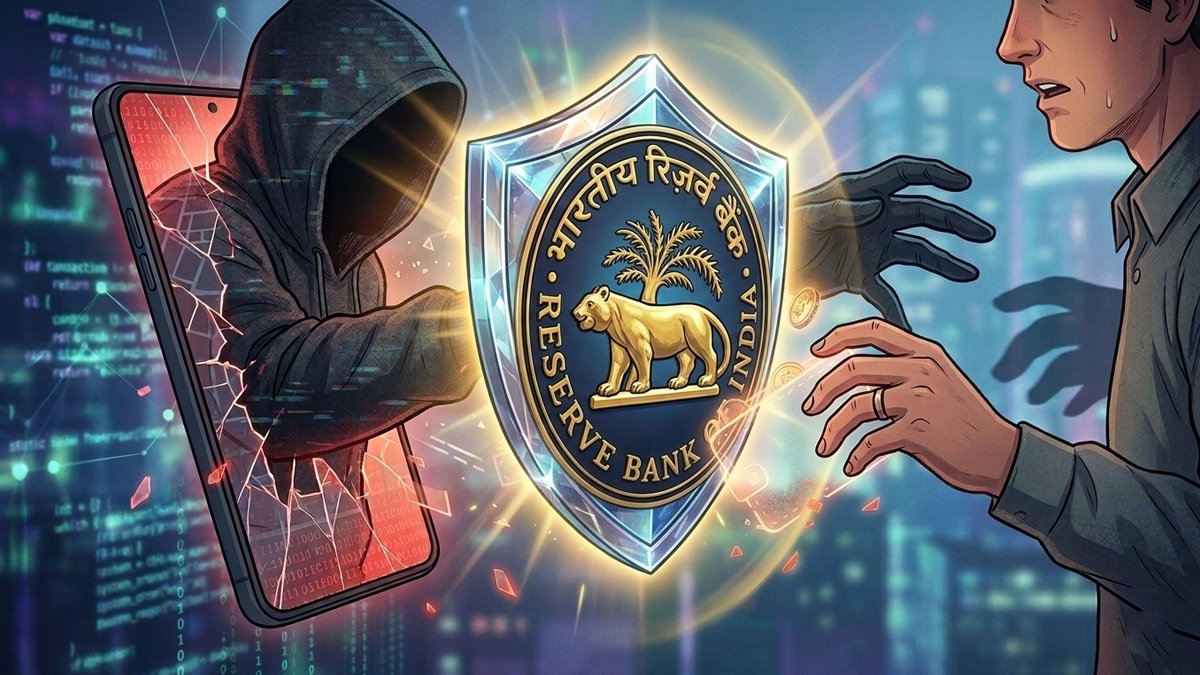
Nearly 2.5 million Indians lost about ₹2.38 lakh crore to digital fraud in 2025, a sharp rise that has prompted the Reserve Bank of India to consider new safeguards for online payments amid the rapid spread of digital transactions across the country.
Fraudsters Use Fear and Urgency
A man received a text message in February asking him to pay a 1,000-rupee speeding fine. The message warned that his driving licence could be suspended if he did not settle the amount quickly.
He clicked the payment link and was asked to share an OTP to complete the transaction. Minutes later, his credit card was charged ₹3.07 lakh, the maximum transaction limit. The RBI report described the case as part of a common scam in India, in which fraudsters send fake messages that mimic official websites and direct people to phishing links.
Experts call this type of fraud social engineering, in which scammers manipulate victims psychologically by creating fear and urgency. India has seen an alarming rise in such fraud alongside the rapid adoption of digital payments over the past half-decade.
FCRF Academy Launches Premier Anti-Money Laundering Certification Program
RBI Weighs New Payment Safeguards
The Reserve Bank of India has stepped in after the surge in digital fraud cases. In a discussion paper released earlier this month, the central bank said it was considering several measures to tackle the problem.
The proposals include a one-hour delay at the payer’s end in account-to-account transactions and additional authentication by a trusted person for high-value digital payments by vulnerable groups, including elderly people. The paper also addresses limits and reviews large credits to customer accounts to ensure they are not mule accounts, and gives people greater control to switch digital payments on or off and set transaction limits.
Experts said the RBI’s proactive stance was welcome but that the proposals could have a limited impact. Rajesh Bansal, former CEO of the RBI’s Innovation Hub, said delayed payments could help prevent the kind of OTP fraud cases, but such scams accounted for only a small part of the broader fraud landscape.
Implementation Challenges Remain
Wrjiu Ray of IDfy, a regulatory technology company, said implementing a payment delay would be difficult because of the number of parties involved in the payment network. The RBI discussion paper also acknowledged that introducing delays would require changes across the system, from transaction queuing to cancellation mechanisms, and would involve cost and effort for the ecosystem.
The central bank also noted that such delays could conflict with the core design principle of immediacy in digital payments. Bansal compared the idea to building an expressway and adding speed breakers every few kilometres, while Ray said scammers could find ways to work around the delay.
Other proposals, including stronger mule account detection through credit limits and enhanced due diligence, could be effective but resource-intensive and costly, Ray said. Bansal said the RBI already has a mule detection platform called Mulehunter.AI, which provides information on beneficiary accounts, but that it needs to be implemented in the banking system in near real time.
Experts said regulation alone would not solve the problem. They called for greater investment in digital literacy, closer coordination between the RBI and agencies such as the police, ministries and market regulator, and sustained public education as India’s population moves online faster than safeguards and awareness can keep pace.
About the author – Manoj Borana is a law graduate from GNLU with a strong interest in legal affairs, technology, cybercrime, and digital safety. He writes about crime, governance, rights, online activity, and technology-related risks, with a focus on raising public awareness.
