
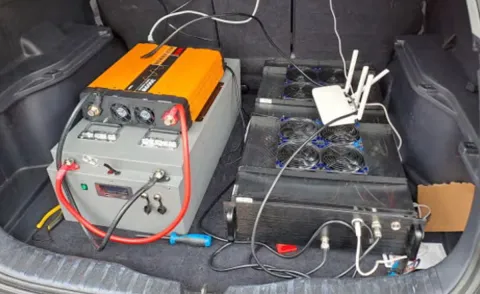
In a first-of-its-kind cybercrime crackdown, Toronto Police have seized sophisticated “SMS blasters” — devices capable of mimicking mobile towers — and arrested three individuals in connection with a large-scale fraud operation. Authorities say the technology enabled scammers to target tens of thousands of mobile users, raising serious concerns about public safety and emerging cyber threats.
The case marks a significant escalation in cyber-enabled crime, with officials warning that such tools can bypass traditional telecom security systems and directly infiltrate users’ devices.
What Are SMS Blasters And Why They’re Dangerous
Investigators revealed that SMS blasters act as fake cellular towers, tricking nearby phones into connecting to them instead of legitimate networks. Once connected, the device sends fraudulent text messages that appear to come from trusted institutions such as banks or service providers.
These messages often contain phishing links designed to steal personal, financial, or login credentials — a tactic commonly known as “smishing.”
Police described this as a “new and emerging threat,” capable of targeting thousands of users simultaneously and exploiting their trust at scale.
FCRF Academy Launches Premier Anti-Money Laundering Certification Program
Massive Impact: Thousands Targeted, Millions Of Disruptions
Authorities said the devices connected to tens of thousands of mobile phones over several months across the Greater Toronto Area.
During this period, more than 13 million network disruptions were recorded — incidents where phones were diverted from legitimate networks to the rogue system.
These disruptions were not just a cybersecurity concern but also a public safety risk. Police noted that affected devices could temporarily lose access to legitimate cellular services, including emergency calls such as 911, for several seconds to minutes.
“Project Lighthouse”: First Case Of Its Kind In Canada
The investigation, dubbed Project Lighthouse, began in November 2025 after a cybersecurity partner alerted authorities to suspicious activity in downtown Toronto.
Police tracked the movement of the device across multiple locations before executing search warrants in March 2026 at residences in Markham and Hamilton.
Three accused — identified as Dafeng Lin, Junmin Shi, and Weitong Hu — now face a total of 44 charges, including fraud, mischief, and use of computer systems for criminal activity.
Officials emphasized that this is the first known criminal case involving SMS blasters in Canada, highlighting how cybercriminal tactics are rapidly evolving.
Cyber Alert: A Glimpse Into The Future Of Digital Fraud
Police have warned that such technologies are already being seen globally and could become more widespread. Unlike traditional scams, SMS blasters do not require access to phone numbers and can bypass telecom filters entirely.
Deputy Chief Robert Johnson stated:
“This is a new and emerging threat… with the ability to reach thousands of devices at once.”
Authorities are continuing to identify victims and assess the full financial impact of the operation.
Experts stress that users should remain cautious of unexpected SMS messages, especially those containing links or requesting sensitive information, even if they appear legitimate.
About the author – Ayesha Aayat is a law student and contributor covering cybercrime, online frauds, and digital safety concerns. Her writing aims to raise awareness about evolving cyber threats and legal responses.
Follow for daily updates on cybercrime, corporate fraud, DFIR, hacking, investigations, and digital forensics
