

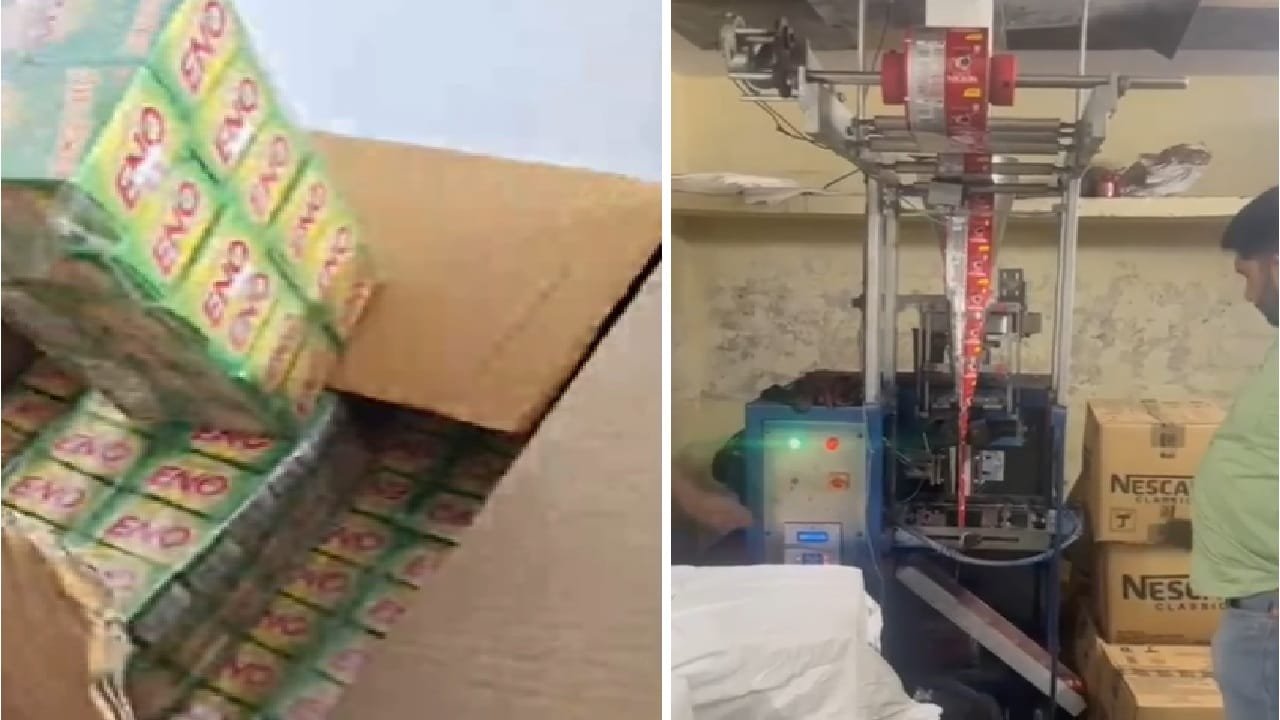

New Delhi: Delhi Police’s Crime Branch has uncovered a large counterfeit manufacturing racket in the capital, seizing fake ENO and counterfeit coffee products from two illegal units operating in the Madhu Vihar area and arresting four people in connection with the case.
Acting on specific intelligence, police raided the premises and found that the units had been producing fake ENO powder and counterfeit coffee sachets for supply to markets across multiple regions through wholesale and retail channels. During the operation, authorities seized goods worth about Rs 20 lakh, including three packaging machines, nearly one lakh ready-to-sell ENO sachets, around 50,000 fake coffee sachets, 500 kg of coffee powder, acid-filled drums, packaging rolls, stickers, cartons and other manufacturing materials.
Counterfeit Goods Confirmed by Companies
Representatives of the concerned companies later examined the seized ENO and coffee products and confirmed that the goods were counterfeit. They said the items had neither been manufactured by them nor authorised under any licensing agreement.
Officials said the circulation of such fake products posed a serious public health risk. ENO, widely used for acidity, gas and indigestion, is directly linked to consumer health, making the spread of counterfeit variants potentially dangerous.
FCRF Returns With CDPO, Its Premier Data Protection Certification for Privacy Professionals
Four Arrested as Probe Widens
The four accused have been identified as Uttam Das, Papai Das alias Pankaj, Nitin Bhardwaj and Sanjay Bansal. Investigators said the group had rented two flats and had been running the illegal operation for the past two months.
Police said Nitin Bhardwaj initially evaded arrest but was later traced through technical surveillance and apprehended from the Sahastradhara area in Dehradun. Sanjay Bansal was subsequently arrested near Kashmiri Gate.
Supply Chain Under Investigation
Police have launched further investigations to trace the wider distribution network and identify additional links in the supply chain. The inquiry is now focused on determining how the counterfeit products were routed into markets and whether more people were involved in the operation.
The case has also renewed concern over the manufacture and sale of fake consumer goods that closely resemble established brands. With health-linked products among those seized, investigators are expected to examine both the scale of the distribution chain and the risks posed to unsuspecting buyers.
Follow for daily updates on cybercrime, corporate fraud, DFIR, hacking, investigations, and digital forensics
