


In Indian boardrooms, the chief information security officer was once treated as a technical guardian — important, certainly, but rarely central to the strategic life of the enterprise.
That arrangement is beginning to dissolve.
Breach reporting obligations have tightened. Sectoral regulators are prescribing more explicit cyber resilience expectations. Privacy compliance is moving from policy language to operational burden. And as artificial intelligence expands both innovation and attack surfaces, organizations are finding that cyber leadership can no longer sit at the edge of business decision-making.
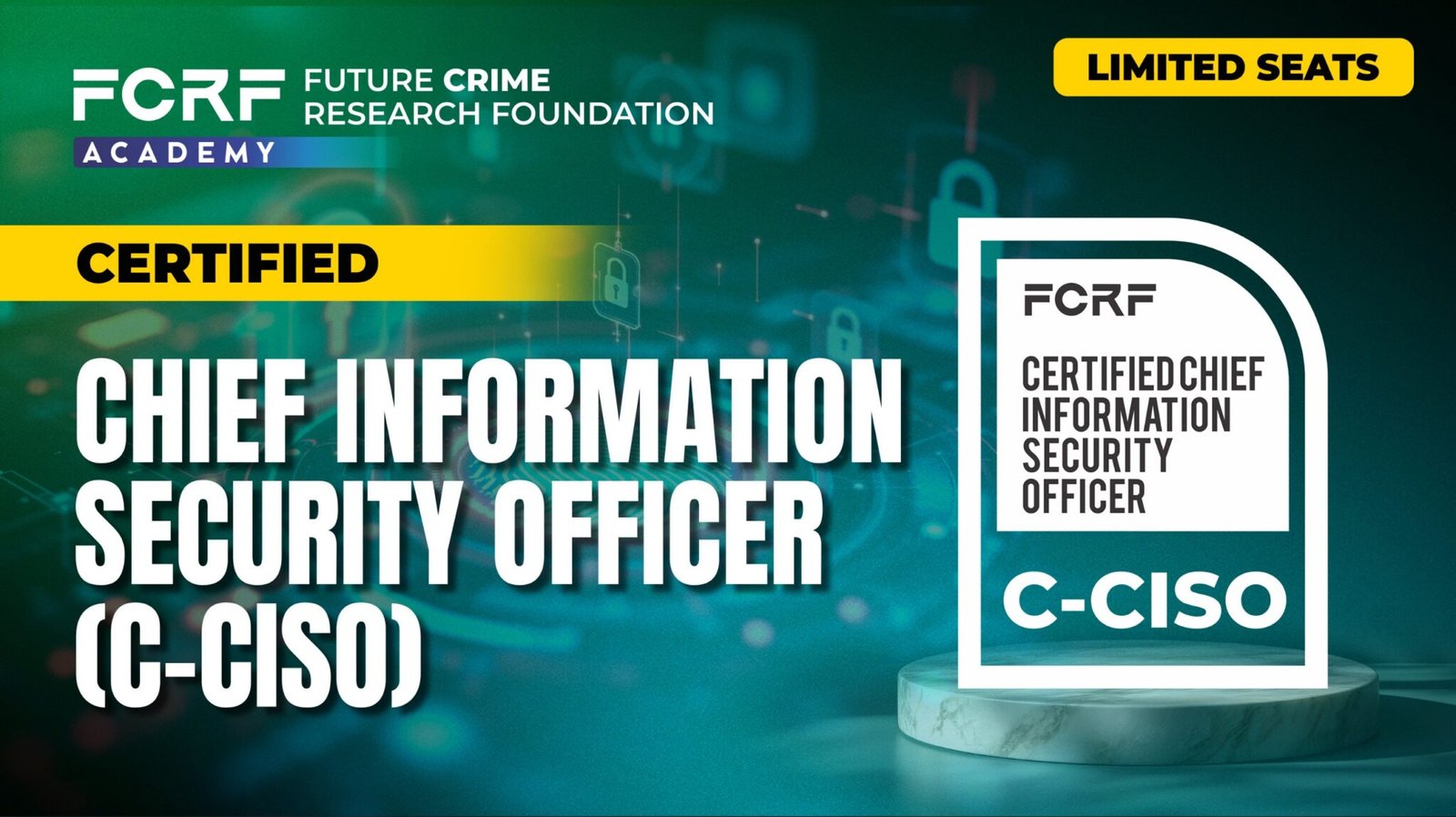
It is against this backdrop that FCRF Academy has announced the launch of its Certified Chief Information Security Officer (C-CISO) program, beginning on April 11, 2026, in the institution’s now-familiar four-week format. The course is structured as a 16-hour certification delivered through 16 modules, each designed to address a different layer of the Indian CISO’s evolving mandate.
The framing is deliberate. According to the course overview, the modern Indian CISO “can no longer rely solely on technical controls” and must now navigate a complex matrix of MeitY directives, RBI and SEBI expectations, the DPDP Act and enterprise risk governance, all while translating cyber exposure into business language understood at the board level.

A Curriculum Built for India’s Regulatory Reality
What distinguishes the program is not simply its executive title, but its regulatory and legal orientation.
The course begins by redefining the CISO as a strategic advisor rather than an IT custodian, examining governance structures, reporting lines and accountability under Indian corporate frameworks. It then moves into the legal architecture that increasingly shapes cybersecurity leadership: the Information Technology Act, 2000, the Bharatiya Nyaya Sanhita, the Bharatiya Sakshya Adhiniyam, and the operational implications of India’s Digital Personal Data Protection Act, 2023, alongside the newly notified DPDP Rules, 2025.
From there, the syllabus turns to sector-specific compliance. Separate modules address SEBI’s Cybersecurity and Cyber Resilience Framework, RBI’s zero-trust and identity-first mandates, and IRDAI’s cybersecurity expectations for insurers. Other sessions focus on protecting critical information infrastructure, quantifying cyber risk through models such as FAIR, building zero-trust environments, running a 24/7 SOC, and aligning response programs with CERT-In’s incident reporting requirements.
Later modules address themes that have become increasingly urgent for senior security leaders: AI-driven attacks, deepfake fraud, prompt injection risks, AI governance, cyber insurance and the challenge of reporting cyber posture to boards in a language that secures budgets and executive attention.
The result is less a narrow technical course than a compressed executive brief on how cybersecurity now operates inside Indian institutions.

From Training Programs to Leadership Pipelines
The C-CISO launch also reflects a broader pattern within FCRF Academy, which has steadily expanded its professional education portfolio across adjacent areas of cyber governance and risk.
Over recent years, the academy has developed certifications and trained tens of thousands in cyber crisis management, data protection, cyber law, governance, risk and compliance, and fraud investigation. The new C-CISO program appears to be positioned as the leadership-layer extension of that ecosystem — a course aimed not just at entry-level learners, but at current and aspiring CISOs, CTOs, IT directors, risk officers and senior security leadership.
That audience definition matters. The role of a CISO in India today is increasingly hybrid. It may involve board presentations one day, incident war rooms the next, privacy compliance reviews after that, and a regulatory response plan by week’s end. Security leadership now requires fluency across law, governance, operations, finance and public accountability.
Training institutions have begun to respond by creating programs that mirror this convergence. FCRF Academy’s version is explicitly practitioner-led and weekend-based, suggesting an attempt to meet the needs of working professionals who must absorb strategic complexity without stepping away from operational responsibilities.
Why the Timing Matters
The launch date — April 11, 2026 — arrives at a moment when cybersecurity leadership in India is under growing structural pressure.
Regulators are not merely asking whether controls exist; they are asking who reports to whom, how quickly incidents are disclosed, whether boards understand exposure, and how resilience is measured. The rise of AI systems has further complicated the equation, adding new attack vectors and governance burdens without reducing older risks. And as cyber insurance markets mature, even financial mitigation increasingly depends on being able to demonstrate credible security maturity.
This is why the CISO role has become more consequential than its title once implied. The position now sits at the intersection of technology, law, operations and institutional trust.
FCRF Academy’s new certification appears to be built on that premise. Its syllabus suggests an understanding that the question facing many organizations is no longer whether they need a CISO, but whether that CISO is prepared for the scale of responsibility the role now carries.
In that sense, the program’s launch is about more than a new course. It is a marker of a larger transition: cybersecurity leadership in India is becoming formalized, professionalized and increasingly inseparable from the way modern organizations are governed. Interested participants can click here to register for the Certified Chief Information Security Officer (C-CISO) program.
Follow for daily updates on cybercrime, corporate fraud, DFIR, hacking, investigations, and digital forensics
