
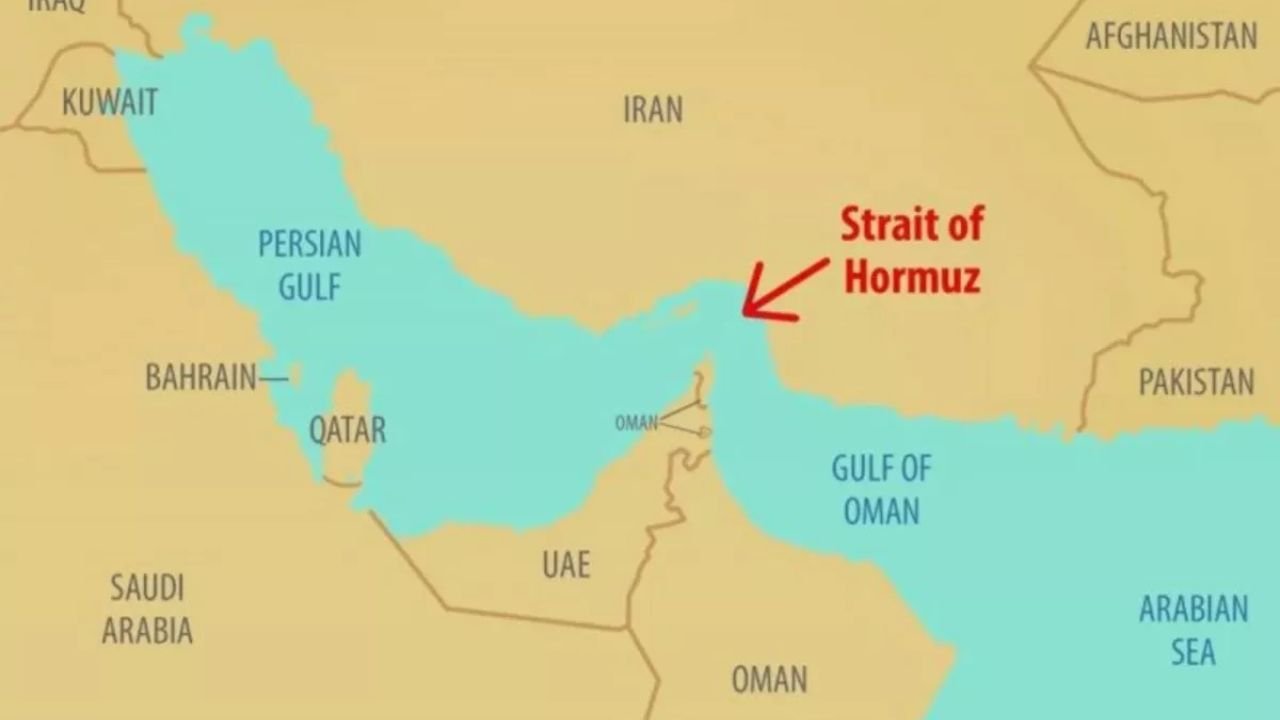
The escalating conflict in West Asia has pushed the Strait of Hormuz — the world’s most critical oil transit chokepoint — to the center of a rapidly intensifying military standoff. Following strikes on key positions, Iran has claimed it targeted a US military base in Bahrain with drones and missiles and warned that any vessel attempting to pass through the Strait of Hormuz would face destruction, calling such movement “equal to death.”
The statement has sharply heightened tensions across the Gulf, triggering fresh concerns in global energy markets over supply disruptions and maritime security.
A brigadier general linked to Iran’s Revolutionary Guard declared that the Strait of Hormuz was effectively “closed,” warning that any ship crossing the waterway would be set ablaze. The strait connects the Persian Gulf to the Gulf of Oman and is regarded as the backbone of global crude oil supply. Nearly 19.8 million barrels of oil transit through this narrow channel every day. Amid rising hostilities, reports indicate that more than 700 oil tankers are currently stranded at both ends of the waterway.
FCRF Launches Flagship Certified Fraud Investigator (CFI) Program
Iran Claims Strike on US Base in Bahrain
Iran stated that it targeted the Sheikh Isa base in Bahrain using 20 drones and three missiles, alleging significant damage. Tehran also claimed that a fuel tanker caught fire during the assault. Iran’s ambassador to the United Nations, Amir Saeid Iravani, said the country remains committed to defending itself “with full force.”
In response, US Central Command indicated that retaliatory strikes were conducted against command structures linked to Iran’s Islamic Revolutionary Guard Corps. According to official statements, facilities associated with Iran’s ballistic missile program were hit using fighter jets and B-1 bombers.
Expanding Attacks Across the Gulf
Amid the spiraling confrontation, Iran reportedly attempted to target the US Embassy in Saudi Arabia with drones. In Riyadh, two drone strikes caused minor damage. Claims have also emerged of attacks on US-linked data centers in the United Arab Emirates, as well as energy installations and vessels in Qatar and Saudi Arabia, raising fears of broader disruptions to oil and gas supplies.
Oman’s major commercial port of Duqm was also reportedly struck by drones for the second time in three days. An oil tanker sustained damage, though no casualties were confirmed.
Advisory for US Citizens in Gulf Region
As the conflict widens, the United States has advised non-emergency personnel and their families to leave 12 Gulf nations. Citizens in the UAE, Bahrain, Iraq, Jordan, Kuwait, and Qatar have been urged to relocate to safer areas. Similar advisories have been issued for Americans in Egypt, Lebanon, the West Bank, Gaza, Syria, and Yemen.
Indian Sailors Caught in Crossfire
India’s Directorate General of Shipping reported that three Indian nationals aboard a vessel operating in the Persian Gulf, Strait of Hormuz, and Gulf of Oman region have died amid the hostilities. Efforts are underway to evacuate Indian sailors and other personnel trapped in the conflict zone. A quick response team comprising senior officials has been constituted and is coordinating with relevant authorities in affected countries.
Airstrikes in Lebanon and Beirut
The conflict’s footprint has extended into Lebanon. Israeli forces launched airstrikes targeting positions linked to Iran-backed Hezbollah in Lebanon and Beirut, with reports indicating 52 fatalities. Separately, airstrikes on an airbase in southern Iran by US and Israeli forces reportedly resulted in the deaths of 13 Iranian soldiers.
What began as a regional escalation now threatens to evolve into a wider geopolitical crisis, with direct implications for global energy security and maritime trade. Mounting tension around the Strait of Hormuz is poised to significantly influence international markets, diplomatic engagements, and strategic calculations in the days ahead.
About the author – Rehan Khan is a law student and legal journalist with a keen interest in cybercrime, digital fraud, and emerging technology laws. He writes on the intersection of law, cybersecurity, and online safety, focusing on developments that impact individuals and institutions in India.
