
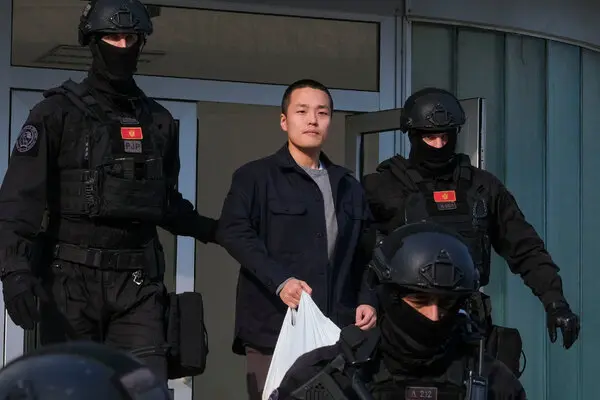

NEW YORK: In a Manhattan courtroom, victims of one of cryptocurrency’s most spectacular collapses described the sudden evaporation of savings, charities hollowed out overnight, and a trust betrayed on a global scale as Do Kwon was sentenced for a fraud that prosecutors said rewrote the human cost of digital finance.
A Courtroom Reckoning for a $40 Billion Collapse
On a long day of sentencing in federal court in Manhattan, the collapse of Terraform Labs was recast not as a technical failure or a volatile market swing, but as an act of deception with consequences measured in ruined lives. Judge Paul A. Engelmayer sentenced Do Kwon, the 34-year-old co-founder of the Singapore-based firm, to 15 years in prison, calling the implosion of his crypto ecosystem “a fraud on an epic, generational scale.”
The government argued that Kwon’s companies had lost investors roughly $40 billion when TerraUSD marketed as a reliable “stablecoin” plunged far below its promised $1 peg in 2022. The crash reverberated through global cryptocurrency markets, triggering what prosecutors described as a cascade of failures that dwarfed even the combined losses of the FTX and OneCoin scandals.
Kwon, once celebrated in crypto circles as a visionary and derided by critics as reckless, sat at the defense table in a yellow jail suit as the judge rejected both the government’s request for a 12-year sentence as too lenient and the defense’s plea for five years as “utterly unthinkable.”
Victims’ Stories: From Paper Losses to Human Wreckage
The most searing moments of the hearing came not from legal arguments, but from victims’ accounts. In letters read aloud by prosecutors more than 300 were submitted investors described savings accumulated over decades vanishing in days.
One person wrote that what looked like “a number on a page” to outsiders represented years of labor, wiped out “literally overnight.” Another investor, Stanislav Trofimchuk, said his family’s investment collapsed from $190,000 to $13,000 in what he called “two weeks of sheer terror,” erasing what he described as 17 years of his life.
Some described consequences far beyond finances. One man told the court that after TerraUSD’s collapse, his wife divorced him, his sons were forced to abandon college plans, and he returned to Croatia to live with his parents. Another said he now lives with the guilt of persuading his in-laws and hundreds of nonprofit organizations to invest.
Chauncey St. John, speaking in court, said charities he worked with lost more than $2 million, while a church group lost about $900,000. He and his wife remain saddled with debt, he said, and his in-laws have delayed retirement to recover. Still, he told the judge he forgave Kwon and prayed for mercy on his soul.
The Illusion of Stability and the Mechanics of Deception
At the center of the case was TerraUSD itself, a digital currency promoted as stable but, prosecutors said, propped up by outside cash infusions rather than the robust mechanisms advertised to investors. Assistant U.S. Attorney Sarah Mortazavi said Kwon had created an “illusion of resilience while covering up systemic failure,” executing the scheme with “arrogance, manipulation and total disregard for people.”
Terraform Labs had presented TerraUSD as a safe place to park savings in an otherwise volatile crypto world. When confidence faltered and the peg broke, investors in both TerraUSD and its sister currency, Luna, rushed for exits that no longer existed.
Judge Engelmayer told Kwon directly that his actions caused people to lose real money not abstract losses on a screen and that the human wreckage was incalculable. Prosecutors estimated that the number of victims could reach into the millions worldwide.
Flight, Forfeiture and the Weight of Accountability
After the collapse, prosecutors said, Kwon attempted to rebuild Terraform Labs in Singapore before fleeing to the Balkans using a false passport. He was arrested in Montenegro in March 2023 and later extradited to the United States, receiving credit for 17 months already spent in custody.
As part of his plea deal, Kwon agreed to forfeit more than $19 million. His lawyers argued that his conduct stemmed less from greed than from hubris and desperation as the project unraveled. The judge rejected a request for Kwon to serve his sentence in South Korea, where he also faces prosecution and where his wife and young daughter live.
Addressing the court, Kwon said he had spent years replaying what he could have done differently and searching for ways to make amends. Listening to victims, he said, had been harrowing and a reminder of the immense losses he caused.
