
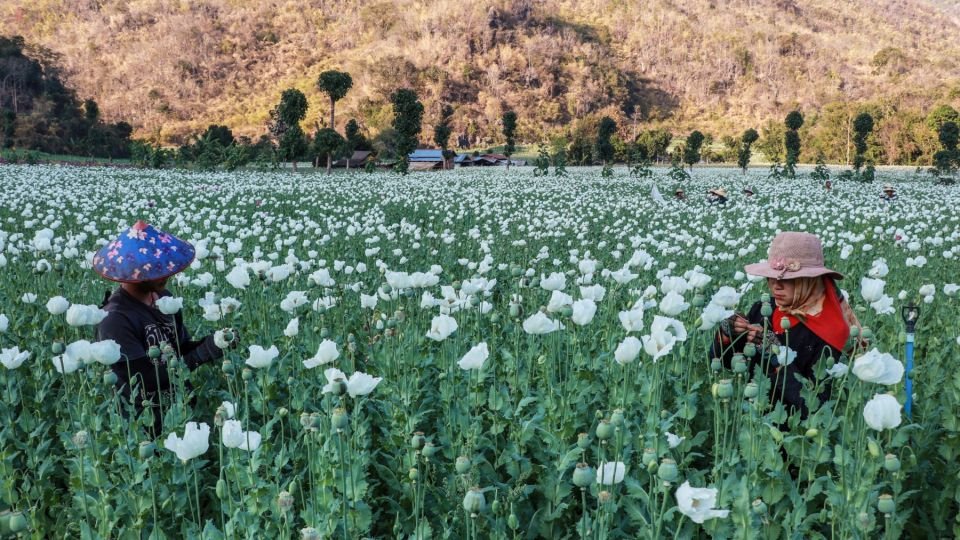

Myanmar’s protracted civil conflict has reignited the country’s role as the epicentre of Asia’s illicit drug economy. According to a new report by the United Nations Office on Drugs and Crime (UNODC), opium cultivation in Myanmar has expanded 17% over the past year to reach 53,000 hectares the largest area under poppy cultivation in a decade.
The findings reinforce Myanmar’s position as a dominant producer in the global narcotics trade, supplying a multi-billion-dollar network that extends across Asia, Australia, Africa and Europe.
Myanmar Overtakes Afghanistan as the World’s Top Opium Producer
With Afghanistan’s poppy fields decimated by the Taliban’s sweeping anti-drug campaign in 2023, Myanmar has effectively replaced it as the world’s largest opium producer. UNODC data suggests the country’s opium and methamphetamine output is now at its highest point in years.
In 2024 alone, authorities across East and Southeast Asia seized 236 tonnes of methamphetamine, much of it traced back to production hubs in Myanmar’s Shan, Kachin and Wa regions areas long beyond government control. UNODC Illicit Drugs Research Officer Inshik Sim said the label “Myanmar” itself can be misleading.
“It’s not the state producing drugs; it’s powerful criminal syndicates and militia networks operating inside Myanmar. The breakdown of governance has given them unprecedented freedom,” he said.
Chinese Cartels Expand Operations in the Golden Triangle
The UNODC report identifies the Golden Triangle the remote border zone connecting Myanmar, Laos and Thailand as the nucleus of regional drug production. Traditionally synonymous with heroin, the region has transformed into the global hub for synthetic drug manufacturing, especially methamphetamine.
Chinese organised crime groups, operating with protection from local warlords and militias in Myanmar’s Shan State, have established extensive industrial-scale laboratories. These facilities produce vast quantities of meth and precursor chemicals, feeding regional and global markets.
“The Myanmar military and law enforcement have virtually no access to these enclaves,” the report notes, making interdiction and intelligence operations nearly impossible.
Post-Coup Instability Drives Drug Production
UNODC links the latest spike in drug output to the fallout from Myanmar’s February 2021 military coup, which plunged the country into political and economic collapse.
Since then:
- The national economy has deteriorated sharply.
- Law enforcement institutions have disintegrated.
- Armed factions have turned to narcotics to fund operations.
- Farmers, facing poverty, have shifted to poppy cultivation.
“The conflict has created a perfect storm,” Sim said. “Both insurgent groups and rural communities now rely on opium and meth production for survival.”
In some conflict zones, farmers are reportedly earning up to $500(₹45,000) per kilogram of raw opium nearly double pre-coup rates.
Thailand Hit Hardest as Meth Floods the Market
Neighbouring Thailand has borne the brunt of Myanmar’s drug boom. In 2024, Thai authorities seized one billion methamphetamine tablets the highest figure ever recorded. Thanapon Thanikkun, intelligence chief at Thailand’s Office of Narcotics Control Board, said traffickers are exploiting the country’s extensive land, air and maritime routes.
“The ease of transport has not only accelerated cross-border smuggling but also driven rising domestic addiction,” he warned.
Drug Profits Fuel Myanmar’s Armed Conflict
The narcotics trade is now deeply interwoven with Myanmar’s internal war economy.
Khun Oo, deputy head of the Pa-O Youth Organization, said that multiple armed groups depend on drug revenue to sustain their military operations.
“They need weapons, recruits, and supplies and the drug trade finances all of it,” he said.
Methamphetamine, which can be produced quickly in small labs, provides a high-profit, low-risk alternative to opium, while poppy farming sustains thousands of rural households whose livelihoods have collapsed amid conflict.
Myanmar’s Narcotics Reach Global Markets
UNODC evidence shows that Myanmar-origin narcotics are now appearing far beyond Asia. Methamphetamine and heroin traced to Myanmar have been intercepted in Japan, Australia, India’s Northeast, and for the first time, Nigeria and parts of Europe. Sim said these trends reflect a clear shift:
“Myanmar’s cartels are no longer just regional players they are expanding into global markets.”
A Growing Threat to Regional Stability
Analysts warn that the convergence of Myanmar’s political collapse, entrenched criminal syndicates and porous borders is fuelling an expanding transnational drug crisis. The UNODC cautioned that unless regional governments coordinate cross-border enforcement and address the underlying conflict, Southeast Asia’s narcotics problem could spiral further out of control threatening public health, economic stability, and regional security across the Asia-Pacific.
