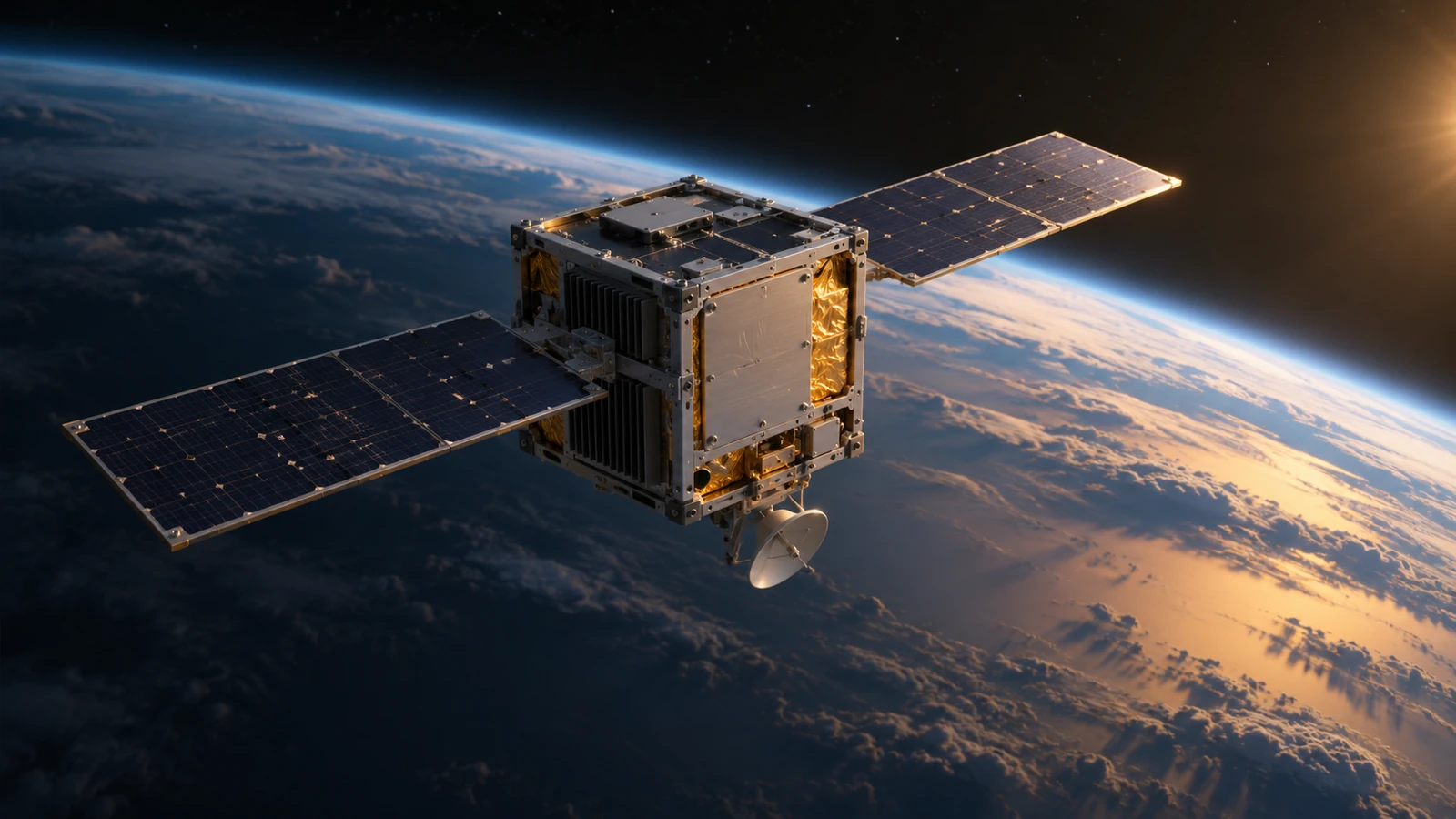


The US Federal Communications Commission has authorised SpaceX to deploy a constellation of up to one million satellites intended to perform computing in orbit. The project, called Starmind, would process data off Earth and deliver results to users and systems on the ground. The November 25 decision gives SpaceX regulatory permission for a system of a scale that has not been demonstrated.
The FCC’s announcement calls it the first US authorisation for a constellation of data centres in space. The figure is an authorised maximum. It does not represent satellites in operation, available computing capacity or a commitment that SpaceX will deploy every module.
What Has the FCC Actually Authorised?
The decision covers a proposed system in non-geostationary orbit. Satellites in these orbits move relative to the ground and to one another. The planned system uses optical links between spacecraft and can supplement those links with radio communications in the bands identified by the commission. Those communications are part of how an orbiting system could exchange data and bring results back to Earth.
The FCC’s earlier notice set out the application and invited comments. The authorisation advances the proposal beyond that review stage. It leaves SpaceX the task of designing and deploying equipment capable of performing the intended work. The regulatory ceiling sets the scale the company may pursue. It does not measure what is practical or commercially sustainable.
That distinction is important for a project whose largest number is also its most memorable claim. It could take many increments of hardware, launches and ground infrastructure to build out a constellation. A small deployment would provide more direct evidence about the system’s reliability and economics than a paper authorisation for a much larger one.
Why Would Anyone Put Computing in Space?
AI is adding demand for electricity, network capacity and cooling in areas already seeing extensive data-centre development. In orbit, a satellite can obtain power from sunlight during suitable parts of its trajectory. A fleet could, in principle, add processing capacity above places where land, power connections or permitting restrict terrestrial expansion.
Space introduces its own resource constraints. Equipment must travel on a launch vehicle. Computers generate heat, and a spacecraft cannot move heat into surrounding air in the way an Earth-based facility can. It has to reject heat through radiators. Designers must also consider radiation, outages in communications and what happens when a processor or another component fails far from anyone who could repair it.
The kind of work sent to orbit may matter more than the headline amount of computing. Jobs that require large, constant transfers between space and Earth could face different costs and delays from jobs that send smaller inputs and return compact results. Similarly, a task that can wait through an interruption may suit an early system better than one that needs an immediate reply every time.
What Would Demonstrate That Starmind Can Scale?
The next practical evidence would come from hardware and operating data. Potential users would want to know how much processing a module can sustain, how readily capacity can be shared across spacecraft, and how reliably the system handles a failed node. They would also need a way to compare the whole cost with the cost of running the same job on Earth.
Regulators and other operators face questions about how large fleets are tracked and what happens at the end of each spacecraft’s life. Processes that work for a demonstration might need to operate on a very different scale in a larger deployment. For readers following emerging technology and infrastructure, the important milestone will be a demonstrated service with known costs, performance and operating limits. The FCC decision makes that experiment possible at an ambitious scale.