
Follow us on Google News

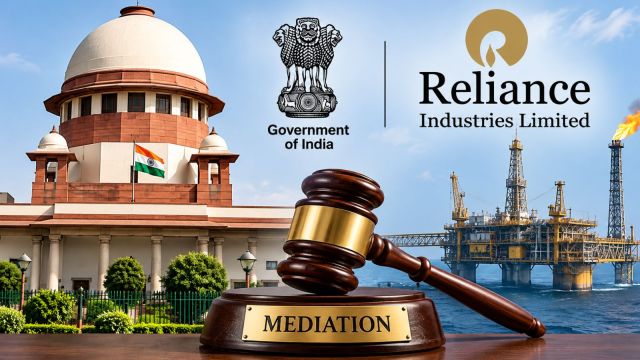
New Delhi: Efforts to resolve the long-standing Krishna-Godavari (KG) Basin gas dispute between the central government and Reliance Industries along with its foreign partners have gained momentum after the Centre informed the Supreme Court that it has no objection to former Supreme Court judge Justice Ranjana Prakash Desai serving as the sole mediator. The clarification came after Justice Desai expressed apprehension that the government might not be agreeable to her appointment. Appearing before a bench headed by Chief Justice Surya Kant, alongside Justices Joymalya Bagchi and V. Mohana, on Thursday, Attorney General R. Venkataramani assured the court that the government would extend full cooperation to the mediation process.
Debate Over Inclusion of Domain Experts
Chief Justice Surya Kant noted during the hearing that Justice Desai had been appointed with the consent of both parties. Senior advocate Kapil Sibal, representing the private consortium, submitted that two domain experts should also be included alongside Justice Desai to assist the mediation panel. Sibal pointed out that the government had proposed the name of a former Petroleum Ministry secretary as an expert, but argued that the former official should not be included if they had handled matters related to the dispute in an official capacity during their tenure. Expressing a desire for an amicable resolution, Sibal underscored the importance of impartial expertise. Earlier, on October 30, the Supreme Court had proposed Justice Desai as sole mediator after observing that the parties had failed to reach a practical solution on their own, while leaving room for two mutually suggested experts to assist her.
Origins of the KG-D6 Gas Migration Dispute
The dispute centres on natural gas production from the KG-D6 block in the Bay of Bengal. The central government has accused Reliance Industries and its consortium partners of producing gas that had naturally migrated from adjoining blocks operated by state-owned Oil and Natural Gas Corporation (ONGC), to which the private operators had no entitlement. Reliance Industries is the operator of the KG-D6 block with a 60 percent stake, while British firm BP Exploration (Alpha) holds 30 percent and Niko Resources holds 10 percent. The government’s compensation claim rests on the August 28, 2016 report of a committee headed by Justice A.P. Shah, which concluded that the contractor gained an unjust enrichment from migrated gas and owed compensation to the government as the owner of unexploited natural resources.
From ₹13,000 Crore Demand to Supreme Court Appeal
Following the committee’s findings, the Petroleum Ministry issued a demand notice on November 4, 2016, seeking approximately $1.47 billion from the Reliance-BP-Niko consortium for around 338.332 million British thermal units of gas allegedly migrated and produced over seven years ending March 31, 2016. After accounting for royalties already paid and adding interest, the total claim rose to roughly $1.55 billion, exceeding ₹13,000 crore at the prevailing exchange rate. Reliance challenged the demand on November 11, 2016, invoking arbitration and arguing that the claim misconstrued the Production Sharing Contract. In July 2018, a three-member international arbitration tribunal ruled 2-1 in favour of the consortium, rejecting the government’s $1.55 billion claim and awarding $8.3 million to the companies. Although a single judge of the Delhi High Court initially upheld the arbitral award, a division bench set it aside on February 14, 2025, following an appeal by the Centre. Reliance and its partners challenged that order in the Supreme Court, where the bench on May 20 declined to stay the proceedings while noting the companies’ willingness to pursue mediation, paving the way for the current settlement effort.