
Follow us on Google News

India is moving to make technical education and digital skills training more accessible in regional languages, with the Union Government’s BHASHINI initiative joining hands with the National Institute of Electronics and Information Technology (NIELIT) to explore the use of artificial intelligence in learning platforms.
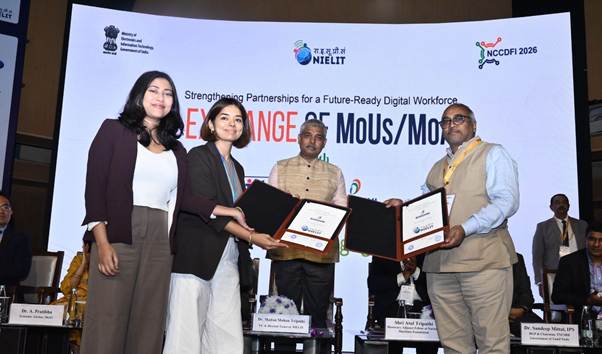
The Digital India BHASHINI Division and NIELIT exchanged a Memorandum of Understanding (MoU) on November 19, 2026, to collaborate on multilingual AI applications, technical education, research and skill development.
The partnership aims to help students access technical courses, learning materials and digital training resources in their preferred Indian languages.
The initiative comes as India expands AI education and digital skilling programmes, raising an important question about whether students unfamiliar with English can participate equally in emerging technology opportunities.
However, the agreement establishes a framework for future cooperation. It does not mean that all NIELIT courses have already become available in regional languages.
FCRF Launches Certified Chief Risk Officer (CRO) Program for India’s Risk Leaders
BHASHINI And NIELIT Join Forces To Reduce Language Barriers
The collaboration brings together two government-backed institutions working in different areas of India’s digital development.
BHASHINI, operating under the Ministry of Electronics and Information Technology, develops artificial intelligence tools that help translate text, recognise speech and make digital services accessible across languages.
NIELIT focuses on electronics, information technology, professional training, research and digital skill development.
Under the agreement, both organisations will explore integrating BHASHINI’s language technologies into NIELIT’s educational and institutional systems.
This could allow students to access technical course materials, digital platforms and training resources in languages they understand more comfortably.
The partnership also proposes cooperation on developing specialised language resources for technical subjects.
Such resources are important because terms used in programming, cybersecurity, electronics and artificial intelligence do not always have simple equivalents in regional languages.
The institutions intend to encourage research, innovation and contributions of linguistic data to improve these technologies.
The agreement was exchanged by Swati Bisht Chowdhary, Head of Ecosystem Engagement at the Digital India BHASHINI Division, and Dr S K Dhurandher, Registrar of NIELIT.
No dedicated project budget, implementation timetable or list of courses selected for translation was announced.
How Multilingual AI Could Change Technical Learning
Artificial intelligence-based language tools can help students understand educational material without relying entirely on English.
For example, a student studying cybersecurity could potentially access an explanation of computer networks in Hindi, Tamil or another supported language.
AI-powered speech recognition can convert spoken words into written text, while text-to-speech technology can read digital material aloud.
Machine translation can convert educational content between languages, although the accuracy of technical terminology requires careful checking.
These capabilities could support students who understand complex subjects but struggle with English-language textbooks or digital interfaces.
They may also help teachers prepare multilingual resources and make technical training more accessible.
However, AI-generated translations are not always accurate. Errors involving programming instructions, security procedures or technical concepts could create confusion.
Human review and appropriate quality checks would therefore remain important when these tools are used in formal education.
The new agreement includes plans to develop domain-specific language resources, which could help address some of these challenges.
BHASHINI Already Supports Hundreds Of Government Websites
The partnership builds on BHASHINI’s expanding role in India’s digital public infrastructure.
According to the Ministry of Electronics and Information Technology, BHASHINI currently supports more than 800 government websites.
The government says its language technology ecosystem has processed over 11 billion AI inferences and handles more than 2.4 crore such operations daily.
An AI inference is a single operation in which a trained artificial intelligence model processes an input and generates an output, such as translating a sentence or recognising spoken words.
BHASHINI currently supports 36 Indian text languages, 23 Indian voice languages and 35 international languages.
These figures describe the wider platform’s capabilities, not the number of languages that will immediately become available in NIELIT courses.
The November agreement also follows other government partnerships involving multilingual artificial intelligence.
In August 2026, BHASHINI entered into an arrangement with NITI Aayog to explore voice-based AI services for public administration.
On November 3, the Securities and Exchange Board of India signed an agreement with BHASHINI to improve access to investor education and financial information across Indian languages.
The latest collaboration extends this approach towards technical education and digital skills.
Implementation Will Determine The Partnership’s Impact
For students in smaller towns and non-English-speaking communities, language can become an additional obstacle when learning programming, cybersecurity or other specialised subjects.
Improving access to understandable technical materials could encourage wider participation in digital training programmes.
The agreement also creates opportunities for researchers and educators to contribute linguistic datasets and develop specialised language tools.
However, its impact will depend on how effectively these technologies are integrated into NIELIT’s learning systems.
The government has not yet disclosed which courses will be covered first, when students can expect access or how translation accuracy will be evaluated.
Those details will determine whether the partnership produces measurable improvements in access to technical education.
Students interested in technical education can follow official NIELIT and BHASHINI announcements for future multilingual learning resources. Existing course availability, fees and eligibility should be verified through NIELIT’s official website rather than unofficial advertisements.