
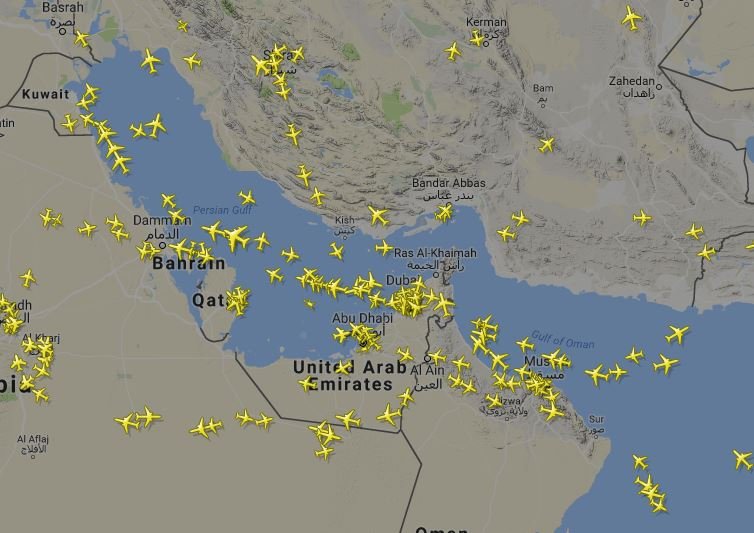
Amid rising tensions between the United States and Iran, the United Arab Emirates (UAE) has taken a clear diplomatic stand, ruling out the use of its airspace, land or territorial waters for any hostile military action against Iran. The announcement comes at a time when speculation over a possible escalation in the region has intensified, drawing close international attention to military movements across West Asia.
In an official statement, the UAE said it would not permit its territory to be used for actions that could destabilise the region or threaten the sovereignty of neighbouring countries. The move is being seen as a significant signal, particularly given the long-standing strategic and defence partnership between the UAE and the United States.
Despite close military cooperation and the presence of American military facilities in the country, the UAE has underlined that regional stability and national sovereignty remain its top priorities. By publicly clarifying its position, Abu Dhabi has sought to distance itself from any potential military escalation involving Iran.
Speculation about a possible military confrontation gained momentum last week after US President Donald Trump said that a “fleet of aircraft” was moving towards Iran, while also expressing hope that such force would ultimately not be required. Against this backdrop, the UAE’s statement is being interpreted as an effort to lower tensions and avoid being drawn into a wider conflict.
The UAE foreign ministry said the country remains firmly committed to protecting its sovereignty and territorial integrity, and will not be part of any hostile action against a neighbouring state. It also reiterated its policy of promoting dialogue, restraint and peaceful resolution of disputes in the region.
The announcement comes as Iran grapples with serious internal challenges. The country has been witnessing sustained protests and unrest, driven by economic hardship, rising inflation, currency depreciation and widespread dissatisfaction with governance. Human rights groups have claimed that thousands of people have died during the unrest, describing it as one of the most severe internal crackdowns since the 1979 revolution.
Certified Cyber Crime Investigator Course Launched by Centre for Police Technology
These domestic pressures, combined with the threat of external military action, have left Iran in a particularly fragile position. Analysts say that any direct conflict between the US and Iran would have far-reaching consequences well beyond the two countries, affecting shipping routes, energy supplies and political stability across West Asia.
The region hosts several US military bases, and even a limited escalation could trigger a chain reaction involving multiple regional players. The UAE’s stance suggests that Gulf countries are keen to avoid becoming launchpads or logistical hubs for military operations that could drag them into a broader confrontation.
Security experts believe the UAE’s decision reflects a careful balancing act — maintaining strong ties with Washington while signalling to Tehran that it does not support military aggression. The move also aligns with recent efforts by Gulf states to improve ties with Iran and reduce regional tensions through diplomacy.
In recent years, the UAE and Iran have taken steps to stabilise relations, including diplomatic engagements and confidence-building measures. The latest statement is seen as consistent with that approach, reinforcing the message that the UAE prefers engagement over confrontation.
Economists point out that regional stability is crucial for Gulf economies, especially at a time when global energy markets remain volatile and trade routes face growing uncertainty. Any military conflict involving Iran could disrupt oil supplies and push energy prices sharply higher, with global repercussions.
For now, tensions between Washington and Tehran remain high, with strong rhetoric continuing on both sides. However, the UAE’s unequivocal position suggests that even if the situation deteriorates, some key regional players are determined to stay out of direct military involvement.
As diplomatic efforts continue behind the scenes, the international community will be watching closely to see whether dialogue can prevail or whether West Asia edges closer to another major crisis with global implications.
About the author – Rehan Khan is a law student and legal journalist with a keen interest in cybercrime, digital fraud, and emerging technology laws. He writes on the intersection of law, cybersecurity, and online safety, focusing on developments that impact individuals and institutions in India.
