

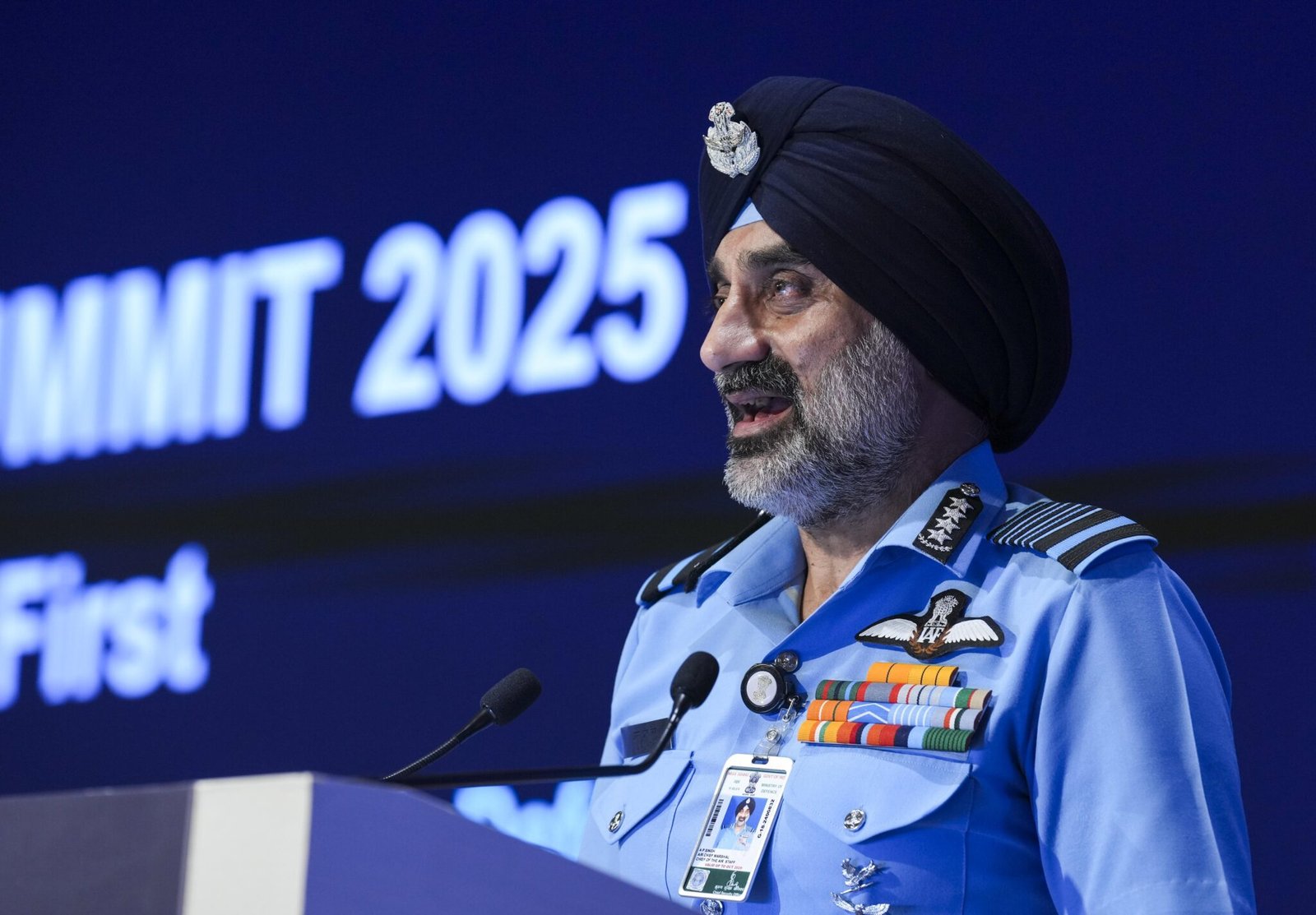

Highlighting the critical need for rapid indigenisation across India’s armed forces, Chief of the Air Staff Air Chief Marshal A. P. Singh stated that military technology must be developed at the speed of relevance, warning that technology delayed is technology denied. Speaking at the commissioning ceremony of INS Malvan, a stealth anti-submarine shallow-water warship built by Cochin Shipyard at the Karwar Naval Base, the Air Force chief acknowledged that the Indian Air Force can learn valuable lessons from the Indian Navy’s long-standing, structured approach to domestic shipbuilding.
The Air Chief emphasized that in modern military conflict, producing indigenous hardware loses its operational value if development timelines stretch across decades. He noted that if an indigenous system takes so long to design, develop, and manufacture that global technological benchmarks shift in the interim, the resulting platform offers little strategic advantage. Emphasizing the imperative for faster research and development cycles, he stressed that all three military branches must ensure their domestic production pipelines keep pace with evolving battlefield dynamics.
Embedding Experts: The Naval Model of Indigenisation
Praising the Indian Navy’s progress in achieving nearly 80 per cent indigenous content by value in its latest warships, Air Chief Marshal Singh admitted that the Air Force had lagged behind in establishing a comparable self-reliant infrastructure. He attributed the Navy’s success to its practice of embedding naval officers directly into warship design and shipbuilding projects from the very beginning of their careers. These officers grow within the same domain, building institutional knowledge that continues even into their post-retirement roles.
The Air Chief urged the aviation sector and the Indian Air Force to adopt a similar institutional framework. By integrating military aviation experts directly into defense public sector undertakings, private aerospace firms, and research agencies throughout the lifecycle of an aircraft, India can bridge the gap between initial operational requirements and final factory delivery. Such structural integration is seen as vital to overcoming chronic delivery delays in national fighter and transport aircraft programs.
Jointness and Evolving Doctrine in Future Warfare
Beyond technological self-reliance, Air Chief Marshal Singh delivered a strong message on inter-service integration, asserting that future wars will not be fought or won by any individual military service in isolation. He emphasized that whether personnel wear the blue of the Air Force, the white of the Navy, or the olive green of the Army, the armed forces must operate as a unified national force. He added that the momentum toward theatre commands and operational jointness, accelerated over recent years under the Chief of Defence Staff framework, remains central to India’s military strategy.
Turning to maritime security, the Air Chief highlighted the vital role played by the Indian Navy in securing sea lines of communication across the Indian Ocean Region. He noted that a nation’s trade routes determine its economic destiny, and recent global maritime disruptions have reinforced the reality that unimpeded sea trade is essential for national security and prosperity. The commissioning of INS Malvan, he noted, represents another significant milestone in safeguarding India’s coastline while advancing the broader goal of national self-reliance.
