

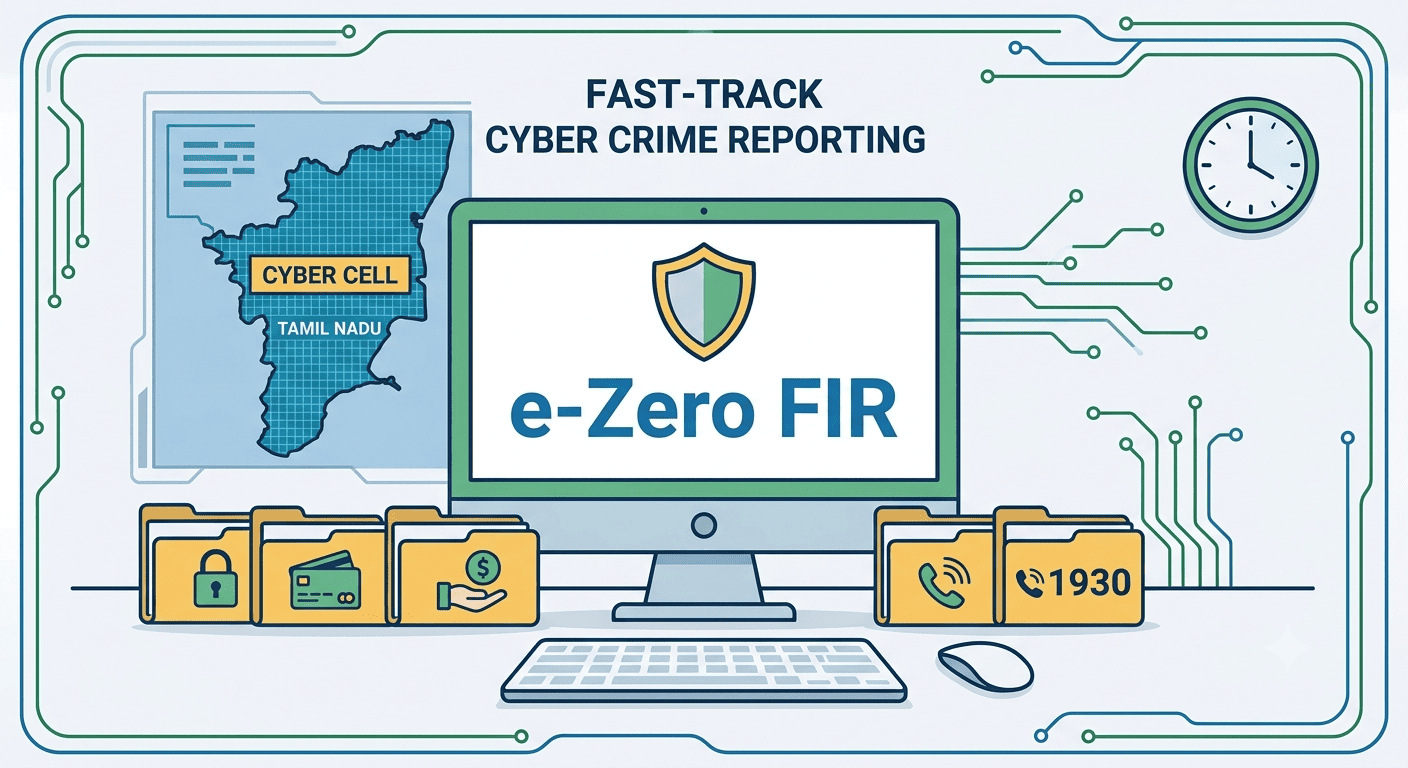

In an effort to strengthen the response to cyber financial fraud, the Tamil Nadu government has introduced the e-Zero FIR system. Under the new mechanism, complaints involving cyber financial frauds of ₹1 lakh or more, reported through the National Cyber Crime Helpline (1930), will now be automatically registered as e-Zero FIRs, enabling faster investigation and improving the chances of recovering defrauded funds.
How the New System Works
According to police, complaints received through the 1930 helpline will be automatically integrated with the Crime and Criminal Tracking Network and Systems and registered as e-Zero FIRs, before being electronically transferred to the jurisdictional Cyber Crime Police Station for investigation, where they will be converted into regular FIRs after necessary verification. Officials said the system eliminates duplicate data entry, significantly reducing the time required for case registration, jurisdictional transfer and the start of investigation, while also facilitating prompt freezing of fraudulent accounts, preservation of digital evidence, and faster fund recovery.
Under the process, victims will receive an SMS confirming their e-Zero FIR’s registration. As required under the Bharatiya Nagarik Suraksha Sanhita, 2023, complainants must visit the concerned police station within three days to authenticate their complaint and complete the legal formalities needed for further investigation.
A Notably Lower Threshold Than the National Model
Tamil Nadu’s ₹1 lakh threshold sets it apart from the framework it is built upon. The Indian Cybercrime Coordination Centre’s original national e-Zero FIR pilot, launched in Delhi, automatically converts financial cybercrime complaints into FIRs only above ₹10 lakh, routing them through a dedicated e-Crime Police Station in the capital before forwarding them to the relevant territorial cyber unit. Odisha’s own recent e-Zero FIR rollout adopted that same ₹10 lakh threshold when it launched its version of the system.
Tamil Nadu’s decision to set its bar a tenth as high mirrors a similar move Delhi Police itself made separately, lowering its e-FIR filing threshold for cyber fraud from ₹10 lakh to ₹1 lakh, with cases then triaged by amount, police stations handling ₹1 to 25 lakh, the Crime Branch handling ₹25 to 50 lakh, and the specialised Intelligence Fusion and Strategic Operations unit handling anything above ₹50 lakh. Tamil Nadu’s approach suggests state authorities increasingly view mid-sized frauds, not just headline-grabbing crore-plus cases, as deserving the same automated, jurisdiction-agnostic urgency.
Why Speed Matters So Much in Cyber Fraud Cases
Police noted that the first few hours after a cyber financial fraud, commonly called the golden hour, are critical for preventing the movement of stolen money, since prompt registration and timely account freezes substantially raise the odds of recovery. The e-Zero FIR mechanism is specifically designed to enable immediate action within that narrow window rather than losing critical hours to jurisdictional back-and-forth.
Tamil Nadu’s cyber crime wing has already demonstrated the value of speed and coordinated intelligence elsewhere, having used a “Pre-Crime Intervention” model built on advanced cyber patrolling to rescue more than 800 individuals from fake investment platforms before they suffered losses, preventing an estimated ₹1,000 crore in potential fraud.
Prof. Triveni Singh, the former IPS officer and cybercrime specialist, said the initial hours following a cyber fraud remain the most critical, and that if a complaint reaches law enforcement and banking channels without delay, fraudulent transactions can often be intercepted before the money is layered or moved further. He said the e-Zero FIR system would let investigators act immediately and significantly improve recovery chances, but stressed that citizens must still report fraud to the 1930 helpline without any delay for the system to work as intended. Tamil Nadu Police have urged the public to report any cyber financial fraud immediately, describing the e-Zero FIR system as a significant technology-driven step toward strengthening the state’s cybercrime response and financial fraud investigations.
