

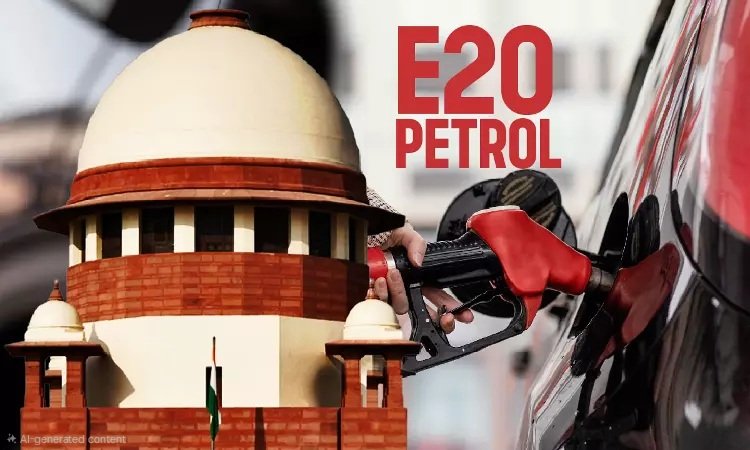
The Supreme Court has dismissed a petition seeking mandatory and uniform disclosure of the exact ethanol content in petrol sold at fuel stations across the country, while allowing the petitioner to approach the competent authority with his grievance.
The plea had sought labelling on every dispensing nozzle to inform consumers of the percentage of ethanol blended into petrol.
A bench of Justices M.M. Sundresh and P.B. Varale declined to entertain the petition filed by advocate Narendra Kumar Goswami. The court also questioned why the petitioner had approached the Supreme Court directly instead of first moving the High Court.
Petitioner sought ethanol percentage on every fuel nozzle
Goswami argued that consumers had a right to know the ethanol content of the petrol they purchased. His plea sought directions to the Central government to ensure mandatory and uniform labelling at petrol pumps, with every dispensing nozzle displaying the exact percentage of ethanol in the fuel.
During the hearing, the bench questioned the petitioner’s locus and asked why the matter had not been taken to a High Court. Goswami maintained that his petition was based on a consumer’s right to information and was not intended to challenge the government’s ethanol-blending policy itself.
Attorney General R. Venkataramani, appearing for the Central government, opposed the petition and pointed to earlier proceedings in which challenges to the policy had been rejected by the Supreme Court.
Goswami, however, distinguished his plea from those cases, arguing that he was seeking disclosure rather than questioning the policy. He compared ethanol disclosure with ingredient information provided on consumer products and reiterated that motorists should be told what proportion of ethanol was present in the petrol they were buying.
The court ultimately refused to entertain the petition and said the petitioner was free to approach the competent authority.
E20 petrol contains 20% ethanol and 80% petrol
E20 petrol is a blend containing 20 per cent ethanol and 80 per cent petrol. The E20 programme is part of the government’s strategy to reduce crude oil imports, lower emissions and encourage the use of domestically produced biofuels.
The introduction of E20 fuel has, however, raised concerns over compatibility with some older vehicles. Questions have been raised over possible fuel-system corrosion, reduced fuel efficiency and the suitability of vehicles that were not specifically designed for E20.
Vehicle manufacturers have increasingly introduced E20-compatible models, but concerns remain over some vehicles sold before 2023.
The debate has also extended to consumer disputes. A district consumer disputes redressal commission in Raipur, Chhattisgarh, recently directed Maruti Suzuki to provide a new Grand Vitara with an E20-compatible engine to a man whose vehicle had allegedly broken down because of the use of E20 fuel.
Concerns continue over older vehicle compatibility
Automotive enthusiasts and experts have increasingly raised objections to the rollout of E20 petrol, particularly over the absence of an option for vehicle owners to choose petrol containing a lower proportion of ethanol.
Some of the criticism has been directed at Union Transport Minister Nitin Gadkari over the push for E20 fuel without offering motorists an alternative with less ethanol.
The Supreme Court’s dismissal does not determine the petitioner’s demand through judicial directions, but leaves him free to raise the issue before the appropriate authority. For now, the wider debate over ethanol disclosure at fuel stations and the compatibility of older vehicles with E20 petrol continues.
