
Follow us on Google News

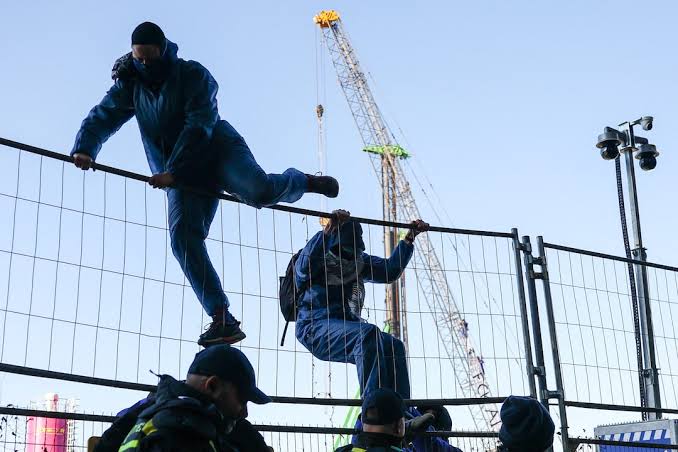
More than 100 protesters entered a Microsoft data centre construction site in Amsterdam on Friday, November 6, 2026, climbing cranes and displaying banners as environmental groups launched coordinated demonstrations against the rapid expansion of artificial intelligence infrastructure across Europe.
The protest targeted a facility being developed by Pure Data Centres for Microsoft in the Dutch capital. Activists crossed the construction-site perimeter, while police monitored the demonstration before moving to clear the site.
The action formed part of a two-day campaign organised by the Stop Dirty Data Centres coalition, which announced demonstrations across 16 countries on November 6 and 7.
Campaigners are demanding a halt to major new data-centre construction until governments establish clearer rules covering electricity demand, water consumption, environmental damage and community participation.
Microsoft said it respected the right to peaceful protest but did not support unlawful or dangerous actions.
FCRF’s Chief AI Officer Certification Returns on November 14 to Prepare Future AI Leaders
Protesters Climb Cranes At Amsterdam Construction Site
The demonstration took place in Amsterdam’s Sloterdijk district, where activists gathered outside the construction site before entering the premises.
Some protesters climbed construction cranes, while others carried banners criticising the environmental consequences of AI infrastructure.
The Dutch activist group Geef Tegengas was involved in the demonstration.
Campaigners argued that data centres place increasing pressure on electricity networks and water supplies while providing insufficient benefits to nearby communities.
They also raised concerns about the use of AI technologies for surveillance and military applications.
Police initially monitored the protest before officers intervened to remove demonstrators. Local reporting indicated that several people were arrested, although a final arrest count was not immediately established.
The project is being developed by Pure Data Centres, which plans to invest more than $1 billion and is backed by Oaktree, a subsidiary of Brookfield.
The developer urged protesters to leave the construction site safely and said it remained willing to discuss concerns with local stakeholders.
Microsoft similarly acknowledged that residents held strong views about the project but maintained that demonstrations should remain lawful.
The incident was a physical intrusion into a construction site, not a cyberattack against Microsoft’s computer networks.
There is no confirmed evidence that protesters accessed company data, compromised servers or disrupted operating cloud services.
Demonstrations Spread Across European Countries
The Amsterdam protest was part of a wider campaign against the construction of large AI and cloud computing facilities.
Organisers announced activities in 16 countries, including demonstrations in Ireland, Poland and Denmark.
In Dublin, campaigners planned a march highlighting the strain that data centres can place on electricity infrastructure.
In Warsaw, activists planned a demonstration near the Polish parliament, while protesters in Denmark targeted another Microsoft-related data-centre development.
The coordinated campaign reflects growing opposition to the expansion of facilities required to train and operate advanced AI systems.
Data centres house specialised computer processors, storage equipment and networking infrastructure.
Large AI facilities can consume substantial electricity, while some cooling technologies also require significant quantities of water.
Campaigners argue that developers should explain how new facilities will affect household utility costs, local water supplies and environmental commitments before receiving permission to build.
The coalition says it does not oppose technological progress or demand the closure of existing data centres.
Instead, it wants governments to pause large-scale construction until appropriate safeguards and oversight arrangements are established.
Technology companies, meanwhile, argue that expanded data-centre capacity is essential for cloud computing, AI development and digital services used by businesses and governments.
Europe Faces Difficult Choices Over AI Infrastructure
The protests come as European governments seek to expand domestic AI computing capabilities while addressing the environmental consequences of new infrastructure.
European Commission technology chief Henna Virkkunen has argued that the region needs more computing capacity to compete internationally and reduce dependence on overseas technology providers.
However, she also emphasised that governments must prevent data-centre expansion from causing severe electricity-price increases, power shortages or environmental damage.
The Netherlands already has approximately 200 data centres operating, planned or under construction.
Across Europe, governments are facing pressure to examine whether existing planning and environmental regulations adequately address the demands of large computing facilities.
Italy and Portugal have been tightening regulatory scrutiny of data-centre development.
A Google-related project in Finland is facing a criminal investigation concerning land clearance, although that investigation is separate from the Amsterdam protest.
Microsoft has also withdrawn from a British data-centre project affected by infrastructure delays.
These developments illustrate how access to electricity, land and environmental approvals can affect the expansion of AI infrastructure.
However, the existence of public opposition does not establish that every data-centre project has violated environmental regulations.
The impact of individual facilities depends on their location, energy arrangements, cooling technology and construction practices.
What The Protest Means For Big Tech Expansion
The November 6 demonstrations highlight a growing challenge for major technology companies investing heavily in AI infrastructure.
Building additional computing capacity requires more than securing equipment and financing. Developers must also negotiate with electricity providers, obtain regulatory approvals and maintain support from surrounding communities.
Opposition can delay construction, increase project costs and encourage governments to introduce additional environmental requirements.
The issue is relevant to India, where proposed data-centre developments have also attracted scrutiny over electricity, water and land use.
For Microsoft and other major technology companies, the immediate question is whether future projects can demonstrate measurable community benefits while addressing concerns about resource consumption.
The Amsterdam incident does not establish that the Microsoft-linked development will be cancelled or that work has been permanently suspended.
For now, the confirmed development is the construction-site protest and the wider international campaign demanding stronger oversight of AI infrastructure.
What This Means For You:
Residents living near proposed data centres should examine publicly available environmental assessments, electricity arrangements and water-use plans. Developers and public authorities should clearly explain how such projects will affect local infrastructure and communities.