

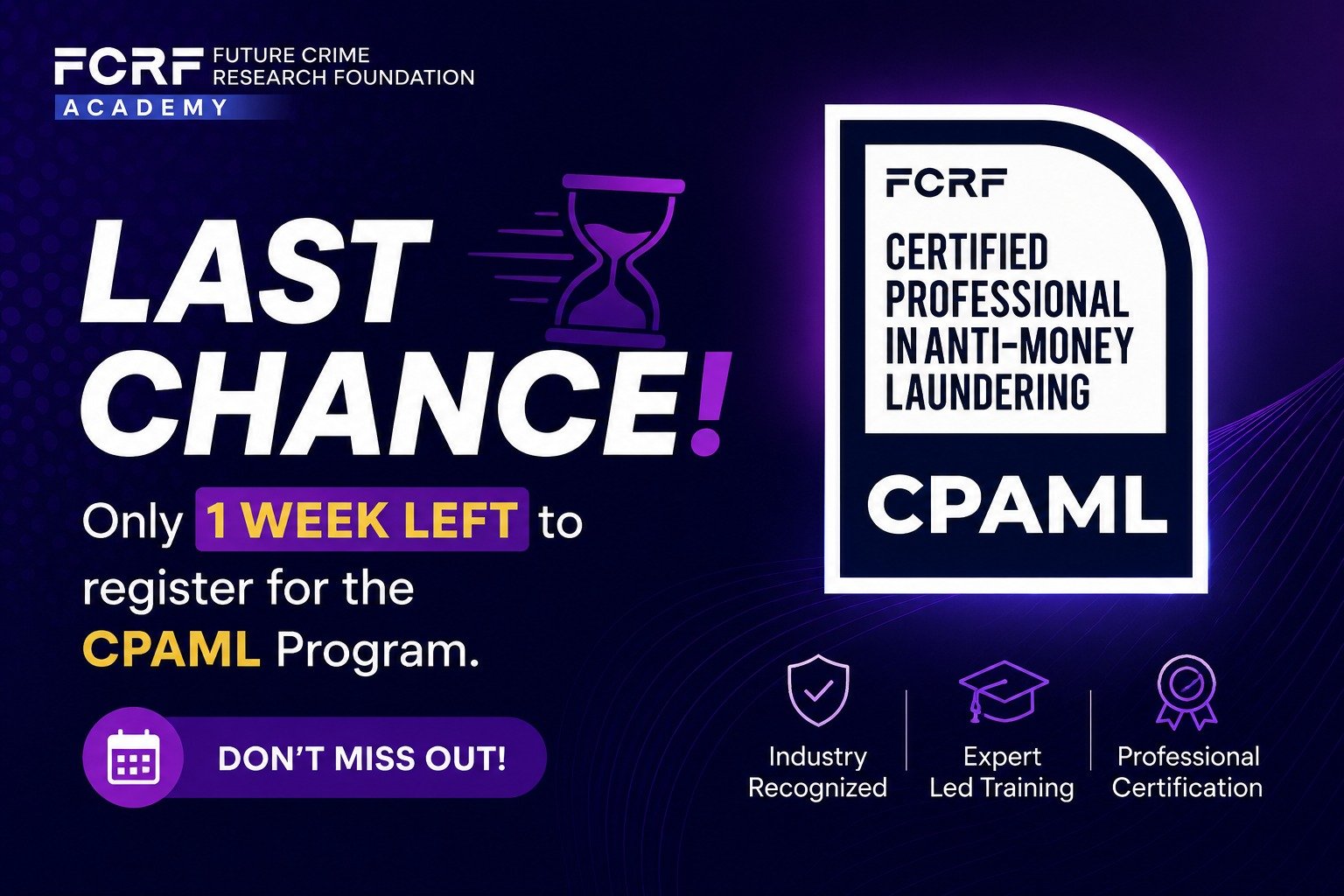

FCRF Academy’s Certified Professional in Anti-Money Laundering (CPAML) program is entering its final registration phase, with the next cohort scheduled to begin on May 16, 2026, in a weekend format from 11 a.m. to 1 p.m. The program is listed as a four-week certification with 16 modules and is currently open for enrollment on the academy’s platform.
The approaching start date gives the course a more urgent frame than a standard training announcement. For professionals in banks, fintech firms, insurance, audit, legal advisory, investigations and compliance departments, the timing comes as financial crime risks are becoming more complex, more digital and more closely watched by regulators.
FCRF Academy has presented CPAML as a practitioner-led program for professionals working across compliance, banking, legal practice, investigations, audit and risk functions. Earlier coverage of the launch described the upcoming cohort as a limited-seat program designed around India’s evolving compliance environment.

Why AML Training Has Become Harder to Ignore
Anti-money laundering compliance has moved well beyond periodic training and procedural documentation.
Today, AML teams are expected to understand customer due diligence, suspicious transaction reporting, sanctions screening, politically exposed person checks, beneficial ownership, transaction monitoring and escalation systems. In many institutions, these functions now sit close to enterprise risk, regulatory liability and reputational exposure.
That is why a short, focused certification can carry practical value for working professionals. The CPAML curriculum, according to the academy’s course positioning, covers areas including the Prevention of Money Laundering Act, KYC and due diligence obligations, beneficial ownership, sanctions and PEP screening, transaction monitoring, suspicious transaction reporting and emerging financial crime risks such as digital laundering and virtual assets.
The pressure is particularly visible in banking and compliance roles, where lapses are rarely treated as isolated errors. A weak AML process can affect onboarding, monitoring, investigations, reporting and institutional trust. For professionals handling these responsibilities, awareness is no longer enough; the market increasingly rewards those who can show structured, role-based competence.
FCRF Academy’s Positioning in Professional Risk Education
The CPAML program also draws on FCRF Academy’s broader attempt to build a certification ecosystem around cybersecurity, governance, cyber law, fraud investigation, digital resilience and compliance.
FCRF’s website describes the Future Crime Research Foundation as an IIT Kanpur’s AIIDE-CoE incubated nonprofit working across cybersecurity, digital crime, fraud risk management, cyber laws, cyber forensics and policy research, with more than 14,000 professionals trained across its ecosystem.
FCRF Academy’s program portfolio includes certifications such as CPAML, Certified Governance, Risk & Compliance Professional, Certified Cyber Crisis Management Professional, Certified CISO, Certified Cyber Law Practitioner, Certified Fraud Investigator and Certified Data Protection Officer.
That background matters because CPAML is not being introduced as a standalone credential in an unfamiliar domain. It is being placed within a wider professional education stack built around risk, regulation, investigation and institutional preparedness. For banking and compliance professionals, that gives the program a more specific identity: not just AML theory, but AML as part of a larger financial-crime and governance framework.
The Urgency Behind the Final Call
The final week before the May 16 start date is likely to be important for professionals who have been considering the program but have not yet registered.
The academy’s earlier launch framing emphasized that AML is becoming a career priority as banks, fintechs, corporates and legal teams respond to stronger regulatory expectations and more sophisticated laundering typologies. The current registration window turns that broader argument into a decision point for learners who want to join the upcoming cohort rather than wait for a later cycle.
The strongest case for CPAML is not that every professional needs another certificate. It is that the compliance profession itself is becoming more specialized, and AML is one of the clearest examples of that transformation. The people expected to detect, document, escalate and respond to suspicious financial activity now need a working command of both regulatory language and operational controls.
As the May 16 cohort approaches, FCRF Academy’s message is straightforward: AML capability is no longer optional for professionals working near money movement, customer onboarding, fraud risk or financial investigations. For many of them, this may be the week to decide whether they want to treat anti-money laundering as a checkbox or as a professional competency. Interested participants can click here to register for the Certified Professional in Anti-Money Laundering (CPAML) program.
Follow for daily updates on cybercrime, corporate fraud, DFIR, hacking, investigations, and digital forensics
