
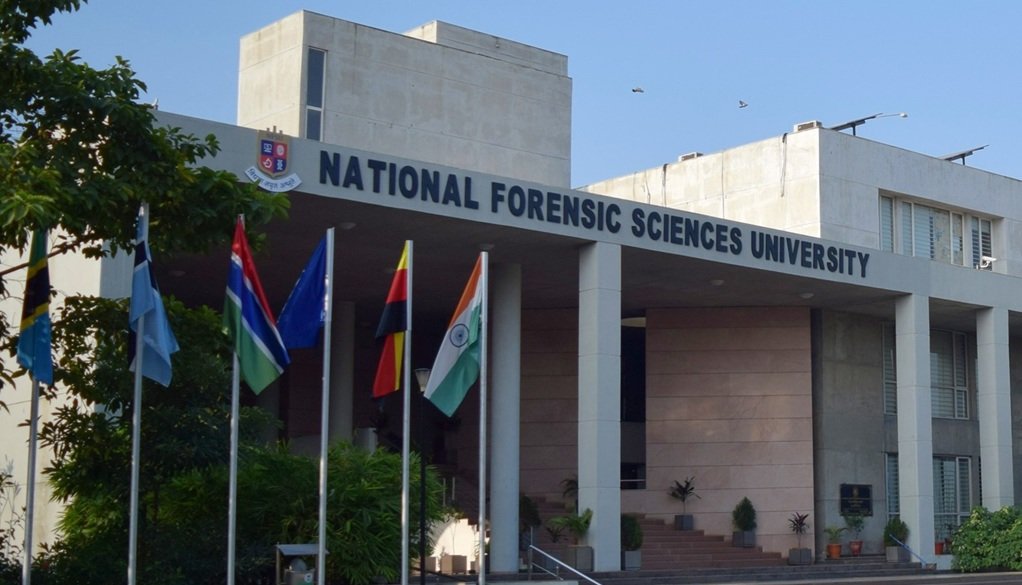

At a moment when India’s criminal justice system is grappling with increasingly complex crimes—from cyber intrusions to DNA-based investigations—the National Forensic Sciences University has opened a wide recruitment window. The move signals not just a hiring exercise, but a quiet recalibration of how the state is investing in forensic capacity.
A University Born of National Priorities
The National Forensic Sciences University (NFSU), India’s only university dedicated exclusively to forensic science, has announced a fresh round of recruitment for scientific and technical positions across its campuses. Issued under a detailed recruitment advertisement for 2025–26, the notification reflects the institution’s expanding role at the intersection of law, science, and internal security.
Established as an institution of national importance, NFSU was conceived to address a long-standing gap in India’s criminal justice ecosystem: the shortage of trained forensic professionals capable of supporting modern investigations. Over the past decade, as courts, police forces and investigative agencies have increasingly relied on scientific evidence, the demand for skilled forensic manpower has steadily outpaced supply.
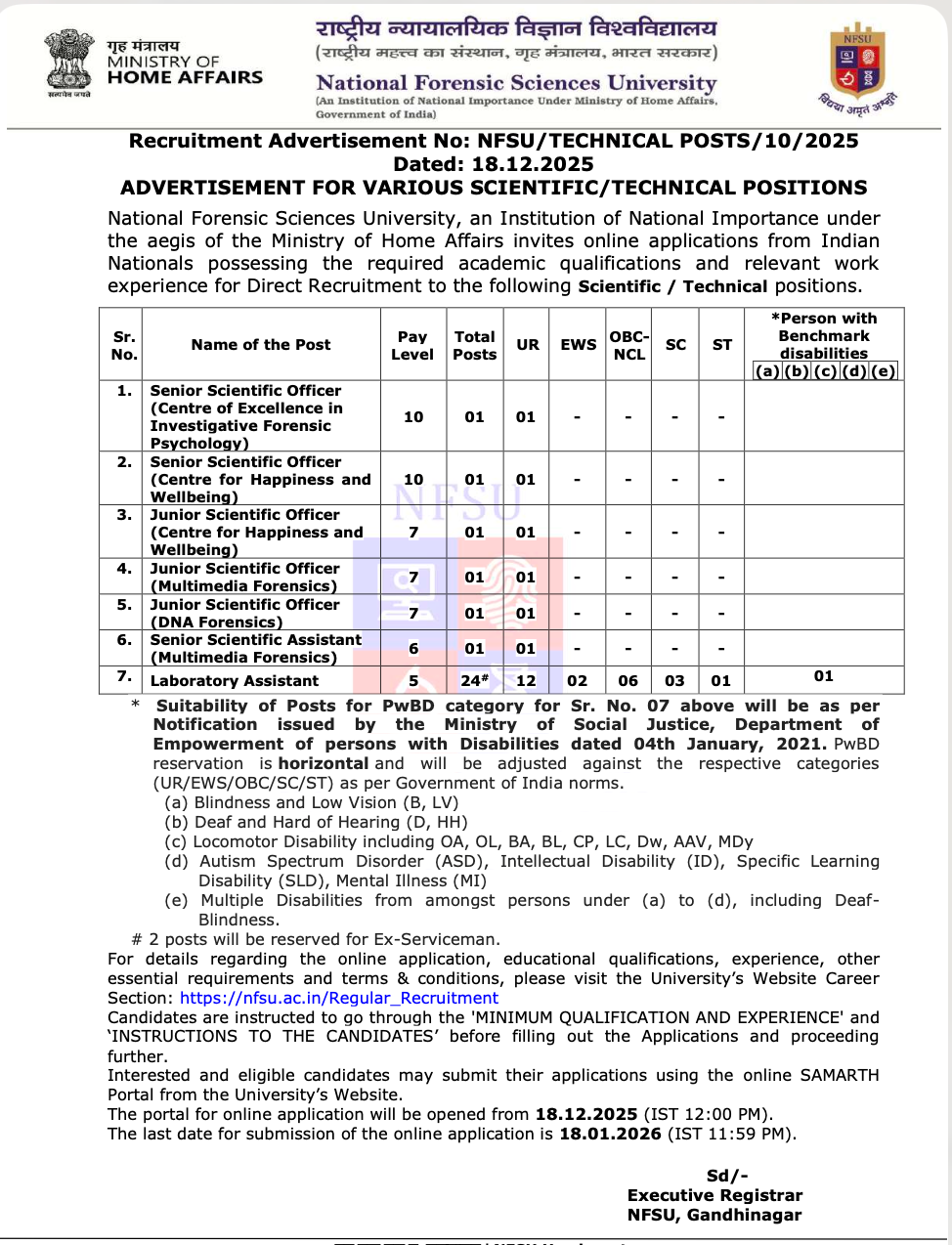
The new recruitment drive, officials say, is aimed at strengthening that backbone—laboratories, classrooms and research units where forensic evidence is analysed long before it reaches a courtroom.
What the Recruitment Looks Like on Paper
According to the notification, NFSU is inviting applications for a range of scientific, technical and laboratory roles, including scientific officers, technical assistants, laboratory staff and domain-specific experts. The posts span multiple disciplines: forensic chemistry, DNA analysis, cyber forensics, digital evidence examination, psychology, ballistics and allied scientific fields.
Unlike routine government hiring, the emphasis here is on specialised qualifications and hands-on experience. Many of the positions require advanced degrees in science or technology, along with demonstrated laboratory or research exposure. The recruitment also includes technical and support roles essential to the functioning of forensic labs—positions that rarely make headlines but are critical to ensuring evidence integrity.
The appointments, to be made through a structured selection process, reflect NFSU’s hybrid character: part academic institution, part operational backbone for India’s forensic infrastructure.
Why Forensic Hiring Has Taken on New Urgency
The timing of the recruitment is not accidental. Across India, investigative agencies are confronting crimes that are increasingly digital, transnational and technologically sophisticated. From deepfake-enabled frauds and encrypted communication trails to complex DNA mixtures in violent crimes, traditional investigative tools are no longer sufficient.
Courts, too, have become more exacting in their scrutiny of forensic evidence, demanding higher standards of scientific rigour and documentation. Delays and backlogs in forensic laboratories—often caused by staff shortages—have been cited in multiple judicial observations as a systemic weakness.
By expanding its scientific workforce, NFSU is positioning itself as both a training ground and a capacity multiplier. Graduates and researchers trained within the university frequently go on to serve in state forensic labs, central agencies and policy advisory roles, giving the recruitment implications far beyond campus boundaries.
Between Academia and the State
What sets this recruitment apart is the institutional space NFSU occupies. Unlike conventional universities, its mandate is closely aligned with state functions—criminal investigation, national security, and judicial processes. At the same time, it operates within an academic framework that values research, peer review and scientific independence.
This dual identity brings its own challenges. Recruiting highly qualified forensic experts into public institutions has historically been difficult, given competition from private laboratories and international opportunities. The current drive appears to be an attempt to close that gap by offering structured roles within a national institution, backed by long-term research and teaching prospects.
For aspiring forensic professionals, the notification offers a rare entry point into a field that is both scientifically demanding and institutionally consequential. For the state, it represents a quieter but significant investment in the credibility of evidence itself—the unseen foundation on which policing and justice increasingly rest.
As applications open and scrutiny begins, the recruitment will test whether India can successfully build and retain the scientific expertise its evolving crime landscape now requires.
