
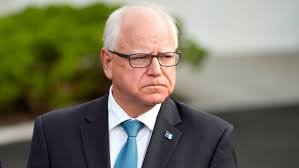
Politics in the US state of Minnesota has intensified after serious allegations emerged against Tim Walz, accusing his administration of a massive fraud of nearly ₹75,000 crore in social welfare programs. The issue surfaced during a recent House committee hearing, where Republican lawmakers mounted a sharp attack, alleging widespread financial irregularities over several years.
During the hearing, Republican leaders Isaac Schultz and Peggy Scott claimed that multiple state-run welfare schemes were affected by systemic fraud. According to them, the alleged irregularities were not isolated incidents but part of a prolonged pattern that went unchecked due to weak oversight and delayed intervention by the administration.
One of the most contentious aspects of the controversy involves whistleblowers. Republican lawmakers alleged that individuals who attempted to expose discrepancies within these welfare programs faced retaliation. In several instances, they claimed, whistleblowers were either ignored or removed from their positions, raising serious concerns about administrative transparency and internal accountability mechanisms.
So far, there has been no detailed official response from Governor Tim Walz or his office addressing the allegations in depth. However, political observers believe the matter could escalate significantly in the coming days, particularly because it involves public funds and schemes intended for economically vulnerable communities.
FCRF Academy Launches Premier Anti-Money Laundering Certification Program
Scope of Alleged “Somali Fraud”
According to the allegations, the suspected fraud primarily took place in welfare programs designed to provide financial and social support to low-income groups. Lawmakers claimed that the misuse of funds occurred through fake beneficiaries, improper disbursements and loopholes in verification systems. The term “Somali fraud” was also referenced during the hearing, indicating that investigators may be examining specific networks or transaction patterns, although no official clarification has confirmed this angle.
Experts note that such large-scale financial irregularities are often rooted in systemic weaknesses. Inadequate data verification, lack of real-time monitoring and insufficient audit mechanisms can allow small discrepancies to grow into major financial scandals. Without strong institutional safeguards, welfare systems handling large volumes of funds become vulnerable to exploitation.
Political and Governance Implications
The timing of the controversy is also significant. The United States is already witnessing heightened political polarization, with tensions between Republican and Democratic parties continuing to rise. Allegations of this scale are likely to deepen political divisions and may become a central issue in upcoming electoral debates.
From a governance standpoint, the case raises critical questions about the effectiveness of oversight in publicly funded welfare programs. If proven true, the alleged scam could represent not only a major financial loss but also a serious blow to public trust in government institutions. Welfare schemes are often lifelines for vulnerable populations, and any misuse of such funds can have far-reaching social consequences.
Protecting Whistleblowers and Future Probes
The situation also underscores the importance of protecting whistleblowers. Individuals who come forward with information about irregularities play a crucial role in maintaining institutional integrity. Without adequate safeguards, fear of retaliation can discourage others from reporting wrongdoing, allowing systemic issues to persist unchecked.
As the controversy unfolds, attention is now focused on whether an independent investigation will be initiated to examine the allegations thoroughly. Political analysts suggest that the outcome of any such probe could have significant implications, not only for Minnesota’s political landscape but also for broader national discourse on governance and accountability.
For now, the issue remains at the center of political debate, with both sides preparing for a prolonged confrontation. What is certain is that the allegations have triggered a major political upheaval, and their impact is likely to be felt well beyond state boundaries in the days ahead.
