

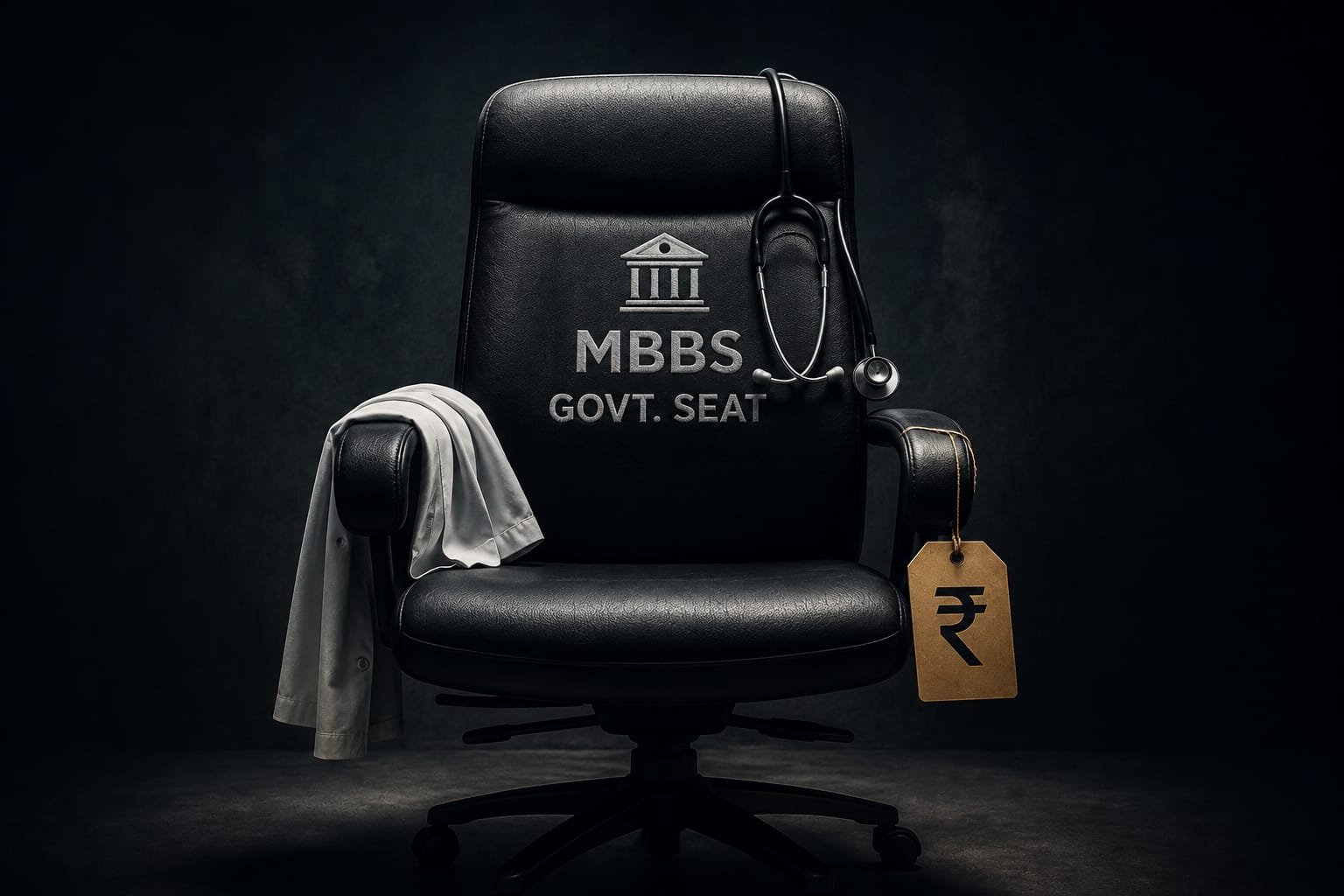
An alleged medical admission racket has been offering government MBBS seats to candidates with low NEET scores by exploiting domicile and quota provisions, raising questions over whether admission safeguards can be manipulated through questionable documents and large payments. The allegations suggest that candidates who may struggle to secure a government seat on merit are being promised alternative routes into medical colleges for sums running into lakhs and, in some cases, crores.
Algoritha Security Launches ‘Make in India’ Cyber Lab for Educational Institutions
Low NEET scores, but promises of government MBBS seats
At the centre of the alleged racket are candidates whose NEET scores or ranks may not ordinarily be sufficient for the government medical seats they are seeking.
Instead of altering NEET results, the suspected operation appears to focus on the next stage of admission, where a candidate’s eligibility for different quotas becomes important.
Government seats were allegedly being promised by claiming access to state and NRI quota routes. In one case, a candidate with 430 NEET marks was allegedly offered a government medical college seat in Rajasthan through the NRI quota.
The arrangement was quoted at ₹10 lakh, with another ₹5 lakh sought for paperwork.
Domicile documents at the heart of alleged manipulation
State domicile rules have emerged as a major concern in the alleged admission racket.
Candidates who are not ordinarily eligible for a state’s quota were allegedly being offered documentation that could establish a purported residential connection with that state.
The allegations involve residency-related records such as address proof, voter identification and electricity connections. Such documents can become significant during counselling because domicile status determines eligibility for seats reserved under state quotas.
The suspected misuse of these provisions could place genuine state-quota candidates at a disadvantage if ineligible applicants are able to enter the same admission pool.
Lakhs demanded for seats, paperwork and admission
Large financial demands were allegedly attached to the promises of government medical admission.
One government MBBS seat offer was priced at ₹18 lakh, with payments linked to documentation, verification and admission. Another alleged arrangement involving the NRI quota carried separate charges for securing the seat and preparing the necessary papers.
The scale of the amounts indicates that the allegations go beyond ordinary admission consultancy and centre on claims of influencing a candidate’s eligibility for highly sought-after medical seats.
Document verification comes under scrutiny
The allegations also raise concerns over the effectiveness of verification during medical counselling.
Domicile certificates and other eligibility records can determine whether a student is entitled to compete for a particular category of government medical seats. Questionable documents entering the counselling system could therefore have consequences beyond a single candidate.
The allegations nevertheless put attention on whether existing verification mechanisms are strong enough to identify improperly obtained eligibility documents.
Alleged admission links stretch across states
Claims surrounding the suspected racket were not limited to one medical college or one state. Government medical admissions in Rajasthan, West Bengal and other states were cited in connection with alleged admission arrangements.
The emerging picture is of a suspected commercial network built around one of the most competitive stages of medical education: access to government MBBS seats.
At its core, the controversy concerns whether domicile and quota provisions designed for eligible candidates are being exploited to offer an unfair route into government medical colleges to those willing to pay substantial sums.
For students and parents, the allegations underline the need for caution during medical admissions. Candidates should rely only on official counselling channels and verified eligibility rules, and should be wary of anyone promising a government MBBS seat in exchange for money, fabricated domicile claims or guaranteed quota access. Any suspicious admission offer or demand for payment outside the official process should be reported to the appropriate authorities.
About the author — Ayesha Aayat writes on cybercrime, digital safety, and emerging online threats. Her work focuses on public awareness, legal clarity, and technology-driven risks.
