

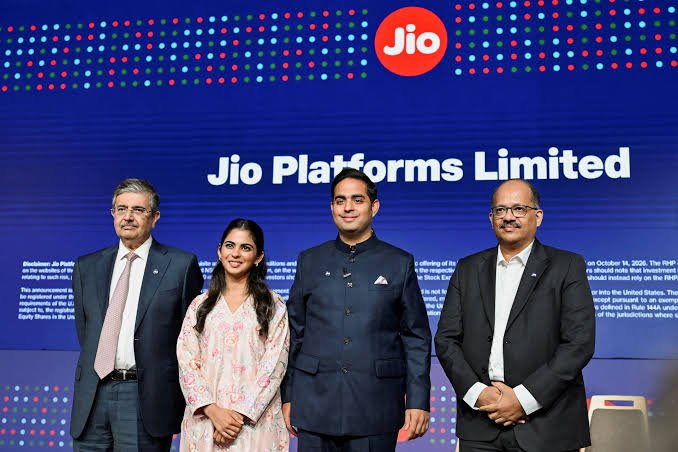

Retail investors have fully subscribed their portion of Jio Platforms’ record-breaking initial public offering as demand for India’s biggest-ever IPO accelerated during the second day of bidding.
The $3.2 billion share sale attracted bids for more than five times the shares available by later on October 22, according to exchange data cited by Reuters.
Institutional investors led the demand, while the retail category crossed full subscription after starting more slowly earlier in the offer.
The IPO marks Reliance Industries’ first public listing of a major business in about two decades and could make Jio one of India’s most valuable listed companies.
FCRF’s Chief AI Officer Certification Returns on November 14 to Prepare Future AI Leaders
Institutional Investors Drive Demand
Qualified institutional buyers emerged as the strongest category in the offering.
By later on October 22, their portion had received bids for nearly 12 times the shares reserved for them.
Retail investors had also fully covered their allocation.
Demand increased sharply from the earlier stages of bidding, when retail participation had lagged behind institutions.
Jio had already attracted substantial interest before the public offer opened.
The company raised about ₹8,110 crore from more than 200 anchor investors, including major global funds and domestic financial institutions.
Investors included BlackRock, Fidelity, Abu Dhabi Investment Authority and several large Indian mutual funds and insurers.
The strong demand shows the scale of investor interest surrounding one of India’s most anticipated technology listings.
India’s Largest IPO Values Jio Above $100 Billion
Jio Platforms is seeking to raise about $3.2 billion through the IPO.
At the upper end of the price range, the offering values the company at approximately $108.3 billion.
That would place Jio among India’s largest publicly traded companies after listing.
The offer consists primarily of new shares rather than existing shareholders selling large stakes.
Jio plans to use most of the proceeds to repay or prepay borrowings at telecom subsidiary Reliance Jio Infocomm.
Reducing debt could strengthen the company’s balance sheet as it increases investment in areas such as artificial intelligence, cloud computing and digital services.
Trading in Jio shares is expected to begin on the BSE and NSE on October 28, subject to completion of the allotment process.
Telecom Still Generates Most of Jio’s Revenue
Jio is often described as a technology and digital-services business, but telecom remains its financial backbone.
Around 90% of Jio Platforms’ revenue comes from its telecommunications operations, according to Reuters.
The business has more than 500 million subscribers.
Its rapid growth began after Reliance Jio launched commercial mobile services in 2016 with aggressively priced data and voice plans.
That strategy triggered a major restructuring of India’s telecom industry.
Several smaller operators disappeared or merged as intense price competition pushed down mobile-data costs.
Jio has since expanded into broadband, cloud services, streaming, digital commerce and artificial intelligence.
The IPO gives investors a way to value those businesses separately from Reliance Industries’ energy, retail and other operations.
Meta and Google Remain Major Strategic Investors
Jio already has some of the world’s largest technology companies among its shareholders.
Meta invested in Jio Platforms in 2020 and owns a significant minority stake.
Google also invested billions of dollars as part of Reliance’s earlier fundraising drive.
Those investments helped Jio raise more than $20 billion from global technology companies and private-equity firms.
The relationships have also moved beyond financial investment.
Jio and Google have worked together on affordable smartphones and cloud technology, while Meta has integrated services such as WhatsApp with Reliance’s digital-commerce operations.
Jio is now expanding further into AI.
That strategy has become an important part of how the company presents itself to investors.
Rather than remaining primarily a telecom operator, Jio wants to become a broader digital infrastructure company spanning connectivity, cloud services and AI.
IPO Becomes Major Test for Indian Tech Valuations
The listing is being closely watched because of its size and Jio’s importance within Reliance Industries.
It also comes at a time when investors are examining whether technology companies can justify large valuations through sustainable earnings.
Unlike many younger technology firms, Jio already generates substantial revenue from a mature telecom business.
That may make the IPO easier for investors to assess.
Strong subscription figures, however, do not guarantee how the stock will perform after listing.
IPO demand can be influenced by market conditions, institutional positioning and expectations of short-term listing gains.
Jio’s longer-term valuation will depend on subscriber growth, telecom pricing, capital expenditure and its ability to generate meaningful revenue from newer businesses such as AI and cloud services.
For Reliance Industries, the listing could also establish a separate public-market valuation for one of the group’s most important businesses.
What this means for you:
Heavy IPO subscription shows strong investor demand, but it does not guarantee post-listing returns. Retail investors should assess Jio’s valuation, earnings and long-term growth prospects rather than relying only on oversubscription figures.
Follow for daily updates on cybercrime, corporate fraud, DFIR, hacking, investigations, and digital forensics
