

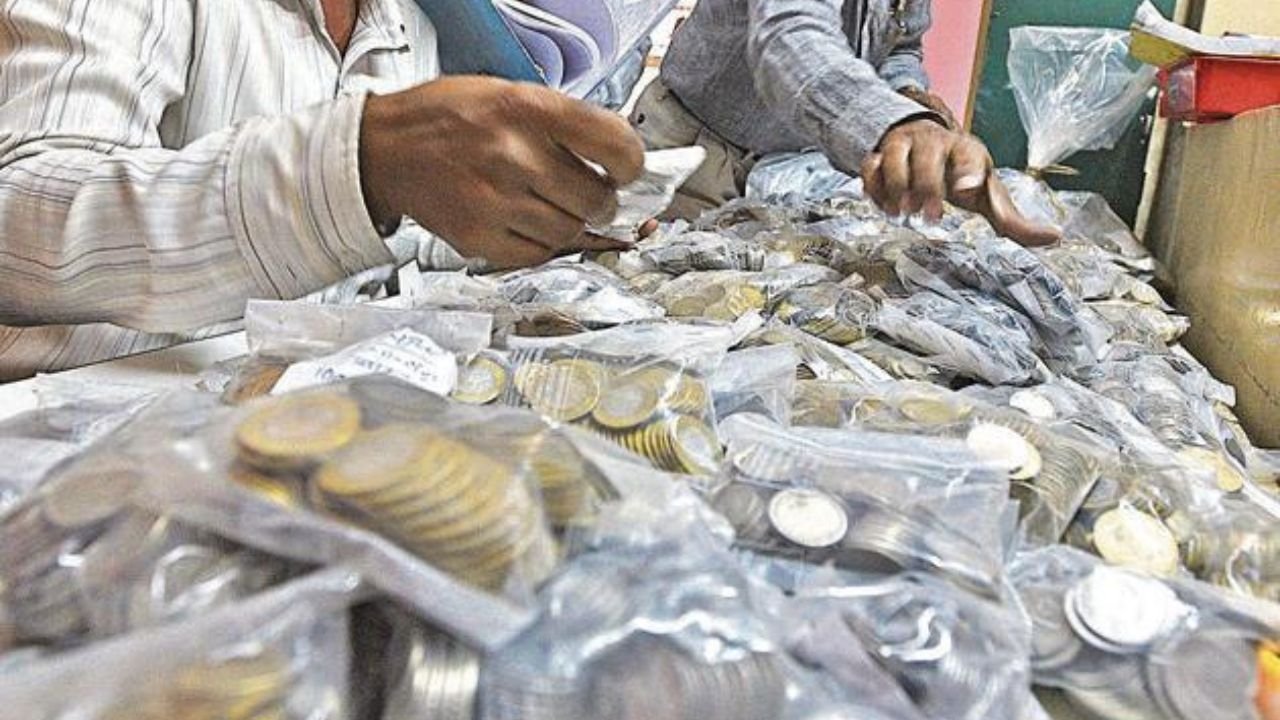

Hathras: Authorities in Uttar Pradesh’s Hathras district have uncovered an alleged coin black-marketing operation after a joint raid by the district administration and police led to the seizure of 102 sacks filled with ₹5 and ₹10 coins from the premises of a local book seller. Officials estimate the total face value of the recovered coins at around ₹4 million (₹40 lakh). The administration said a detailed investigation is underway, and legal action will proceed after the counting and verification of the seized coins are completed.
According to officials, the raid was conducted following confidential information that a large quantity of coins had been stockpiled and was being traded illegally from premises located in Hanuman Gali. Acting on the tip-off, a joint team led by the Sub-Divisional Magistrate and officers from Hathras Gate Police Station simultaneously searched locations in Hanuman Gali and Nayaganj on Saturday. During the operation, officers searched the shop and warehouse attached to the residence of a book seller identified as Naveen, where they recovered 102 sacks filled with coins.
Authorities said the seized cache primarily consisted of ₹5 and ₹10 denomination coins. After the recovery, officials secured the stock and initiated the process of counting and verifying the currency. While the preliminary estimate places the value of the seized coins at approximately ₹4 million, the exact amount will be confirmed only after the counting process is completed.
During questioning, the accused allegedly admitted that he had been collecting coins in bulk and transporting them to Delhi. Investigators claim he purchased coins with a face value of ₹100 for around ₹85 and sold them in Delhi, where demand for loose change was reportedly higher. According to the investigation, the transactions allegedly generated profits ranging between 5% and 10%. Police are now attempting to identify others who may have been involved in the network and determine how the procurement, transportation and distribution of the coins were organised.
Investigators are also examining the accused’s links with traders, intermediaries and other individuals who may have participated in the alleged operation. Financial records, banking transactions and other digital evidence are being analysed to establish whether the activity was confined to the local area or extended to other states. Officials said the role of additional suspects would be examined if further evidence emerges during the investigation.
The Sub-Divisional Magistrate said the seized coins are being formally verified and that the process of registering a First Information Report (FIR) under the applicable legal provisions has begun. Police stated that the accused was not arrested immediately because the offences currently under investigation carry a maximum punishment of less than seven years under the applicable legal framework. However, he continues to be questioned and has been directed to cooperate with the investigation. Authorities added that further legal action would depend on the evidence collected during the inquiry.
Experts note that Indian coins are legal tender, and artificially creating a shortage of circulating coins for financial gain can adversely affect the monetary system. Large-scale hoarding of coins may disrupt retail trade, public transport, small businesses and other cash-based daily transactions. For this reason, enforcement agencies generally treat such cases seriously and investigate the source, supply chain and distribution network involved.
Police are now focused on identifying everyone connected to the alleged purchase and sale of the coins, preparing a complete inventory of the seized currency and examining the financial aspects of the suspected operation. Officials said appropriate legal action would be taken after the investigation is completed and all available evidence has been thoroughly assessed.
About the author — Suvedita Nath is a science student with a growing interest in cybercrime and digital safety. She writes on online activity, cyber threats, and technology-driven risks. Her work focuses on clarity, accuracy, and public awareness.
Follow for daily updates on cybercrime, corporate fraud, DFIR, hacking, investigations, and digital forensics
