

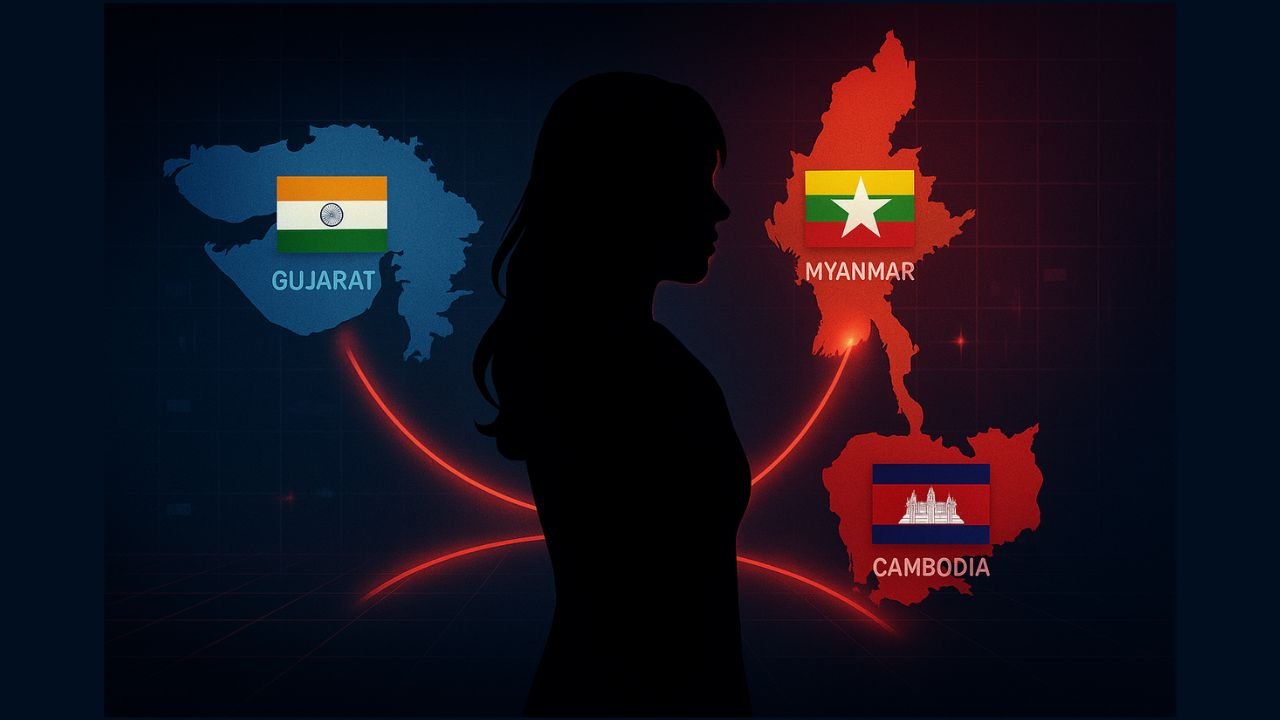

Authorities in Gujarat say a Vadodara-based woman played a key role in one of the most intricate trafficking pipelines uncovered in India in recent years—a system that channeled unsuspecting job seekers into cyber-fraud compounds across Myanmar and Cambodia. The Cyber Crime Centre for Excellence of the Gujarat CID announced the arrest of Payal Chauhan, alleging that she served as a sub-agent in a network that has grown into a major focus for Indian and Southeast Asian law-enforcement agencies.
Algoritha Prepares You for Seamless DPDP Compliance — Contact Us for Complete Implementation Support
Her arrest marks the sixth in a case that has increasingly revealed connections between local recruiters, Pakistani intermediaries, and Chinese cyber syndicates operating across both sides of the Thai–Myanmar border. Police officials describe the system as one in which trafficked Indian workers were turned into “cyber slaves,” forced to perpetrate online scams under threats of violence.
A Promise of Overseas Work That Led to Coercion and Exploitation
According to investigators, Chauhan was recruited by Nilesh “Neel” Purohit, the alleged Gujarat kingpin arrested last week. Her role, officials said, involved identifying vulnerable job seekers—often young men hoping for a high-paying foreign placement—and promising them data-entry or customer support roles in Thailand or Myanmar. From there, the pipeline moved swiftly: airfare arranged, documents collected, and transit facilitated through airports until victims were handed over at the destination.
What awaited them, authorities say, bore no resemblance to what they had been promised. Passports, mobile phones, and identity documents were confiscated immediately. Victims were taken through illegal border crossings, including routes along Myanmar’s Moei River, and delivered to compounds in KK Park and other enclaves run by internationally coordinated cybercrime groups.
Inside these compounds, recruits were forced to work long hours running phishing operations, crypto scams, romance frauds, Ponzi schemes, and a shifting catalogue of digital deceptions targeting consumers across the world. Those who resisted, officials note, were met with physical violence, confinement, or deprivation.
International Pressure and a High-Stakes Race to Rescue Indian Nationals
The emergence of cyber-fraud compounds in post-coup Myanmar has placed Indian authorities under growing pressure, especially as hundreds of Indian citizens began contacting families and government channels for help.
Over the past three years, nearly 4,000 Indians have been repatriated, through efforts involving the Ministry of External Affairs, Interpol, the CBI, the Intelligence Bureau, and state police forces. These rescues, officials say, were made possible only through complex negotiations with foreign governments and local power brokers who control the borderland zones where many of the scam centers operate.
Investigators say numerous victims explicitly named Chauhan and Purohit as the agents who arranged their travel, some alleging they were misled until the moment they were handed over to Chinese handlers inside Myanmar. Passport images of Pakistani and Nepali nationals found on Chauhan’s mobile phone suggest the network may have been recruiting across multiple countries.
Betting Rings, Crypto Channels, and the Financial Web Behind Cyber Slavery
Beyond trafficking, Chauhan is accused of helping sustain the financial machinery underpinning the cyber-fraud industry. According to police, she facilitated “mule” bank accounts used to launder illegal proceeds and handled master IDs for online cricket betting operations managed from Dubai and Goa. She is also suspected of enabling cryptocurrency-based settlements—an increasingly preferred method for cyber syndicates seeking anonymity and cross-border transferability.
Her arrest adds to a cluster of detentions that include Purohit’s close associates Hitesh Somaiya, Sonal Faldu, Bhavdeep Jadeja, and Hardeep Jadeja. Investigators say the network extended far beyond Gujarat, linking small-time agents with multinational criminal groups that thrive on unstable border regions and fragmented jurisdiction.
As one senior official put it, the challenge now is not only identifying the recruiters but “unraveling the wider ecosystem that allowed thousands of Indians to be trapped in foreign compounds under the guise of employment.”
