


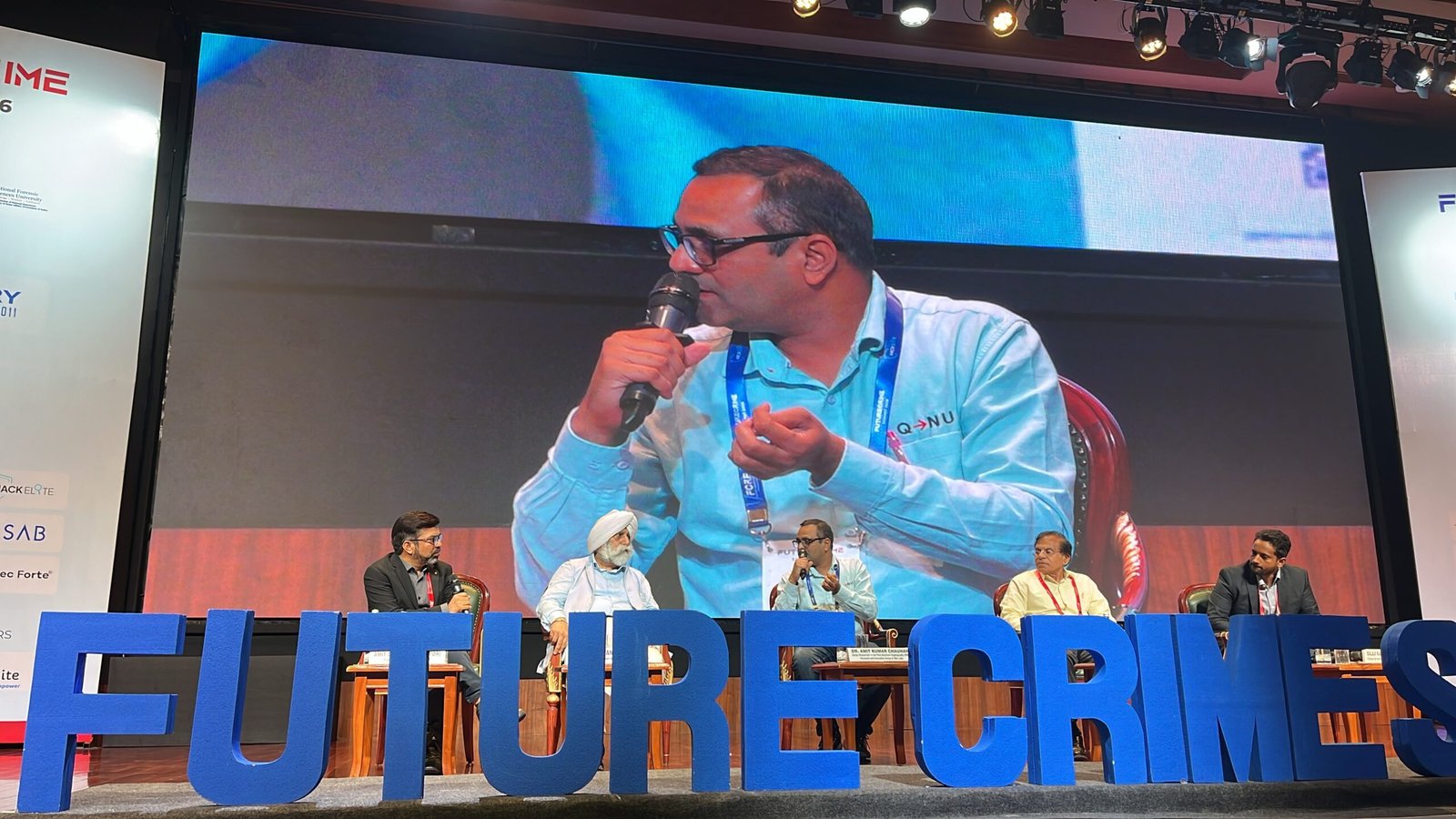
New Delhi: Continuing the high-level morning deliberations on the second day of the FutureCrime Summit 2026 at Bharat Mandapam, leading researchers, legal luminaries, and technical experts convened for Panel 9. Titled “Beyond Encryption: Quantum-Safe Security and Future Tech-Crimes,” the session examined the existential security challenges posed by quantum computing, post-quantum cryptography (PQC), and the convergence of artificial intelligence with advanced data decryption capabilities.
Post-Quantum Threat Vectors and Panel Direction
Moderated by Prof. Amit Dubey, Cyber Security Evangelist, the panel steered discussions toward national preparedness, private sector readiness, and the urgent necessity of building quantum-resistant infrastructure before quantum systems reach operational maturity.
The transition from classical cryptographic standards to post-quantum key exchange mechanisms represents a critical security mandate for modern digital infrastructure. By addressing the interception of encrypted data streams by foreign threat actors, public and private sector entities can establish resilient post-quantum defensive vectors capable of protecting sensitive long-term data assets.
Detailed Insights Across Policy, Technical Roadmaps, and Migration Timelines

Justice Talwant Singh (Retd.), Former Judge of the Delhi High Court and Senior Advocate, detailed the legal and policy implications of quantum-era threats, raising serious alarms regarding “harvest now, decrypt later” adversary strategies. He explained that hostile entities are actively intercepting and archiving encrypted network traffic today with the explicit intent of decrypting it once quantum processing achieves scale. While praising central government initiatives to prioritize post-quantum cryptography, Justice Talwant Singh warned that key private sector entities—particularly commercial banks, insurance platforms, and healthcare providers—remain dangerously unprepared, leaving critical citizen data exposed while questioning the governance frameworks protecting indigenous defense research.
Dr. Amit Kumar Chauhan, Senior Researcher in the Post-Quantum Cryptography (PQC) Research and Innovation Group at QNu Labs, outlined the architectural transition required for quantum resilience, emphasizing that organizations must establish comprehensive data inventories before attempting cryptographic overhauls. He clarified that post-quantum security focuses on replacing vulnerable key exchange protocols and underlying mathematical algorithms rather than dismantling basic encryption concepts. Dr. Chauhan added that while quantum threats loom on the horizon, artificial intelligence presents an immediate operational risk by autonomously detecting subtle vulnerabilities within data center architectures, calling for aggressive public-private partnerships modeled on international frameworks to accelerate deployment.
Dr. P.K. Khosla, Pro Vice Chancellor at Chitkara University, addressed the strategic timeline for infrastructure migration, asserting that organizations cannot afford to delay post-quantum adoption until quantum hardware reaches commercial viability. He urged public and private institutions to conduct immediate risk assessments to identify classified or sensitive data assets requiring confidentiality horizons of ten years or longer. Prioritizing long-term sensitive data stores, Dr. Khosla noted, serves as the primary prerequisite for deploying targeted post-quantum cryptographic wrappers and protecting strategic assets against future decryption attempts.
Balaji Kapsikar, Senior Manager of Cyber Security & Cyber Risk and DPO, focused on operational integration challenges, detailing how quantum-safe protocols can be deployed across legacy IT environments without causing systemic operational disruption. He highlighted the compound risk where artificial intelligence functions as the strategic brain while quantum computing acts as the execution engine to breach classified environments. Kapsikar reinforced that categorizing data by sensitivity—especially across defense, banking, and insurance sectors—is essential to prevent adversaries from analyzing intercepted intelligence to execute multi-vector attacks against national infrastructure.
