

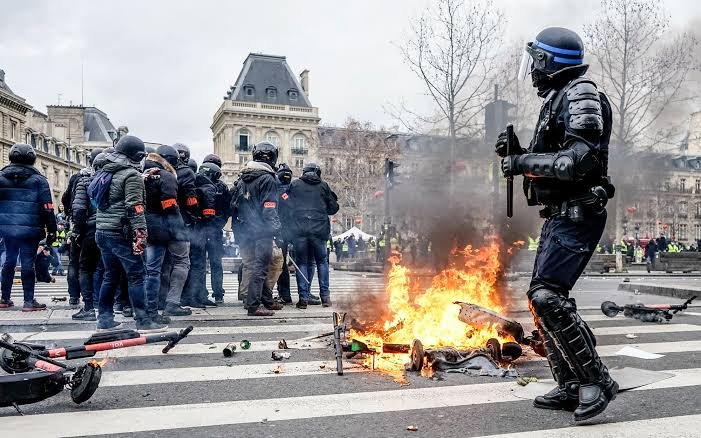

PARIS — Around 550,000 demonstrators took to the streets across France on Saturday as growing anger over inflation, low wages, high fuel prices, and deteriorating public services culminated in widespread unrest and clashes with police. What began last month as student demonstrations over school conditions and living costs rapidly widened into a nationwide protest across more than 110 locations. While organizers claimed turnout surpassed official estimates, multiple marches turned violent as masked groups targeted shops, public infrastructure, and law enforcement vehicles, prompting riot-control officers to deploy tear gas.
Destruction in Limoges and Widespread Urban Unrest
In central France, a fire set inside the historic Limoges Town Hall inflicted catastrophic damage on the 143-year-old building, which was originally inaugurated in 1883. The blaze rapidly engulfed the roof, triggering the collapse of the building’s bell tower and sections of the upper floors onto the levels below. Local authorities reported that roughly two-thirds of the exterior was severely damaged before firefighters brought the flames under control.
Similar scenes of unrest extended across other major urban centers. In Paris, demonstrators clashed with police into the evening, lighting fires at multiple sites and damaging commercial properties as security forces used tear gas to disperse crowds. In Marseille, looters targeted luxury retail establishments, including boutiques associated with Rolex and Louis Vuitton. Commercial property damage, clashes, and disruptions to daily trade were also recorded in Nice, Nantes, Bordeaux, Lille, Toulouse, and Strasbourg.
Scrutiny Over Police Tactics Mounts
The escalation in street violence has brought increased scrutiny to police methods and the use of force during crowd-control operations. Public concern intensified following reports that a 14-year-old boy suffered a broken jaw earlier in the week, alongside the circulation of footage from Alençon in northwestern France showing an officer restraining a girl by holding her neck.
These incidents have amplified questions regarding demonstrator safety and deepened friction between citizens, public institutions, and law enforcement. The expanding unrest reflects wider social and economic discontent, with demonstrators emphasizing growing economic inequality, stagnant incomes, and the erosion of essential public services.
Economic Protests Spread Across Western Europe
Demonstrations over living costs and inflation also spread across Belgium, Italy, and Portugal over the weekend. In Brussels, Belgian police deployed tear gas and water cannons against protesters accused of hurling stones and committing arson, with water cannons also utilized in the eastern city of Liège amid ongoing student-led grievances over education. In Italy, protests against inflation and depressed wages in Milan and Bologna saw sporadic confrontations between demonstrators and security personnel, marked by incidents of stone-throwing.
In Lisbon, thousands marched to highlight Portugal’s deepening housing crisis, where property prices have more than doubled since 2017 and rising rents have priced out many local residents. Protesters demanded higher wages, improved pensions, and expanded public services, though Minister for Parliamentary Affairs Carlos Abreu Amorim stated that the government would not alter its policies based on street slogans. The cross-border unrest underscores mounting pressure on European governments struggling to address widespread dissatisfaction over purchasing power, public infrastructure, and the rising cost of living.
Follow for daily updates on cybercrime, corporate fraud, DFIR, hacking, investigations, and digital forensics
