


In boardrooms, compliance teams and cybersecurity operations centres, artificial intelligence has moved from promise to pressure. Organisations are no longer asking only how quickly they can adopt AI. They are beginning to ask who will govern it, who will approve it, who will audit it and who will be responsible when it fails.
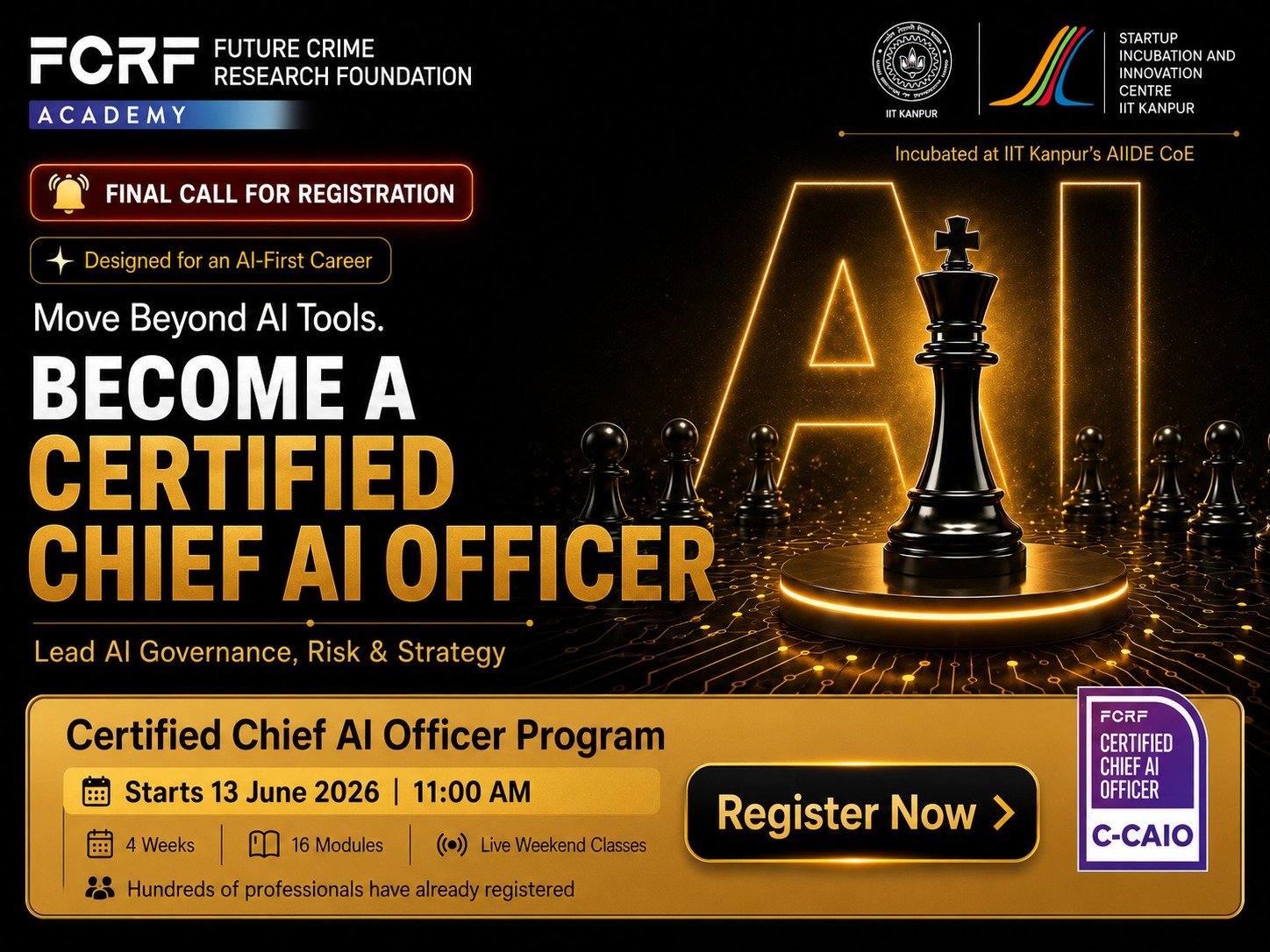
That question has brought new urgency to FCRF Academy’s Certified Chief AI Officer program, which is scheduled to begin its first live session on 13 June at 11 a.m. With the launch now less than a week away, the program has entered its final registration phase, drawing interest from professionals who increasingly see AI governance as a leadership function rather than a purely technical skill.
The program has already seen participation from hundreds of senior professionals, government officers, lawyers, compliance professionals, cybersecurity practitioners and industry leaders, according to FCRF Academy. It follows a four-week, 16-module live weekend format built around AI governance, risk, cybersecurity, privacy, vendor management, regulatory preparedness and responsible AI leadership. Interested participants can click here to register now for the C-CAIO program.

Why the Final Window Matters
The timing is central to the program’s appeal.
Across sectors, AI adoption has moved faster than internal governance. Employees are using generative AI tools for drafting, coding, research, customer support, analytics and automation. Business units are testing AI products. Vendors are adding AI features into existing platforms. Cybersecurity teams are experimenting with AI-assisted threat detection and response.
But many organisations still lack a clear framework for AI accountability. Questions around data leakage, confidential information, hallucinated outputs, biased decisions, vendor opacity, model misuse and employee use of unsanctioned AI tools are no longer hypothetical.
The first wave of AI adoption was about use. The next phase is about control. Organisations must now decide what data can be used in AI systems, which use cases need approval, how vendors should be assessed, how risks should be documented and who will be accountable when AI-generated outputs create legal, operational or reputational harm.
That is why the remaining days before the 13 June start date matter. Professionals who join now enter the first cohort at the moment when AI governance is becoming a boardroom, compliance and cybersecurity concern.
Why Cybersecurity, GRC and Compliance Professionals Are Joining
For cybersecurity professionals, AI has become both a tool and a threat. It can help detect anomalies, summarise incidents, support SOC workflows and accelerate threat analysis. But it can also strengthen phishing, deepfakes, synthetic identity fraud, voice cloning, data theft and automated exploitation.
That dual-use reality has made AI governance part of cybersecurity strategy. A CISO or cyber risk leader must now understand not only AI tools, but also the controls around them: access, data exposure, audit trails, vendor risk, model behaviour and incident response.
For GRC and compliance professionals, the challenge is equally direct. AI systems are entering regulated workflows involving fraud detection, credit assessment, customer onboarding, employee evaluation, legal research, compliance reporting and automated decision-making. Each use case brings questions of fairness, transparency, privacy, accountability and regulatory readiness.
FCRF Academy has positioned the CAIO program not as a general AI tools course, but as a professional certification in AI governance, risk and responsible leadership. Its curriculum covers AI and generative AI fundamentals, the role of the Chief AI Officer, AI strategy, governance architecture, risk classification, data governance, privacy, cybersecurity, vendor management, deepfake and fraud risks, audit readiness and India-specific regulatory preparedness.
The CAIO Role Is Becoming a Function, Even Where the Title Does Not Yet Exist
Many Indian organisations may not immediately appoint a formal Chief AI Officer. But the function is already emerging.
In some companies, AI governance may sit with the CTO. In others, it may be handled by the CISO, legal head, compliance officer, risk team, data protection officer, digital transformation unit or innovation office. The title may differ, but the responsibility is becoming unavoidable: someone must supervise AI adoption.
That person must understand enough technology to ask the right questions, enough law to recognise exposure, enough cybersecurity to identify misuse, enough compliance to design controls and enough business strategy to guide adoption responsibly.
This is where the CAIO program is attempting to create a new professional pathway. It is aimed at senior executives, lawyers, government officers, CISOs, DPOs, compliance officers, GRC professionals, auditors, consultants, cybersecurity practitioners, law enforcement professionals, fintech teams and technology managers.
The program’s appeal lies in that cross-functional design. It recognises that AI governance cannot be owned by engineers alone. Nor can it be managed only through legal disclaimers or policy documents. It requires a shared professional language across technology, law, cyber risk, privacy, compliance and leadership.
FCRF’s Cyber Risk Background Gives the Program Its Edge
FCRF Academy’s advantage comes from its existing work in cybersecurity, cyber law, data protection, digital forensics, fraud investigation, anti-money laundering, GRC, cyber crisis management and emerging technology risk.
The Academy is the learning and capacity-building arm of the Future Crime Research Foundation, and its earlier programs have drawn lawyers, government officers, police officials, cybersecurity professionals, compliance teams, corporate executives, consultants and students seeking specialised training in technology-linked risk domains.
That background gives the CAIO program a sharper positioning than many AI courses that focus mainly on productivity, tools or prompt engineering. FCRF’s approach places AI within the wider universe of cybercrime, legal accountability, privacy, fraud, governance and organisational risk.
As the 13 June start date approaches, the final registration push reflects a larger professional shift. AI is no longer a future-facing subject that organisations can study at leisure. It is already entering business systems, public institutions, fraud ecosystems, cyber operations and regulatory conversations.
For professionals still considering whether to join, the urgency is not simply about a course deadline. It is about a changing workplace reality: the people who understand AI governance early may shape how organisations adopt, control and defend AI in the years ahead.
FCRF Academy’s Certified Chief AI Officer program begins on 13 June at 11 a.m. Registrations are currently in the final call phase. Interested participants can click here to register now for the C-CAIO program.
Follow for daily updates on cybercrime, corporate fraud, DFIR, hacking, investigations, and digital forensics
