

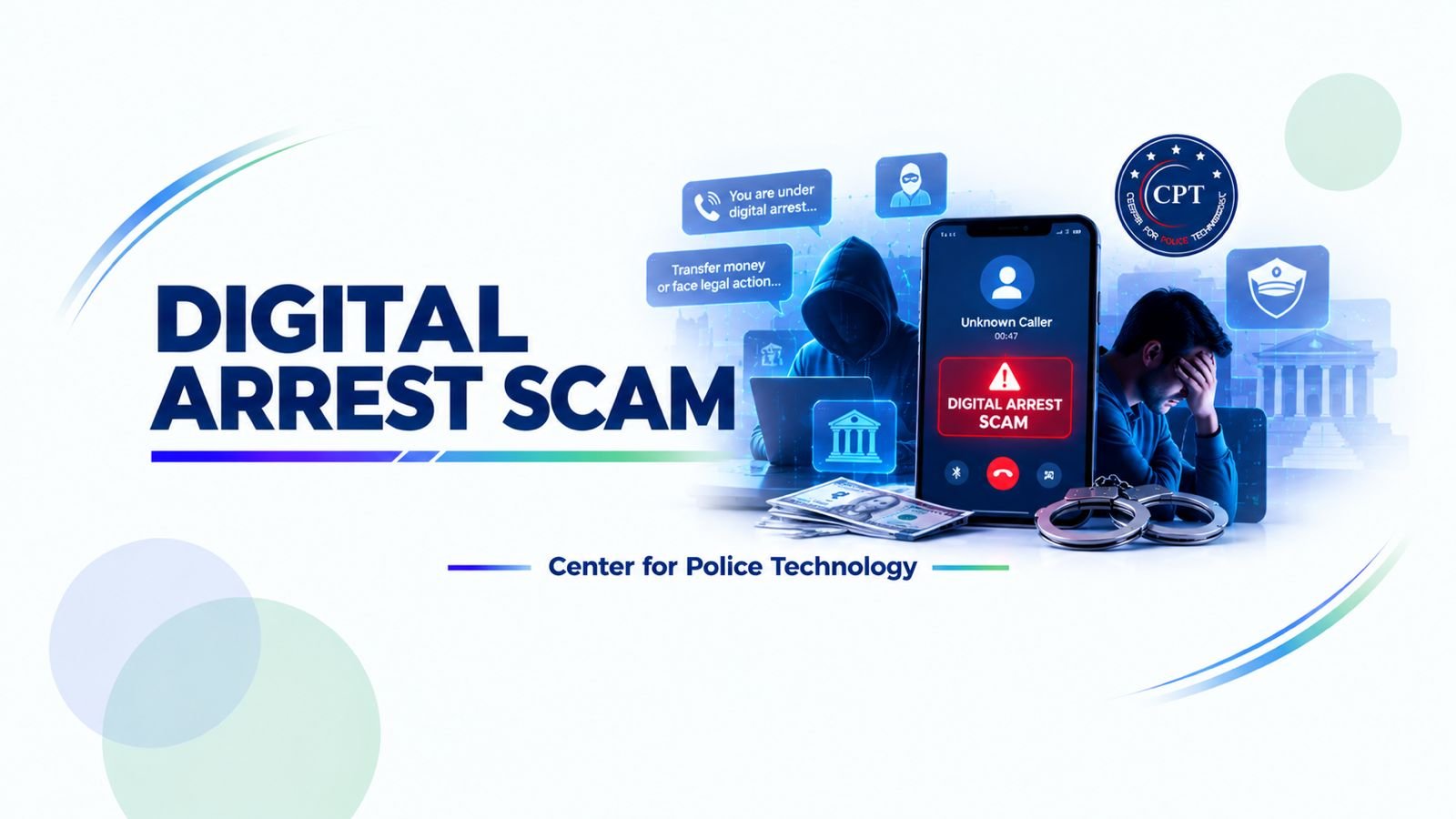
Centre for Police Technology (CPT) presents a 31-Day Cybersecurity Knowledge Series for police personnel, law enforcement agencies (LEAs), corporate investigators, digital forensics professionals and cybersecurity practitioners.
Digital arrest scams exploit one of the most powerful tools a criminal can use: fear of law enforcement. Victims are told they are suspects in serious criminal cases, accused of involvement in money laundering or drug trafficking, and threatened with immediate arrest. Scammers impersonating police officers or officials from agencies such as the CBI use video calls, forged documents and intimidation to make these fabricated threats appear real.
The objective is often simple: isolate the victim, control their decisions and force them to transfer money.
What Is a Digital Arrest Scam?
A digital arrest scam is a form of cyber-enabled financial fraud in which criminals impersonate law enforcement officers, government officials or judicial authorities to frighten victims into believing they are under investigation or effectively under arrest.
Scammers may claim that a parcel containing illegal substances has been intercepted, that a bank account is linked to money laundering, or that the victim’s identity has been used in a criminal case. They may display fake identity cards, forged arrest warrants, fabricated case documents and convincing video-call backgrounds.
A digital arrest is not a recognised legal procedure in India. Genuine law enforcement does not place people under arrest through a video call or demand money to settle an investigation.
How Criminals Execute the Scam
Digital arrest scams commonly follow a carefully staged sequence:
- Initial contact: The victim receives a call or message from someone claiming to represent a police station, investigative agency, courier company or government department.
- Fabricated allegations: The caller claims the victim’s identity, bank account, phone number or parcel is connected to a serious crime.
- Fake authority: Scammers use uniforms, forged documents, agency logos and video calls to manufacture credibility.
- Psychological isolation: Victims may be instructed to remain on video calls, avoid contacting family members or refrain from discussing the alleged investigation.
- Financial coercion: Criminals demand transfers described as verification payments, security deposits or money for account clearance. Some claim the funds will be returned after the investigation.
- Continued extortion: After the first payment, scammers may invent new allegations or demand additional money.
The combination of urgency, shame and fear can make even financially experienced individuals vulnerable.
FCRF’s Chief AI Officer Certification Returns on November 14 to Prepare Future AI Leaders
How Criminals Use Technology
Digital arrest scams are not simply telephone fraud. They can involve multiple digital tools and organised criminal networks.
- Caller ID manipulation and spoofing: Calls may appear to originate from familiar or official-looking numbers.
- Forged digital documents: Fake notices, identity cards, warrants and case files create an illusion of legitimacy.
- Video-call deception: Criminals use backgrounds, uniforms and rehearsed scripts to simulate official environments.
- Personal data exploitation: Information gathered from data leaks, social media or earlier scams can make threats appear credible.
- Mule bank accounts and payment intermediaries: Stolen funds may move through accounts controlled by intermediaries before being transferred or withdrawn.
- Cryptocurrency and layered transfers: In some cases, criminals move funds through multiple financial channels to complicate tracing.
These techniques can conceal individual identities, but transaction records, communication metadata and other digital evidence may help investigators connect the operation.
How Police and Investigators Can Trace the Crime
Digital arrest cases require coordinated financial investigation, cyber forensics and evidence preservation.
1. Trace the money trail
Investigators can examine beneficiary bank accounts, UPI transaction references, transfer timestamps, withdrawal patterns and onward transfers. Rapid coordination with banks and payment providers may help flag or freeze available funds, subject to applicable procedures.
2. Preserve communication evidence
Call logs, phone numbers, messaging records, emails, video-call details and original screenshots can help establish the sequence of events. Investigators should preserve original files and metadata where available.
3. Analyse devices and accounts
With appropriate legal authority, forensic examination may identify relevant messages, call histories, downloaded documents, remote-access applications and other artefacts associated with the fraud.
4. Identify interconnected accounts
Transaction analysis can reveal links between beneficiary accounts, mule-account networks, repeated recipients and other reported frauds. These connections provide investigative leads, not automatic proof of an individual’s guilt.
5. Correlate evidence across jurisdictions
Telecom records, bank information, platform records and other relevant evidence may need to be obtained through lawful requests and coordinated with the appropriate agencies. Investigators must corroborate digital indicators before attributing a scam to a particular suspect.
6. Maintain the chain of custody
Evidence should be documented, securely preserved and handled in accordance with applicable legal and forensic procedures so that its integrity can be assessed during prosecution.
What Ordinary People Should Do
The most effective defence is to recognise the warning signs and refuse to act under pressure.
- End suspicious calls. Do not remain on a video call simply because the caller claims to be an officer.
- Verify independently. Contact the relevant agency through its official website or publicly listed contact details—not numbers supplied by the caller.
- Never transfer money under threat. No legitimate investigation should require you to pay a supposed security deposit to avoid arrest.
- Do not share sensitive information. Never reveal OTPs, PINs, passwords or banking credentials.
- Preserve evidence. Keep transaction IDs, phone numbers, messages, screenshots and call details.
- Report quickly. If money has been transferred, contact your bank or payment provider immediately and call India’s cybercrime helpline 1930. You can also report the incident at cybercrime.gov.in.
Speed matters because prompt reporting may improve the chances of identifying and intercepting funds, although recovery is not guaranteed.
The Role of Organisations and Financial Institutions
Banks and payment providers can strengthen fraud monitoring by identifying suspicious transaction patterns, unusual beneficiary activity and rapid movement of funds. Clear escalation channels can help victims report suspected fraud without delay.
Police departments and public institutions should regularly communicate that digital arrest threats are fraudulent, train frontline personnel to recognise these cases and encourage victims to report promptly without fear or embarrassment.
Awareness campaigns should also address families and caregivers, as scammers may deliberately isolate victims from people who could challenge their claims.
The Future of Digital Arrest Investigations
As impersonation tactics evolve, investigators will need stronger coordination between cybercrime units, financial institutions, telecom providers and digital platforms. Data-led analysis can help identify recurring phone numbers, payment routes, beneficiary accounts and operational patterns across multiple complaints.
However, technology alone cannot solve these cases. Effective investigations depend on timely reporting, lawful access to records, careful evidence handling and cross-jurisdictional cooperation.
Conclusion: Break the Fear, Follow the Evidence
Digital arrest scams turn trust in public institutions into a weapon against ordinary people. Their success depends on convincing victims that they have no time, no choice and no one they can safely contact.
For citizens, the answer is to pause, verify and report. For investigators, it is to follow the money, preserve digital evidence and connect individual complaints to wider criminal networks.
Fear may silence a victim, but timely reporting and sound digital investigation can expose the fraud.
Day 22 — Digital Arrest Scams
31 Days | 31 Key Topics | October 2026
Follow Centre for Police Technology (CPT) for the complete 31-Day Cybersecurity Knowledge Series.
Follow for daily updates on cybercrime, corporate fraud, DFIR, hacking, investigations, and digital forensics
