Follow us on Google News

Global losses from cybercrime could reach a staggering ₹1,170 lakh crore (USD 14 trillion) within the next three years — a figure surpassing the GDP of many nations. The projection was shared by Sachin Kakkad, Director of Engineering and Site Lead (Privacy, Safety & Security) at Google, during the CNBC-TV18 Global Leadership Summit (GLS 2025) held in Mumbai on Friday.
Speaking at the panel discussion “Securing the Next Gen Cloud World,” Kakkad said that “Global losses from cybercrime, estimated at ₹835 lakh crore (USD 10 trillion) in 2025, are projected to surge to ₹1,170 lakh crore by 2028 — an amount comparable to the size of the global healthcare industry.”
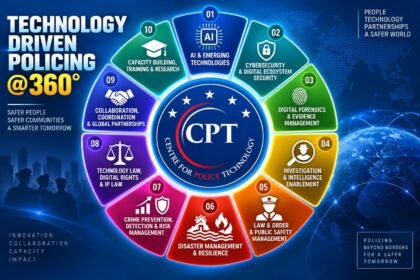
https://the420.in/centre-for-police-technology-launched-as-common-platform-for-police-oems-and-vendors-to-drive-smart-policing/
‘No Longer Child’s Play, Cybercrime Has Become Organized Warfare’
Kakkad emphasized that today’s cyber attackers are “no longer teenage hackers but highly organized criminal networks and state-sponsored actors” targeting institutions ranging from “schools and hospitals to energy grids.”
He cited examples such as the JLR ransomware attack, which halted production at a major automotive plant, and the Taylor Swift deepfake video incident, which underscored the growing threat to privacy and digital trust in the modern age.
Kakkad described the challenge as the “Defender’s Dilemma” — “An attacker needs to find only one weakness, but a defender must secure everything.” The solution, he noted, lies in Agentic AI, which can “automate up to 80% of cybersecurity operations.”
Quantum Computing: The Next Great Threat
Sandip Patel, Managing Director of IBM India and South Asia, warned that quantum computing could render current cybersecurity infrastructure obsolete within two to four years. “Quantum technology will enable hackers to break existing encryption — what we call a ‘harvest now, decrypt later’ strategy,” Patel explained.
Both IBM and Google, he added, are heavily investing in post-quantum cryptography, with Kakkad noting, “We believe these technologies will secure passwords and data for decades to come.”
‘Trust is the Biggest Asset in Banking’
Jai Kotak, Co-Head of Kotak 811, stressed that banks are not just custodians of money but also of “trust.” He cautioned that AI-driven deepfake technology could “seriously compromise systems like video-KYC.”
“Digital trust should never be taken lightly,” Kotak said. “A single breach can shake the entire foundation of banking confidence.”
Accountability and Shared Responsibility
On the question of who bears responsibility after a data breach, Kotak remarked that it depends on “where the vulnerability originated.” Patel added that cybersecurity “must become a boardroom issue — it’s a shared responsibility, not merely an IT department function.”
Deepfakes and Disinformation: The Biggest Emerging Threats
Concluding the discussion, Kakkad described deepfakes and misinformation as “the greatest threats of the next decade.” He suggested three simple personal safety measures:
- 1. Establish a secret code word with family and friends.
- 2. During a video call, ask the person to wave their hand in front of their face — deepfakes often can’t replicate this gesture.
- 3. If a call feels suspicious, hang up immediately and call back — since spoofing works only one way.
Analysis: Cybercrime Is Becoming a ‘Digital Pandemic’
The discussions at GLS 2025 made one thing clear — cybersecurity is no longer just a technical issue but a global economic risk. The projected ₹1,170 lakh crore loss reflects not just data theft but a systemic threat to financial institutions, civil liberties, and digital trust.