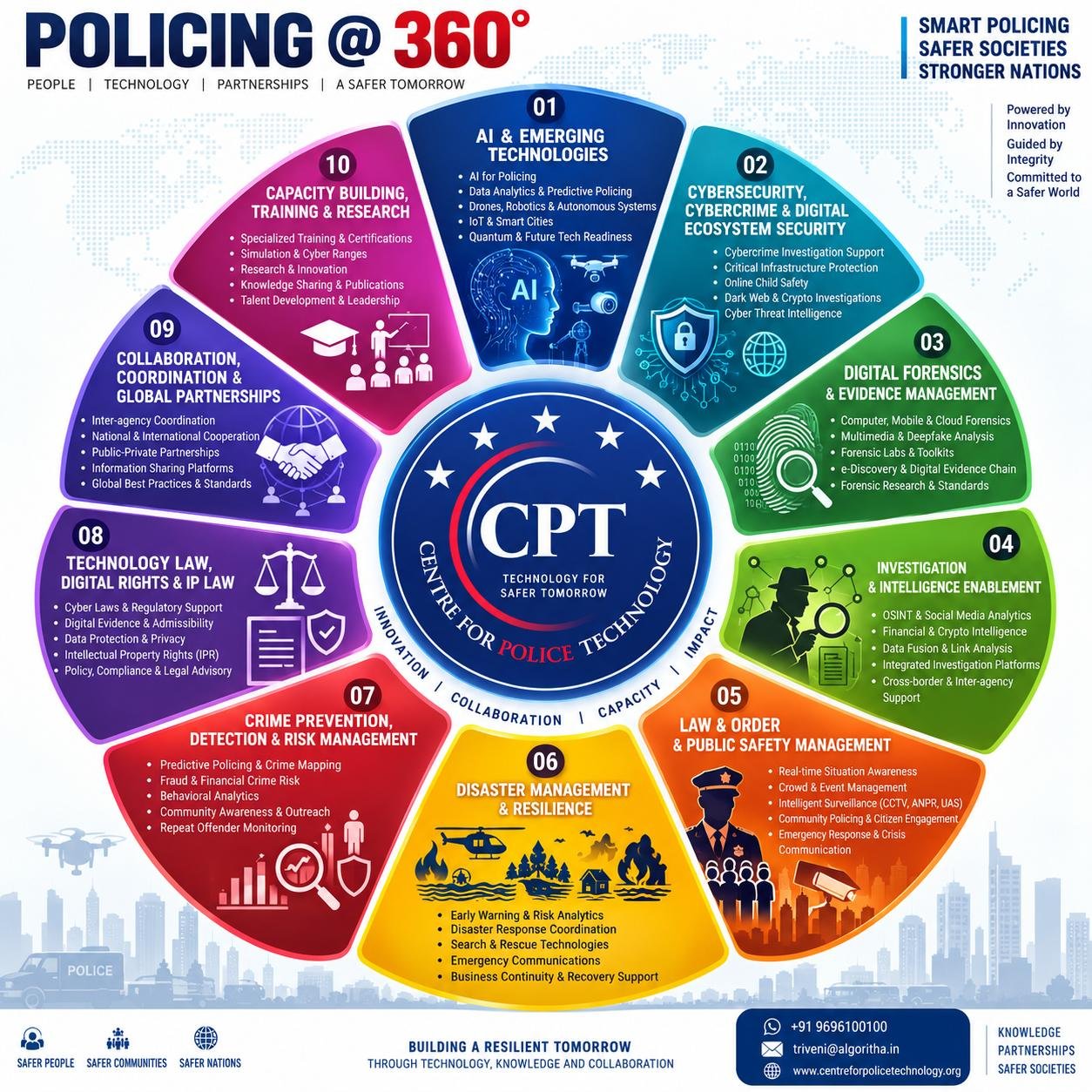
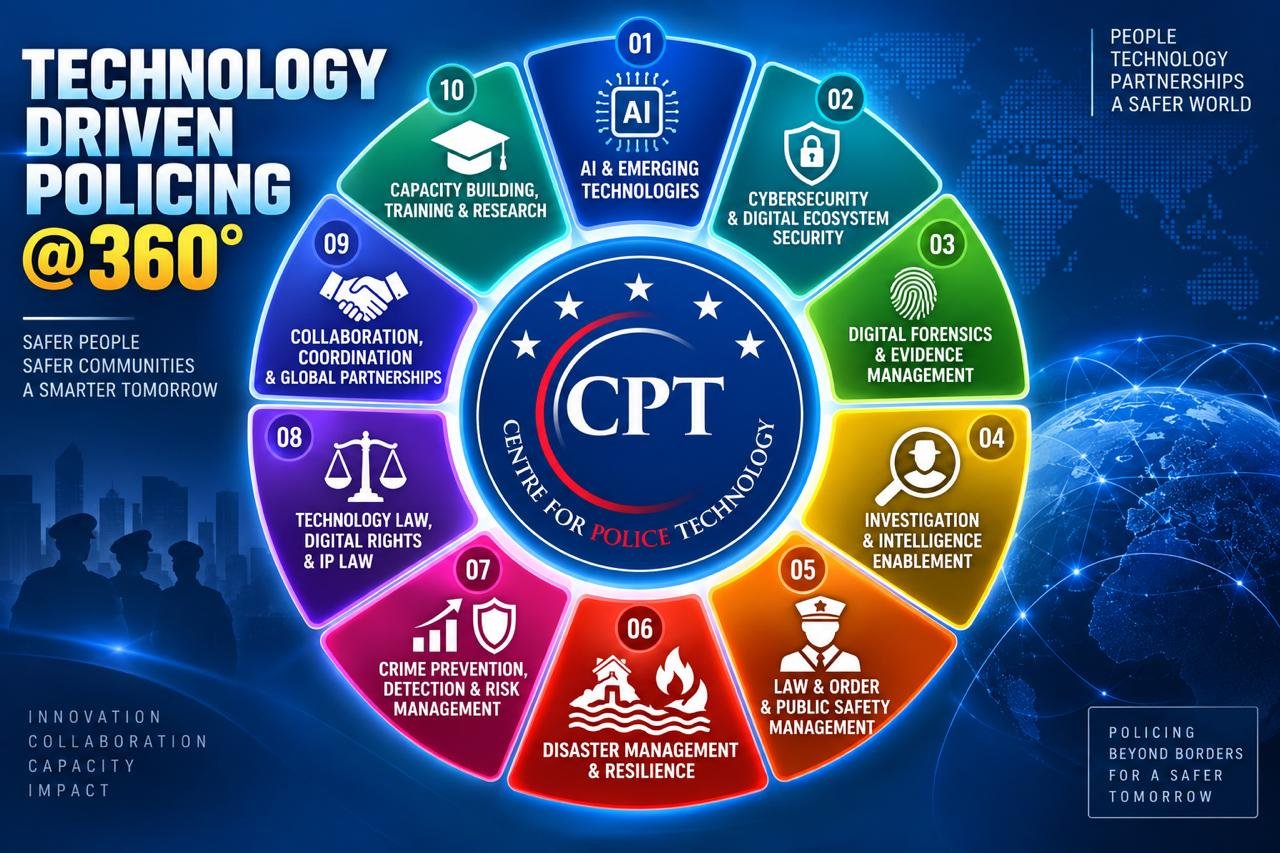
The Centre for Police Technology (CPT) is building a multidisciplinary, practitioner-led ecosystem aimed at bringing policing experience, technology, intelligence, investigation, research, law, innovation and industry expertise onto a common platform to contribute towards a safer and more secure India.
CPT invites serving and retired Police and Law Enforcement Agency (LEA) officers, investigators, cyber and fraud-risk professionals, forensic experts, researchers, academics, technologists, physical-security specialists, legal professionals, developers, innovators and PoliceTech, DefenceTech and SecurityTech startups from India and across the world to contribute, collaborate and potentially lead its 10 specialised verticals.
The initiative, conceptualised around “Technology-Enabled Policing @360°,” seeks to create an ecosystem in which professionals who understand policing and security challenges can work directly with those capable of researching, designing, testing and developing solutions.
Rather than becoming another conventional professional network, CPT envisages a knowledge, research, capacity-building and innovation ecosystem led by practitioners and domain specialists.
Professionals may associate with CPT as volunteers, mentors, researchers, trainers, advisors, collaborators, solution developers or domain experts. Based on their expertise and experience, distinguished professionals may also be considered to lead or co-lead one of CPT’s specialised verticals.
Technology-Enabled Policing @360°: CPT’s 10 Specialised Verticals
The proposed CPT framework comprises ten interconnected domains reflecting the evolving requirements of policing, investigation, security and public safety worldwide.
1. AI & Emerging Technologies
This vertical will explore the transformative role of Artificial Intelligence, Generative AI, Agentic AI, advanced analytics, drones, robotics, biometrics, Internet of Things, smart sensors, autonomous systems and emerging technologies in policing.
Its focus will include technology assessment, responsible AI adoption, operational use cases and understanding new risks created by rapidly evolving technologies.
2. Cybersecurity & Digital Ecosystem Security
As crime increasingly migrates into digital environments, this vertical will address cybercrime prevention and response, cyber threat intelligence, online safety, Dark Web threats, cryptocurrency-enabled crime, digital policing and critical-infrastructure security.
The objective is to connect cyber investigators, security practitioners, researchers and technology specialists to strengthen both preventive and investigative capabilities.
3. Digital Forensics & Evidence Management
Modern investigations increasingly depend upon the ability to identify, acquire, preserve, analyse and present digital evidence.
This vertical will cover computer, mobile, cloud, network, IoT, multimedia and cryptocurrency forensics, along with forensic laboratories, e-discovery, evidence integrity, chain of custody, forensic standards, tools and emerging methods of digital-evidence examination.
4. Investigation & Intelligence Enablement
This vertical will explore how technology can strengthen conventional and specialised investigations through Open-Source Intelligence (OSINT), social-media intelligence, financial intelligence, cryptocurrency intelligence, data fusion, link analysis, investigative analytics and integrated investigation platforms.
It will also encourage knowledge sharing around complex, organised and cross-border investigations requiring multi-source intelligence and inter-agency support.
5. Law & Order & Public Safety Management
Technology has become integral to maintaining law and order and protecting citizens.
This vertical will focus on real-time situational awareness, intelligence-led policing, crowd and event management, traffic management, surveillance technologies, command-and-control platforms, community policing, emergency response and smart public-safety systems.
The objective will be to study how technology can improve preparedness, decision-making, response time and citizen safety without losing sight of accountability and proportionality.
6. Disaster Management & Resilience
Disasters increasingly demand technology-driven coordination across multiple agencies.
This vertical will cover early-warning systems, geospatial intelligence, risk analytics, crisis coordination, emergency communications, search-and-rescue technologies, drones, disaster-response platforms, continuity planning and recovery technologies.
It can provide a multidisciplinary interface between police, emergency responders, disaster-management professionals, researchers, technology providers and innovators.
7. Crime Prevention, Detection & Risk Management
Preventing crime is increasingly as data-driven as investigating it.
This vertical will examine crime analytics, crime mapping, behavioural analysis, predictive and intelligence-led approaches, fraud and financial-crime risks, organised crime, trafficking, repeat-offender analysis and technology-assisted crime prevention and detection.
It will encourage responsible use of analytics and intelligence to help agencies move from purely reactive enforcement towards risk-informed prevention.
8. Technology Law, Digital Rights & IP Law
Technology-enabled policing must operate within clearly understood legal, constitutional and regulatory boundaries.
CPT’s dedicated legal vertical will therefore focus on Technology Law, Cyber Law, digital evidence and admissibility, data protection and privacy, surveillance law, Artificial Intelligence governance, digital rights, platform accountability, Intellectual Property Rights (IPR), technology licensing and emerging legal issues surrounding new technologies.
The vertical can bring together police officers, investigators, prosecutors, lawyers, academics, policymakers and technologists to examine how innovation can be deployed while respecting legality, due process, privacy, accountability, digital rights and intellectual property.
This interaction between law and technology will become increasingly important as policing adopts AI, biometrics, drones, digital intelligence and advanced surveillance technologies.
9. Collaboration, Coordination & Global Partnerships
Modern crimes do not recognise departmental, corporate or geographical boundaries.
This vertical will promote inter-agency coordination, Police–Industry–Academia partnerships, public-private collaboration, national and international cooperation, information sharing, professional exchanges and adoption of global good practices.
It can also provide an interface through which international experience can inform Indian policing while Indian innovations and operational expertise can reach global professional communities.
10. Capacity Building, Training & Research
CPT proposes integrating the closely related functions of professional development, research and innovation within one vertical.
The domain will encompass specialised training, cyber ranges, simulations, investigation workshops, leadership development, research and innovation, horizon scanning, technology assessment, publications, case studies and continuous professional development.
Research should not remain confined to academic papers. CPT envisages encouraging research capable of progressing into proof-of-concepts, pilots and deployable policing solutions.
Connecting Those Who Understand the Problem With Those Who Can Build the Solution
One of CPT’s central objectives is to address a fundamental gap in the policing-technology ecosystem.
A police investigator may understand an operational problem exceptionally well but may not have access to the researchers, engineers, forensic scientists or developers capable of converting that requirement into technology.
At the other end, a technology company or startup may possess an innovative product but have limited exposure to real-world policing requirements.
CPT intends to become the bridge between these communities.
Police and security practitioners can identify operational challenges. Researchers can study them. Investigators and forensic experts can provide domain knowledge. Legal experts can examine regulatory implications. Developers can build prototypes. Technology companies and startups can transform promising concepts into scalable solutions.
Through such collaboration, CPT aims to encourage problem identification, applied research, proof-of-concepts, technology evaluation, field pilots and eventually deployable solutions.
Encouraging Indigenous PoliceTech, DefenceTech and SecurityTech
The initiative also seeks active participation from startups, innovators and developers working across PoliceTech, DefenceTech, SecurityTech, CyberTech, ForensicTech, AI, drones, robotics, surveillance, communications, intelligence systems and emergency-response technologies.
India’s policing and security ecosystem presents unique operational requirements. Technology designed without understanding those realities may struggle in deployment.
CPT therefore seeks to facilitate direct interaction between practitioners who experience operational problems and innovators capable of solving them.
Such collaboration could help strengthen an indigenous security-technology ecosystem in which innovation is increasingly driven by actual requirements emerging from the field.
Experience After Service Can Continue to Serve the Nation
CPT also places particular emphasis on involving retired professionals.
India possesses an enormous reservoir of institutional knowledge among retired Police and LEA officers, investigators, intelligence professionals, forensic scientists, engineers, technologists, legal professionals and security practitioners.
Decades of operational experience need not disappear after retirement or transition from government service.
CPT seeks to create opportunities through which such professionals can continue contributing through mentoring, training, research, advisory inputs, case studies, technology evaluation, policy discussions and capacity building.
Participation need not necessarily involve a major time commitment. Even professionals able to contribute only limited time may voluntarily associate with a CPT vertical closely aligned with their expertise.
One Integrated Community for a Safer India
The rationale behind the 10-vertical model is simple: modern security challenges rarely remain within a single professional domain.
A cyberattack may develop into financial fraud. AI may enable deepfakes and synthetic identities. A drone can be both a policing tool and a security threat. Cryptocurrency can intersect with fraud, organised crime and money laundering. Digital evidence may determine the outcome of a physical-crime investigation.
At the same time, AI, facial recognition, surveillance, biometrics and large-scale data analytics create important questions around privacy, digital rights, admissibility of evidence, accountability and technology law.
A major disaster may simultaneously require police, emergency services, communications specialists, drone operators, geospatial experts and technology companies.
These challenges cannot be effectively addressed by one profession working in isolation.
CPT therefore proposes an integrated ecosystem connecting Police and LEAs, corporate investigators, forensic professionals, cyber and fraud-risk specialists, physical-security professionals, lawyers, researchers, academia, developers, technology companies and startups.
CPT Opens Empanelment of Experts in Police Technology
CPT is now inviting professionals and organisations interested in contributing to this mission to express their interest through its Empanelment of Experts in Police Technology initiative.
Applicants can indicate their areas of expertise and preferred CPT verticals and explore opportunities to participate as volunteers, domain experts, mentors, researchers, trainers, advisors, collaborators, solution developers or potential vertical leaders, depending upon their capabilities, professional profile and experience.
The invitation is open to professionals from India and across the world.
Want to Become Part of the CPT Ecosystem?
Serving and retired Police/LEA officers, investigators, cyber and fraud-risk professionals, forensic specialists, researchers, academics, physical-security experts, AI and technology professionals, Technology/IP Law experts, developers, innovators, startups and other professionals willing to contribute can submit their interest here:
Join CPT – Empanelment of Experts in Police Technology
Based on expertise, professional background and experience, selected experts may have opportunities to contribute, collaborate, mentor, undertake research, support training and capacity building, evaluate technologies, develop policing solutions or lead/co-lead specialised CPT verticals.
From Professional Network to Problem-Solving Ecosystem
The objective is not simply to create another association or professional networking platform.
CPT seeks to develop a community capable of converting:
Experience → Knowledge → Research → Collaboration → Innovation → Technology → Better Policing → Safer Societies
The longer-term vision is a professional ecosystem where an experienced investigator can mentor a researcher, a researcher can collaborate with an engineer, an engineer can work with a startup, a legal specialist can assess the implications, and a policing agency can ultimately benefit from a solution created around a genuine operational requirement.
CPT Mission
People + Policing + Technology + Intelligence + Collaboration = A Safer India
Come with your expertise. Share your experience. Mentor professionals. Research emerging threats. Build policing solutions. Collaborate globally. Contribute to a Safer India.