
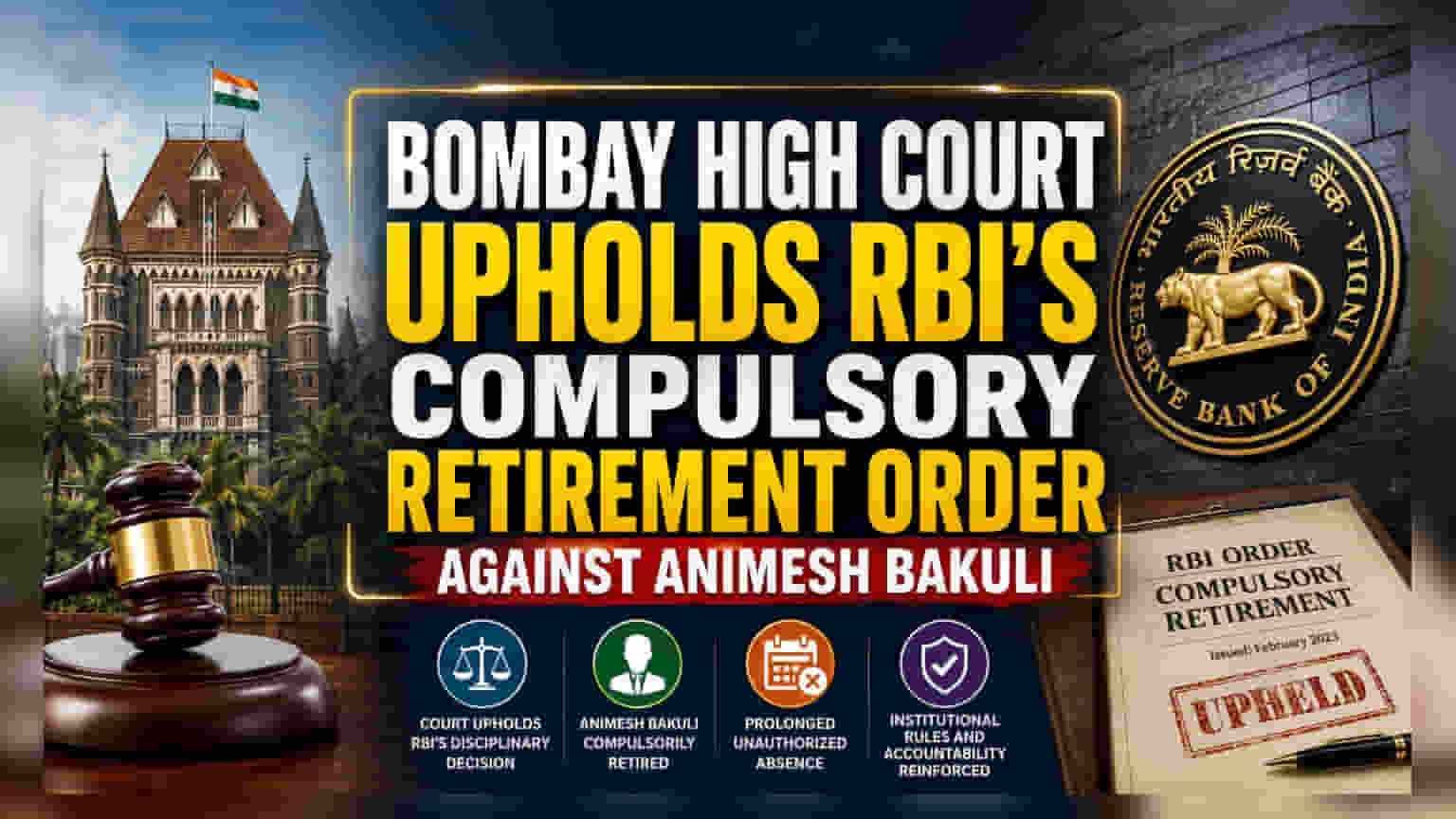
In a significant ruling on workplace discipline and accountability in public institutions, the Bombay High Court has upheld the Reserve Bank of India’s (RBI) decision to compulsorily retire a former employee who remained absent from duty without authorization for nearly three years. The court observed that prolonged unauthorised absence from a responsible position in the country’s central banking institution was not only a violation of service rules but also detrimental to public interest.
The case involved former RBI Senior Assistant Animesh Bakuli, who had approached the court challenging the compulsory retirement order issued against him. He sought the quashing of the disciplinary action and requested restoration of salary, allowances, and other service benefits that he claimed had been withheld. However, after examining the records and circumstances of the case, the High Court declined to interfere with the RBI’s decision.
Registration Begins for FutureCrime Summit 2026, India’s Largest Cybercrime Conference
The Rejected Transfer and Pandemic Absence
According to court records, Bakuli joined the RBI as an assistant in 2013. After successfully completing his probation period, he was confirmed as a permanent employee and was later promoted to the position of Senior Assistant. During his tenure, he submitted multiple requests between 2017 and 2018 seeking a transfer to Kolkata. Those requests, however, were not approved by the central bank.
In his petition, Bakuli argued that a combination of factors, including the rejection of his transfer requests, the disruptions caused by the Covid-19 pandemic, and the poor health of his parents, contributed to his inability to attend work regularly. He further contended that the disciplinary proceedings initiated against him violated principles of natural justice and that he had not been provided a fair opportunity to defend himself.
RBI Cites Three Years of Total Silence
The RBI, on the other hand, informed the court that the employee remained absent from duty from March 19, 2020, and continued to stay away from work without authorization for nearly three years. The bank stated that he neither resumed his duties nor provided a satisfactory explanation for his prolonged absence.
According to the RBI, several communications were sent to him through email and other channels directing him to report back to work, submit leave applications, or furnish medical certificates supporting his absence. Despite repeated reminders and opportunities, the employee allegedly failed to respond adequately or regularize his absence.
Court Declares Long Absence as Grave Misconduct
Court records further revealed that the RBI repeatedly attempted to engage with the employee and encouraged him to clarify his position. The central bank argued that by remaining absent without permission for such an extended period, he had effectively abandoned his responsibilities. Following departmental proceedings, an order of compulsory retirement was issued on January 31, 2023, and communicated to him through all available addresses.
In its judgment, the High Court emphasized that a Senior Assistant in the RBI occupies a position carrying significant responsibility and accountability. Employees serving in such roles are expected to maintain consistent attendance, discipline, and commitment to institutional responsibilities. The court held that remaining absent without authorization for nearly three years constituted grave misconduct under service rules.
The judges also noted that prolonged unauthorized absence can adversely affect the functioning of an institution, particularly one entrusted with critical public responsibilities. Given the nature and duration of the misconduct, the court concluded that the penalty of compulsory retirement could not be considered disproportionate, arbitrary, or excessively harsh.
